





Germany and the UK are Europe’s two biggest markets for plant-based food. For a few years now, they have been heading in opposite directions. In Germany, retail sales of plant-based alternatives rose by 3.1% in 2025 to €1.71 billion. In the UK, they fell by 1.2% to £848 million. UK sales have been declining since their peak in 2021.
The non-profit GFI Europe looked into why on 5 November 2026. The short answer: Aldi, Lidl and the price at the till.
In short
- Germans and Britons are equally keen to eat less meat: 51% in both countries.
- Discounters take 46% of grocery sales in Germany and 19% in the UK. That is where cheap own brands sell.
- Plant-based milk costs 10% more than dairy milk in Germany and 72% more in the UK.
- The UK debate about ultra-processed food hits plant-based products hard. In Germany, it barely registers.
Contents8 chapters
Same wishes, different shopping baskets.
At first glance, the two countries look alike. In a survey by GFI Europe with HarrisX and Plant Futures, 8% of German adults and 9% of UK adults said they were vegan, vegetarian or pescetarian. In both countries, 51% want to eat less meat and dairy or more plant-based food. Around a quarter of meat reducers in both countries cite cost.
With intentions that similar, GFI argues, what matters most is what is on the shelf, what it costs and how people see it.
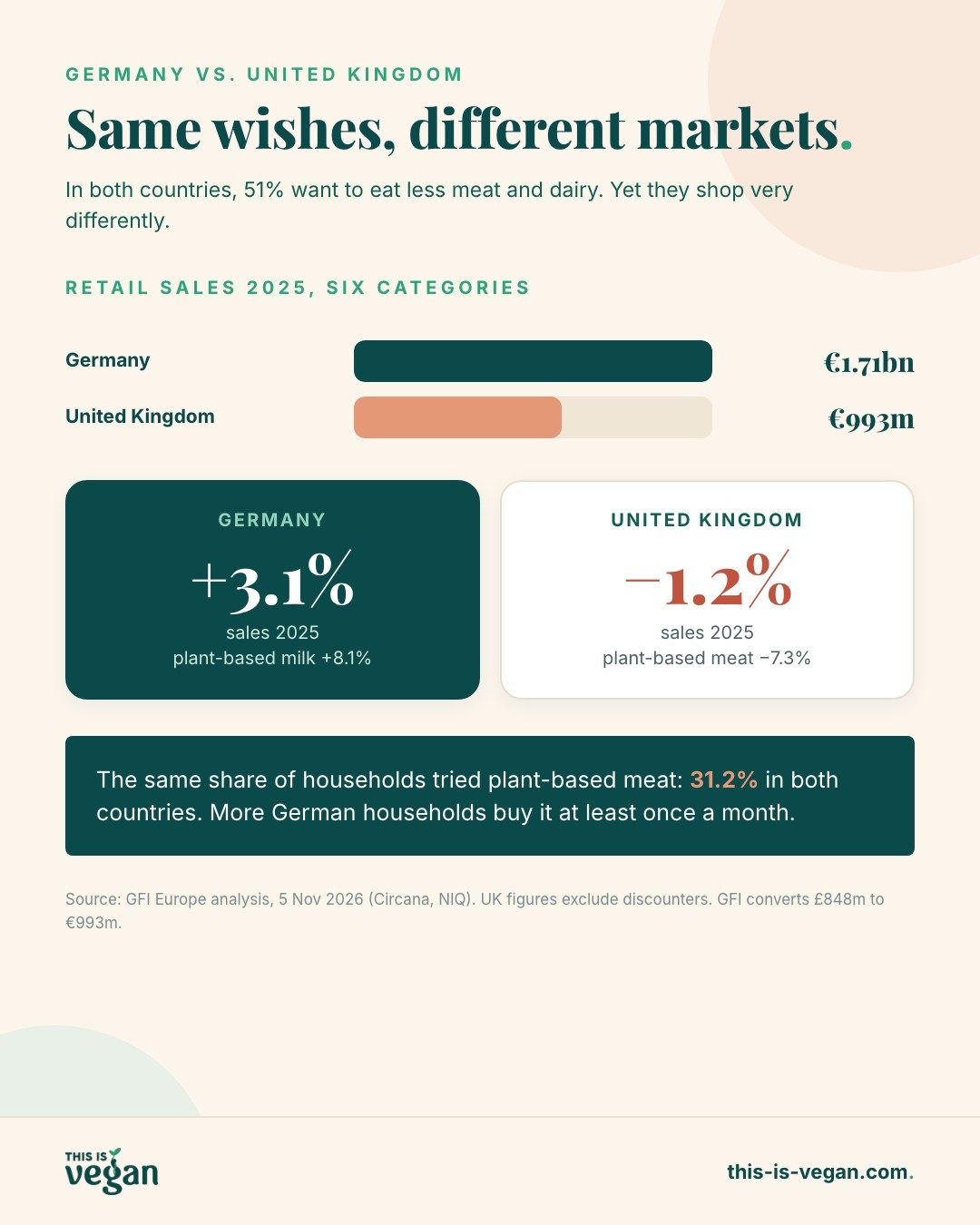
The gap is biggest for plant-based meat. German sales reached €751 million in 2025, up 0.2% after 4.4% growth the year before, and Circana data show the German market up 10.8% in value and 9.4% in volume in the twelve months to August 2026. UK sales fell 7.3% to £295 million in 2025.
Plant-based milk grew by 8.1% to €632 million in Germany, while UK sales were flat with a 0.5% rise to £419 million. The household data are telling: 31.2% of households in both countries bought plant-based meat at least once in 2025. But 9.4% of German households bought it at least monthly, compared with 8.1% in the UK. People try it equally often. Germans come back more.
Aldi and Lidl make the difference.
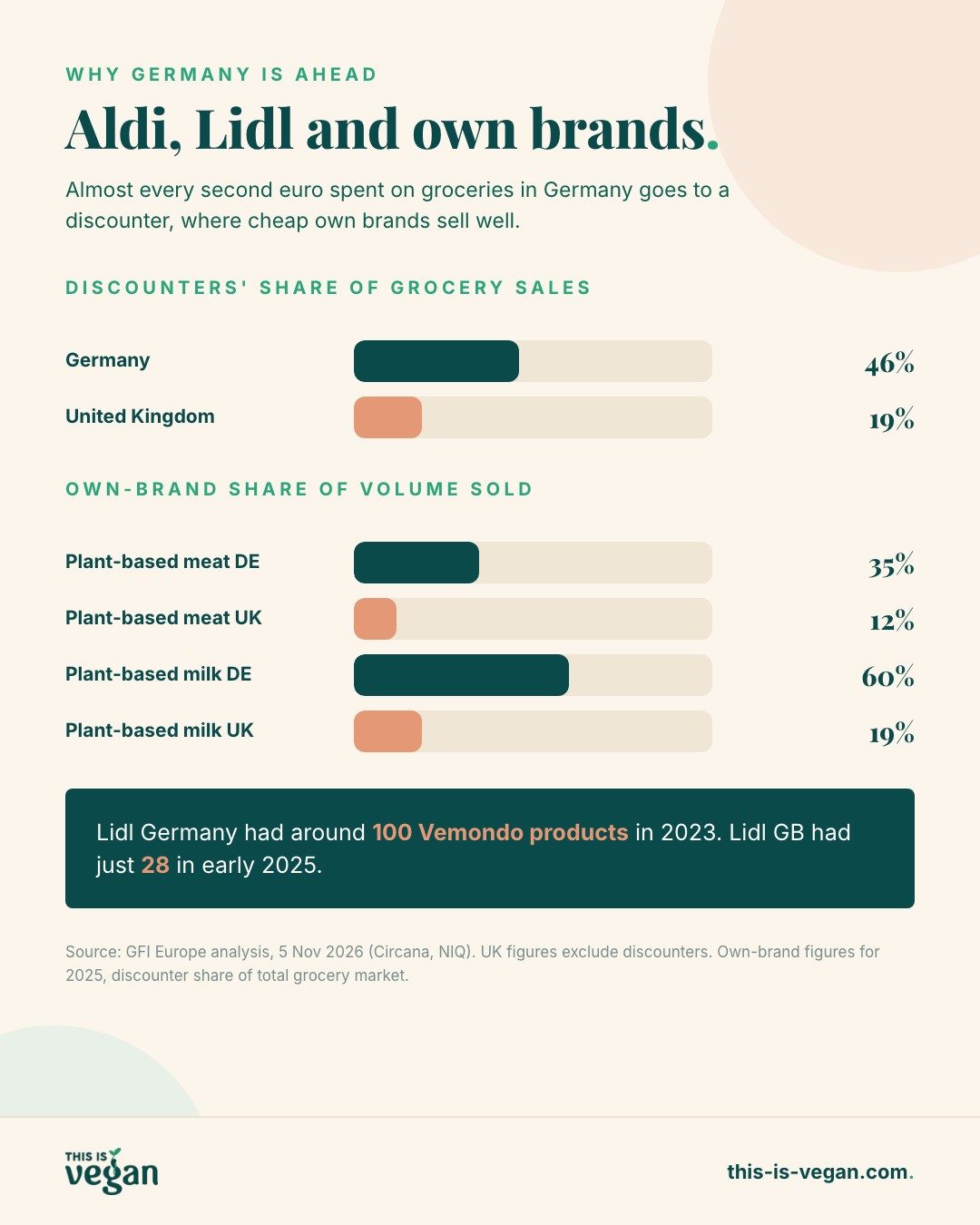
According to GFI, the structure of the grocery market is the key factor. Discounters such as Aldi and Lidl hold 46% of all grocery sales in Germany, compared with 19% in the UK. In 2025, German discounters accounted for 31% of plant-based meat sales and 33% of plant-based milk sales. In the UK, the figures were 13% and 24%.
Own brands add to this. In Germany, 35% of plant-based meat and 60% of plant-based milk sold by volume in 2025 came from supermarket own brands. In the UK, it was just 12% and 19%, even though own brands hold the same share of the overall grocery market in both countries. German own-brand plant-based ranges seem to meet shoppers’ needs better.
Bigger ranges, price promises and cold cuts
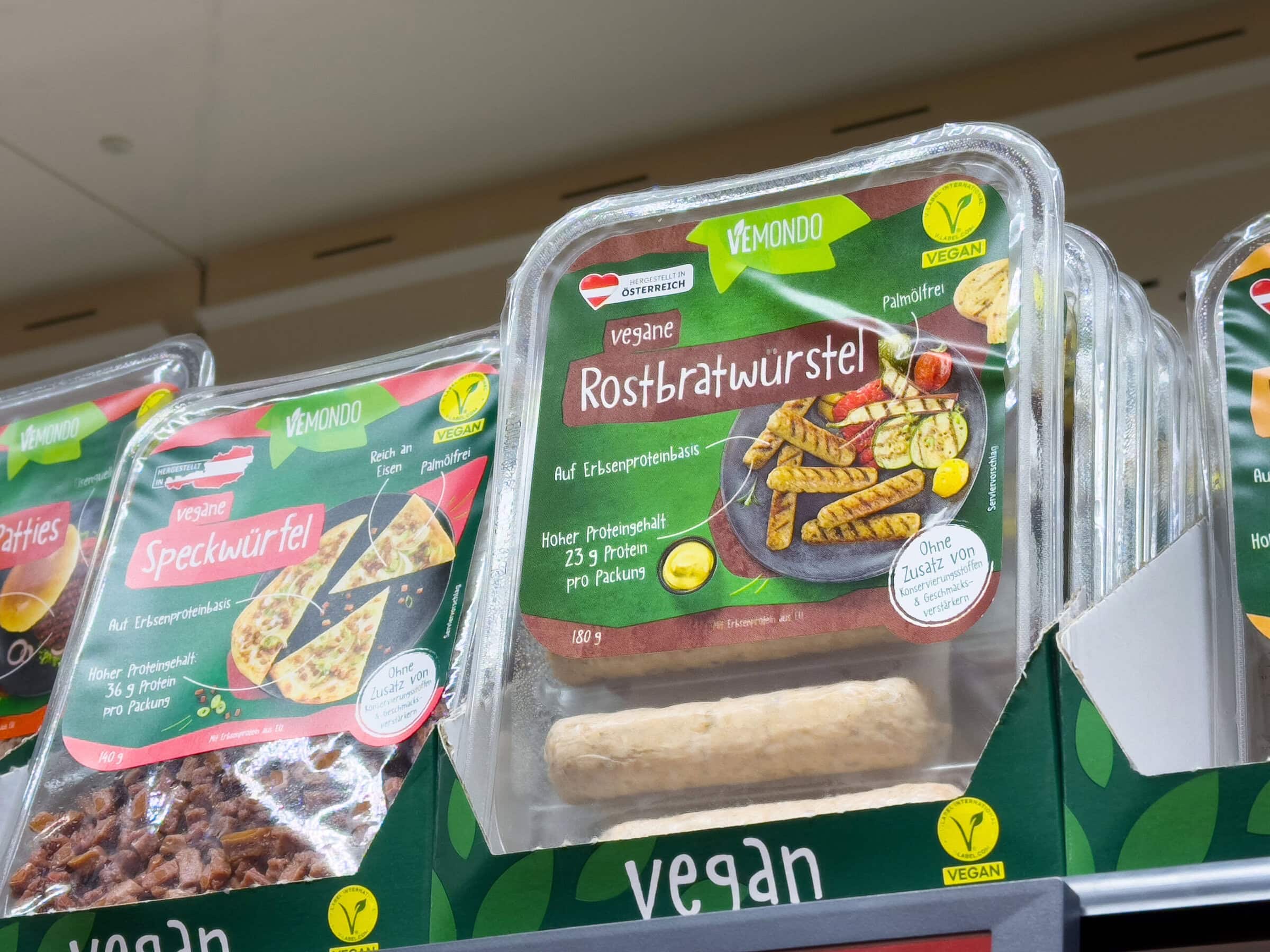
German ranges are much larger. Kaufland offered more than 100 own-brand plant-based products in 2024, and Lidl Germany had around 100 vegan products in its Vemondo range in 2023. Lidl GB had only 28 Vemondo products in early 2025.
In 2023, Lidl Germany and Kaufland both promised to price their own-brand plant-based products at or below the animal-based equivalent. Lidl’s vegan sales then rose by 30%. No leading UK retailer has made a similar commitment, although Lidl GB promised “market-leading prices” for plant-based products in 2024.
The products also fit daily life better in Germany. Plant-based cold cuts sell well there because they replace salami on bread and need no cooking. In the UK, sausages and burgers are the most common formats, and they need to be cooked. If you are not confident cooking with plant-based ingredients, something that goes straight onto a sandwich is the easier choice.
Plant-based milk: 10% vs. 72%.
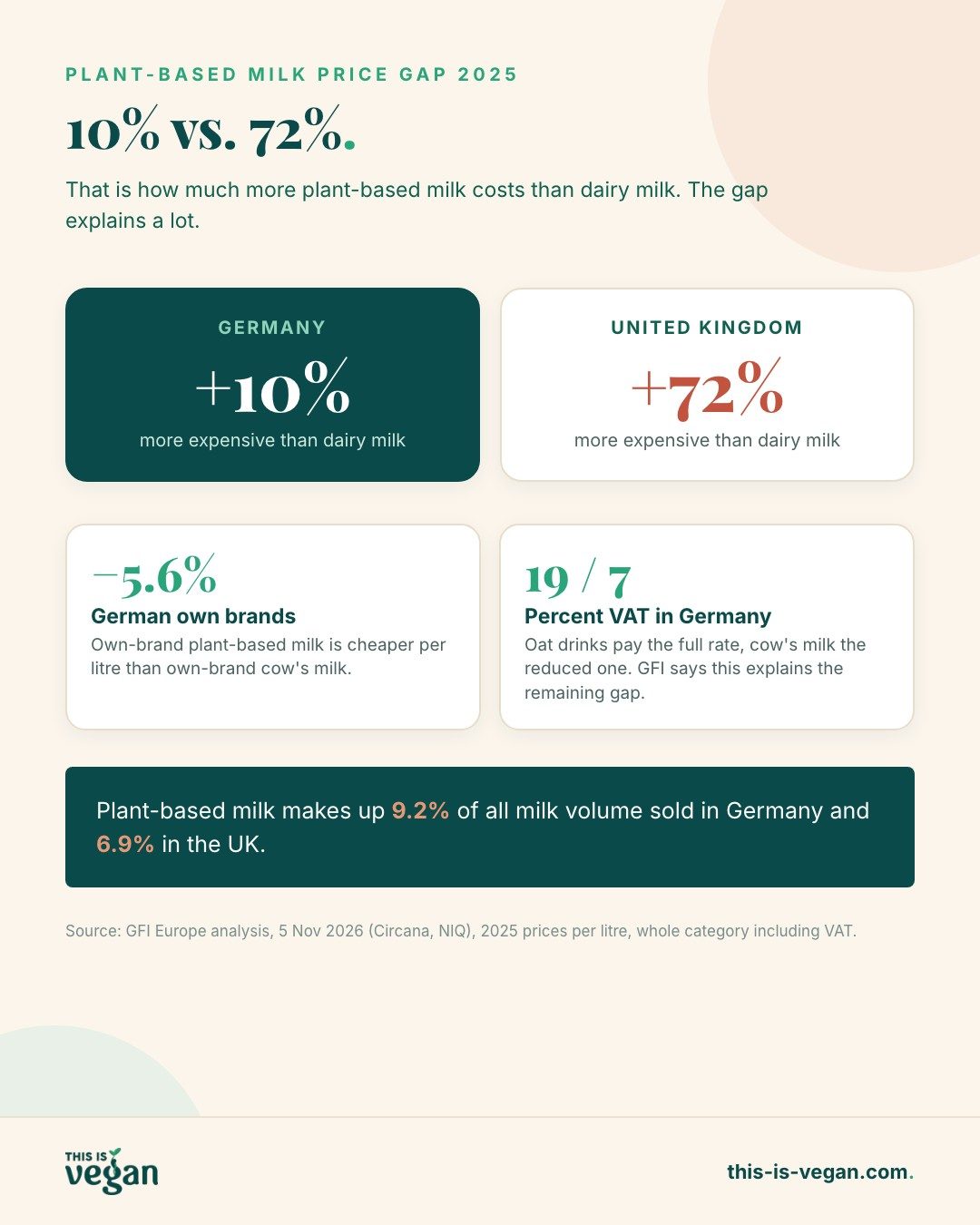
The effect is clearest for plant-based milk. German own-brand plant-based milk was 5.6% cheaper per litre than own-brand cow’s milk in 2025. Across the whole category, plant-based milk cost only 10% more than dairy milk. In the UK, the gap was 72%.
Plant-based milk makes up 9.2% of all milk volume sold in Germany and 6.9% in the UK. GFI notes that the category’s share tends to grow wherever the price gap narrows. In Germany, the remaining gap comes down to tax: oat drinks carry 19% VAT, while cow’s milk is taxed at 7%. With equal tax, GFI says, the gap would disappear.
Comparing meat prices is harder because full price data for animal meat are missing in both countries. In Germany, plant-based sausages were 44% more expensive per kilo than meat sausages in 2025, according to Circana. At Tesco in the UK, plant-based meat is on average 34% more expensive. A 2025 ProVeg price study did find that at most German retailers, the cheapest plant-based cold cuts, sausages, burgers and schnitzels cost less than comparable animal products.
Targets matter less than action.
Three of Germany’s seven leading retailers have plant-based targets. Lidl Germany aims for 20% of its protein sales to be plant-based by 2030. REWE aims for 60% of its food to be plant-based by 2035. Aldi Süd reached its target of 1,400 vegan products in 2026 and wants to grow plant-based sales by 20% by 2030. Aldi Nord, EDEKA, Kaufland and Netto have no such targets.
In the UK, only one of the six biggest supermarkets has a target: Lidl GB aims for 25% of its protein sales to be plant-based by 2030 and has already beaten its 2025 goal. Asda and Tesco missed their targets, while Aldi, Morrisons and Sainsbury’s have none. The figures come from ProVeg’s Protein Shift Hub.
GFI itself warns against reading too much into targets. The Netherlands leads Europe on retailer targets, yet plant-based sales there are falling too. Prices and ranges in store matter more.
Germans cut back more, Britons argue about processing.
Consumers do differ in some ways. 39% of Germans say they are actively reducing their meat intake, compared with 31% in the UK. 26% of German meat reducers say their tastes have changed, against 19% in the UK. Ethics is cited by 10% of German meat reducers but only 3% in the UK.
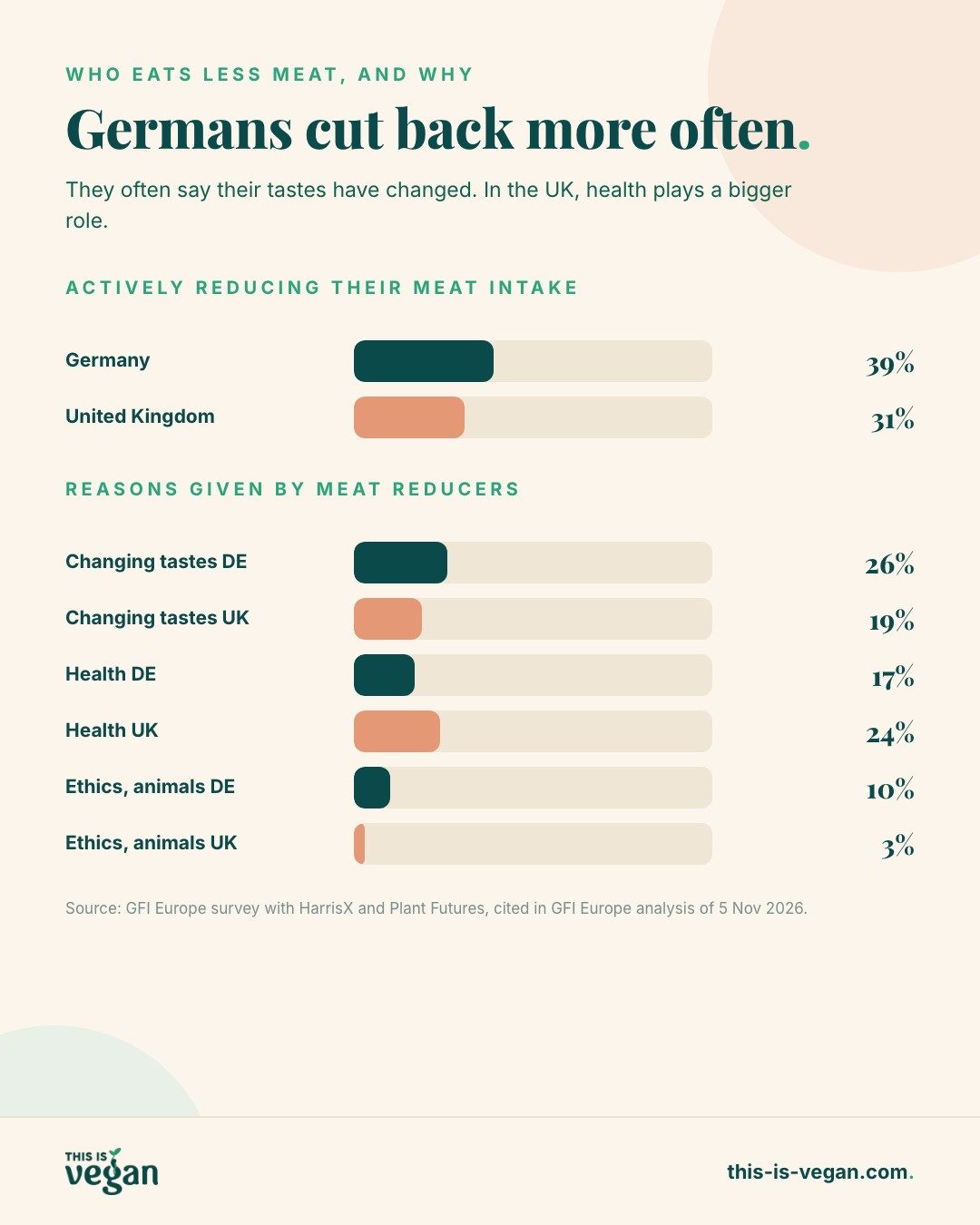
Health is the bigger topic in the UK: 24% of British meat reducers mention it, compared with 17% in Germany. The UK has had a loud debate about ultra-processed food for years, and according to GFI, British media link it to plant-based products far more often than German media do. Plant-based meat is usually classed as ultra-processed, and headlines have blamed the debate for falling sales.
How much this matters is unclear. In UK focus groups, many participants saw plant-based meat as processed but did not reject it for that reason alone. Those already unhappy with taste or texture found one more reason to avoid it. Those with good experiences kept buying. The debate adds doubt, but it does not decide on its own. We looked at what the label means in our piece on ultra-processed meat alternatives.
Germans also see a smaller gap between plant-based and animal products, for example in how confident they feel cooking them and how familiar they are. GFI cannot say whether that is down to better products or different expectations.
How solid is the comparison?.
The analysis has limits, and GFI names them. The UK sales figures exclude discounters, where plant-based products have performed well, so the UK decline may be somewhat overstated. Plant-based meat is also defined differently: in the UK, only products that mimic meat count, while the German category includes formats such as bean burgers. The figures are based on Circana retail data and NIQ’s household panel. Restaurants and cafés are not included.
It also matters who is doing the maths. GFI Europe is a donor-funded organisation that promotes alternative proteins. Its analysis ends by urging UK retailers to grow their affordable own-brand ranges and manufacturers to invest in taste and convenience. The underlying data come from independent market research firms.
What this means for animals.
For animals, what counts is how much meat, milk and eggs people stop buying. Oat drink sales alone say little about that. Even Germany is still at the start: plant-based sausages made up 1.73% of the volume of all packaged sausages in 2025, according to GFI. Every extra percentage point stands for pigs, cattle and chickens that are not fattened and slaughtered.
The comparison also shows what helps. Ethics is not the main reason most people eat less meat, even in Germany only 10% say so. Money is. When plant-based options sit cheaply next to the meat at the discounter and are easy to use, more people buy them regularly. So supply decides, and retailers and policymakers can do the most here, from own-brand pricing to VAT.
FAQ.
Why is Germany’s plant-based market growing?
According to GFI Europe, mainly because of strong discounters, large own-brand ranges and lower prices. Plant-based milk costs only 10% more than dairy milk in Germany. More Germans are also actively cutting back on meat and see plant-based products as closer to animal products.
Why is the UK plant-based market declining?
The analysis points to several factors: discounters have a much smaller market share, own-brand ranges are smaller, plant-based milk costs 72% more than dairy milk, and the debate about ultra-processed food hits plant-based meat harder. No single factor explains the decline.
How big are the two markets?
Across six categories, retail sales reached €1.71 billion in Germany and £848 million (about €993 million) in the UK in 2025. The UK figures exclude discounters.
Is plant-based milk cheaper than cow’s milk in Germany?
For own brands, yes: it was 5.6% cheaper per litre in 2025. Across all brands, plant-based milk costs 10% more. One reason is VAT, which is 19% on plant-based milk and 7% on cow’s milk in Germany.
Sources and method
This article is based on “Why is Germany’s plant-based market growing while the UK’s stagnates?” by Helen Breewood, GFI Europe, published on 5 November 2026. Market data come from Circana and NIQ, survey data from GFI Europe with HarrisX and Plant Futures, and retailer targets from ProVeg’s Protein Shift Hub. The sausage figure is taken from GFI Europe’s German retail report 2023 to 2025. We created the infographics ourselves from these figures. Currency conversions are GFI’s.
Want our reporting to show up first in Google's Top Stories? Add This Is Vegan as a preferred source on Google.