





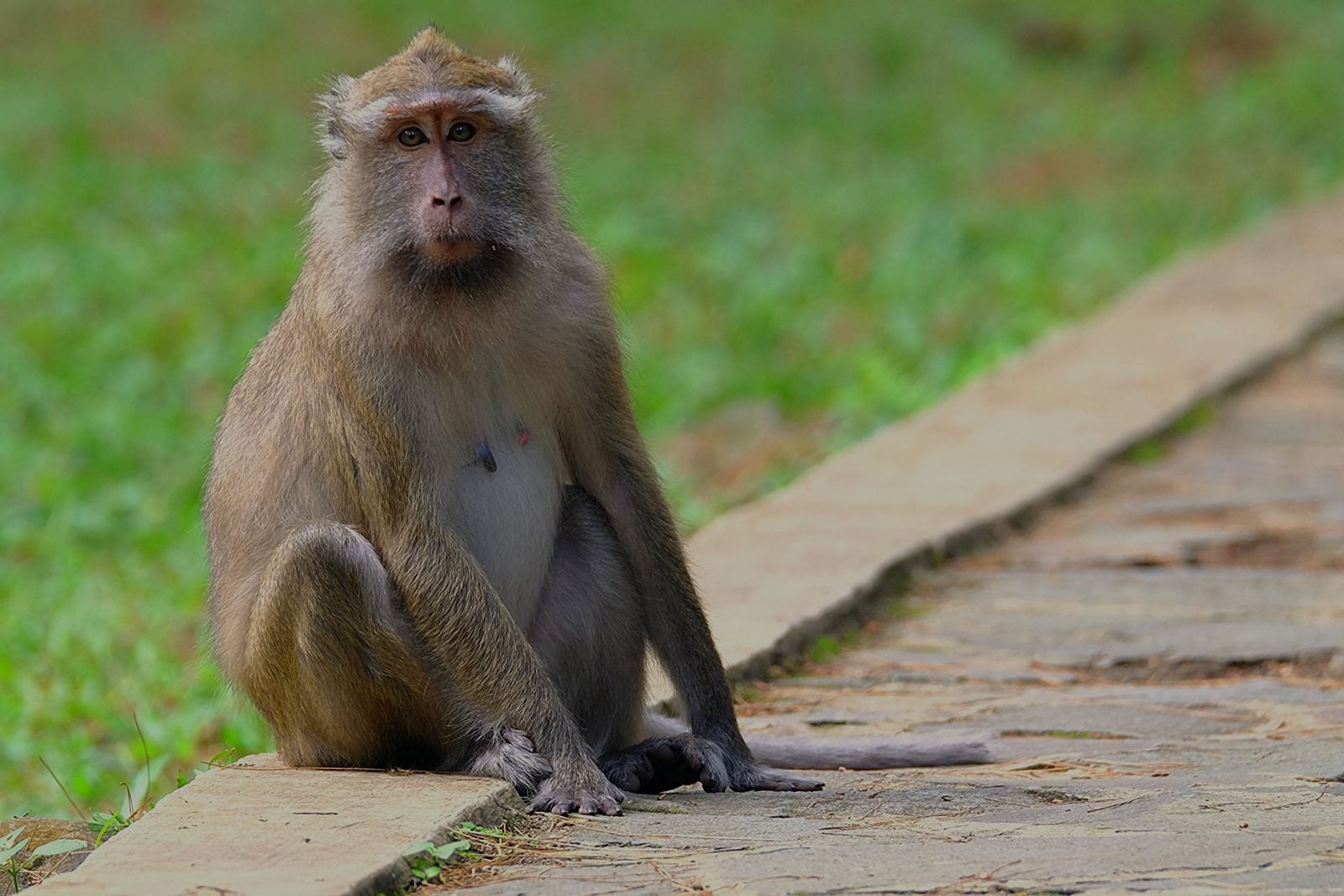
One of the largest breeding facilities for research monkeys could be built in the US. The startup behind it, Safer Human Medicine, is backed by 20 million dollars from Joe Lonsdale, cofounder of the data company Palantir. The plan is to hold up to 30,000 long-tailed macaques. The company was founded by a former executive of Envigo, the firm behind the Virginia beagle scandal.
In short
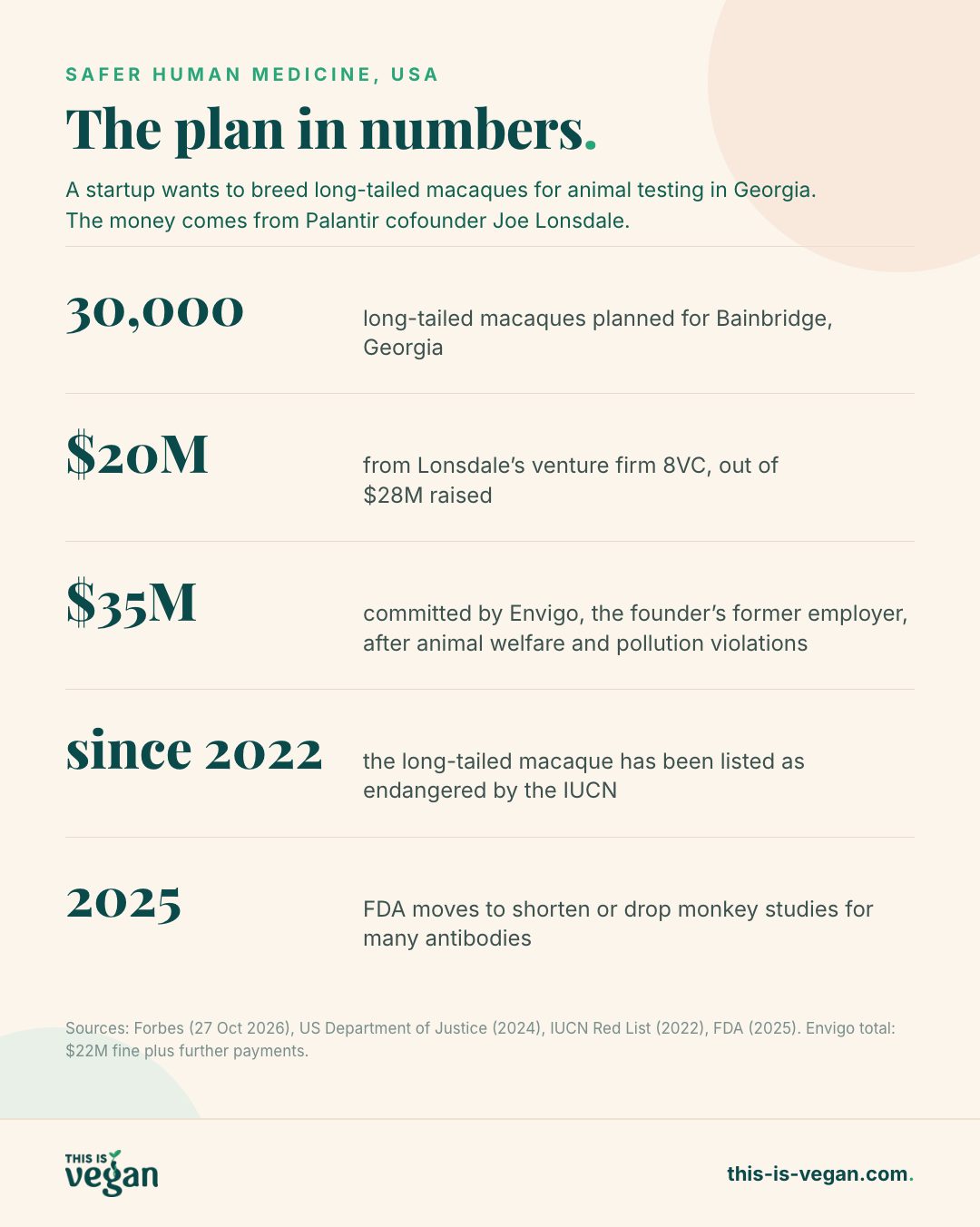
- The plan: Safer Human Medicine (SHM) wants to hold up to 30,000 long-tailed macaques for animal testing in Bainbridge, Georgia
- The money: 28 million dollars raised, 20 million of it from Lonsdale’s venture firm 8VC, according to Forbes
- The founder: Jim Harkness spent three years as chief operating officer at Envigo, which paid a record penalty for animal welfare violations in 2024
- The opposition: residents and the local district attorney have been fighting the project in court since 2024
- The countertrend: the US Food and Drug Administration (FDA) wants to reduce monkey testing for many drugs
Contents8 chapters
Who is behind the plan.
Safer Human Medicine was founded in 2023. The company says it is building the first large network of breeding and quarantine facilities for research monkeys in the US. Its customers are meant to be drug companies, contract research labs and universities. It plans to breed long-tailed macaques, also called crab-eating macaques. They are the monkey species most often used in animal testing worldwide.
As Forbes reported on 27 October, SHM has raised 28 million dollars so far. 20 million of that came in 2023 from 8VC, the venture firm of billionaire Joe Lonsdale. Lonsdale cofounded Palantir, a data analytics company that works mainly for government agencies and the military. SHM isn’t listed as a portfolio company on 8VC’s website. But Lonsdale mentioned his investment on a podcast in May and defended the company’s work there as pro-human. He told Forbes: “America needs a reliable domestic supply of research primates.”
The Envigo backstory.
SHM’s founder and CEO is Jim Harkness. According to Forbes, he spent three years as chief operating officer at Envigo, one of the large suppliers of laboratory animals in the US. He left in October 2022, shortly after Envigo agreed to close its beagle breeding facility in Cumberland, Virginia.
Conditions there had made national headlines. The US Department of Justice found inadequate veterinary care, too few staff and poor living conditions. More than 4,000 beagles were removed from the facility in 2022 and later rehomed. In June 2024, two Envigo companies pleaded guilty to violating the Animal Welfare Act and the Clean Water Act. The criminal fine was 22 million dollars, and parent company Inotiv committed to more than 35 million dollars in total. According to the Justice Department, it is the largest fine ever agreed to in an Animal Welfare Act case.
One thing matters for context: the companies were convicted, not Harkness personally. As far as is publicly known, he was not charged in connection with the case. SHM states on its website that animal welfare is a “top priority”.
Bainbridge pushes back.
The facility is planned for Bainbridge, a small town of around 14,000 people in southern Georgia. The local development authority had promised SHM about 200 acres of land and tax breaks, and the project was estimated at almost 400 million dollars. When the plans became public in early 2024, residents began to protest. They worry about property values, groundwater and monkeys escaping. Animal protection groups such as PETA support them.
Since then, the project has kept several courts busy. In February 2024, SHM sued the development authority in federal court to hold it to the deal. District Attorney Joe Mulholland tried to stop a 300 million dollar bond for the project but lost at the Georgia Supreme Court in April 2025. In January 2026, a federal judge allowed him to join the contract dispute, as the local paper The Post-Searchlight reported. The case has not been decided. SHM says it remains fully committed to Bainbridge.
Why the industry wants US-bred monkeys.
There is a real shortage behind the plan. The US imports most of its research monkeys. China, long the largest supplier, stopped exports in 2020. Since then, many animals have come from Cambodia, Vietnam and Mauritius. In 2022, US prosecutors charged alleged members of a smuggling ring accused of passing off wild-caught long-tailed macaques from Cambodia as captive-bred.
The same year, the International Union for Conservation of Nature (IUCN) listed the long-tailed macaque as endangered. The reasons include habitat loss and capture for trade and research. SHM and its backers therefore present domestic breeding as a clean alternative to imports. Critics argue that it locks in demand for research monkeys for decades instead of reducing it.
Headwind from Washington.
On its website, SHM argues that animal testing is legally required before human trials. That is no longer quite true. Since the FDA Modernization Act 2.0 of late 2022, companies in the US may also submit data from non-animal methods. In practice, though, the FDA still expects animal data for many drugs.
That is what the agency wants to change. In April 2025, it presented a roadmap to make animal testing the exception in drug safety studies. It starts with monoclonal antibodies, a group of drugs that has so far required particularly large numbers of monkeys. In December 2025, a draft guidance followed under which six-month monkey studies can be shortened or dropped for many of these drugs. The US National Institutes of Health (NIH) also announced in 2025 that it would put more weight on animal-free research. More on this in our article on Harvard’s monkey experiments and the NIH’s change of course.
A new review shows how little animal testing often delivers for humans: of 83 drugs tested on rodents for acute injuries, only 3 made it to approval. We covered it here: only 3 of 83 drugs reached approval.
An animal ethics perspective.
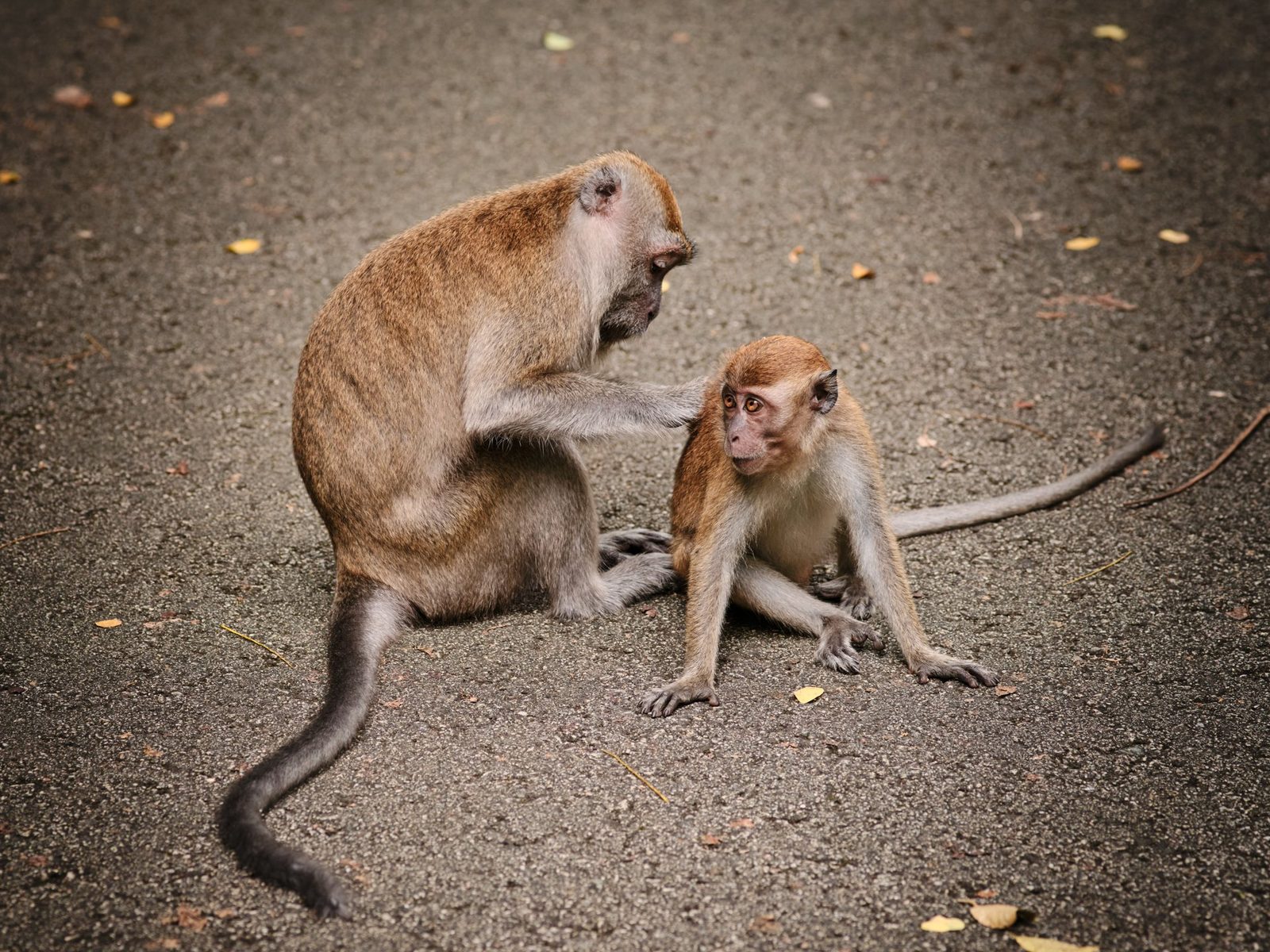
Long-tailed macaques live in large groups with clear hierarchies, friendships and close bonds between mothers and their young. They recognise each other, learn from each other and demonstrably suffer from isolation and stress. In a breeding facility of this size, thousands of them would be born only to be sold to laboratories later. Most experiments there end with the animal’s death.
Lonsdale frames the question as a choice between a human and a monkey. But it rarely comes down to that. Where animal tests reveal little about humans, the animals’ suffering does little for patients either. At the same time, more and more methods work with human cells, organ chips or computer models. Putting millions into breeding 30,000 monkeys is a bet that this shift will stay slow.
What you can do.
- Support animal-free research. Organisations like Cruelty Free International campaign for research without animals.
- Shop without animal testing. With cosmetics and household products, you can act directly, for example with vegan, cruelty-free cosmetics.
- Stay informed and share. The Bainbridge project hasn’t been decided. Public attention has already made a difference there.
Frequently asked questions.
What is Safer Human Medicine?
A US company founded in 2023 that wants to breed and sell monkeys for animal testing. It plans a facility for up to 30,000 long-tailed macaques in Bainbridge, Georgia.
What does Joe Lonsdale have to do with it?
According to Forbes, his venture firm 8VC invested 20 of the 28 million dollars SHM has raised so far. Lonsdale is a cofounder of Palantir.
Will the facility be built?
That’s still open. Several lawsuits are pending, including a contract dispute in federal court. SHM is sticking with the site.
Why are monkeys used in animal testing?
Mainly for safety tests of new drugs, such as antibodies, and in infection and brain research. The FDA wants to gradually reduce these tests for many drugs.
Sources ●
Forbes: Why This Palantir Billionaire Is Backing A Plan To Breed 30,000 Monkeys (27 October 2026), US Department of Justice: Envigo guilty plea (June 2024), The Post-Searchlight: Court okays intervention in primate facility case (January 2026), FDA: plan to reduce animal testing (April 2025) and draft guidance on monkey testing for antibodies (December 2025), Safer Human Medicine website, Removal from the wild endangers the once widespread long-tailed macaque (American Journal of Primatology, 2023). Photos: hartono subagio and CK Seng / Pexels. This article contains affiliate links. If you buy something through them, we earn a small commission at no extra cost to you. As an Amazon Associate, we earn from qualifying purchases.
Want our reporting to show up first in Google's Top Stories? Add This Is Vegan as a preferred source on Google.