







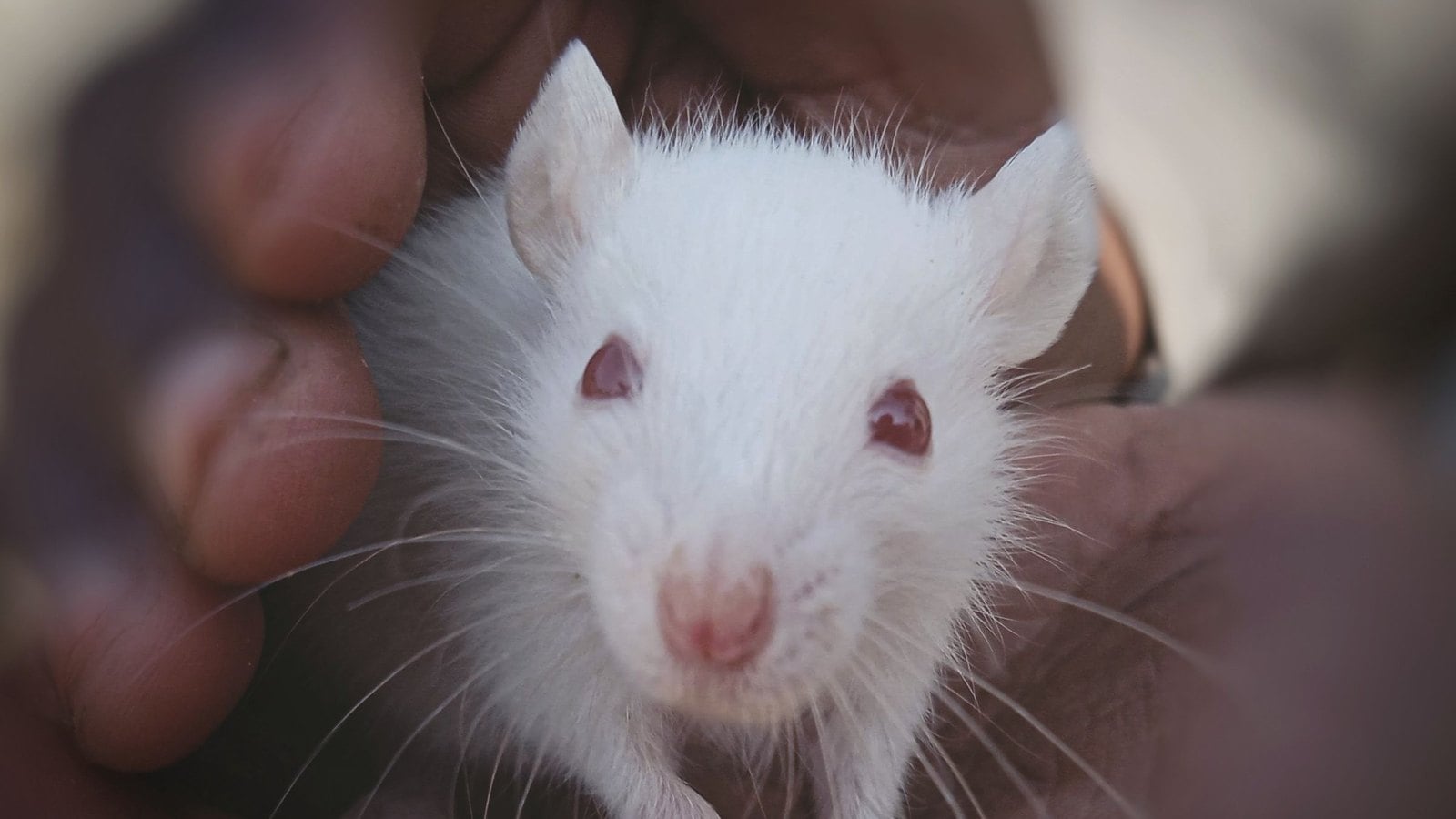
Rats with brain injuries, mice with crushed spinal cords, rabbits with burns: for decades, treatments for acute injuries have been tested on animal models like these. A new systematic review in the journal PLOS ONE has counted how much of that research reaches patients. Of 83 drugs, only 3 were approved as a new class of drug for exactly the injury they were tested on.
In short
- The data: 1,257 animal studies in rats, mice, guinea pigs, hamsters and rabbits, published 1990 to 2010
- Human trials: 20% of the animal studies were followed by clinical trials
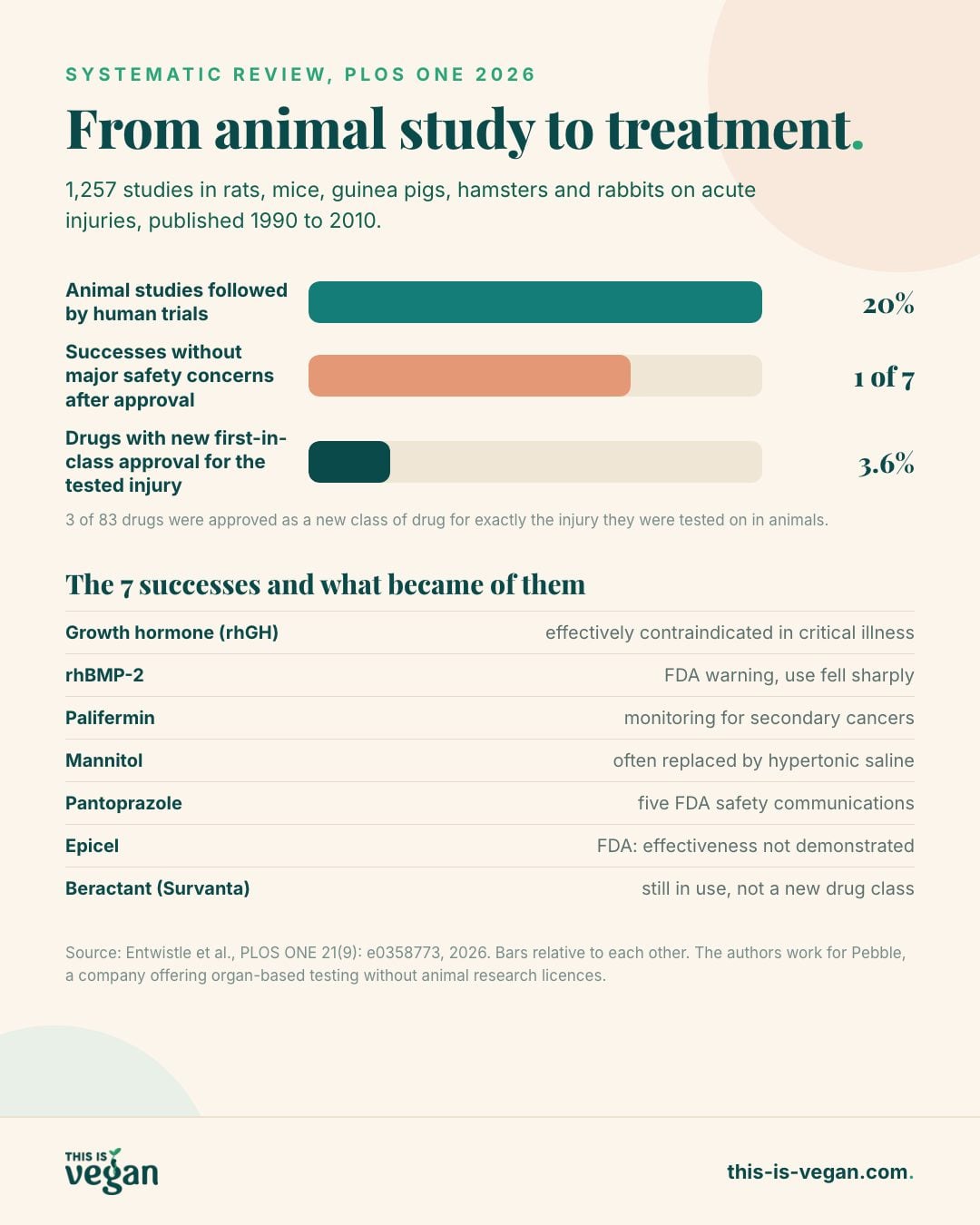
- Approval: 3 of 83 drugs (3.6%) were approved as a new class of drug for the tested injury
- After approval: 6 of 7 treatments counted as successes later showed major safety problems
- The context: the findings apply to acute injuries and small animals, not to all research
Contents8 chapters
What the researchers looked at.
The team led by Timothy Entwistle and James Fildes in Manchester searched the MEDLINE database for animal studies on acute injuries. These include traumatic brain injury, spinal cord injury, burns, acute lung and kidney damage and radiation injury. Each study tested a treatment that wasn’t yet in routine clinical use. In the end, 1,257 studies from 1990 to 2010 were included.
The long gap was deliberate. It often takes many years for an animal study to turn into an approved treatment. So for every therapy, the researchers traced whether it was tested in humans, whether a regulator approved it and what happened after it reached the market. There was enough data for 100 therapies, 83 of them drugs.
From 20 percent to 3.6 percent.
At first glance, the record looks decent. 251 of the 1,257 animal studies were followed by clinical trials, or 20%. This figure often comes up as a success rate in the debate about animal testing. The authors consider it misleading, because testing a drug in humans doesn’t mean it works in humans.
So they counted more strictly. The question was which drug was approved as a new class of drug for exactly the injury it had been tested on in animals. That applied to 3 of 83 drugs, or 3.6%. 15 drugs clearly failed in human trials. Because studies with negative results are published less often, the authors see 3.6% as an upper limit.
What became of the successes.
Seven treatments in total were approved for the injury tested in animals. Besides the three new drugs, the researchers count four more with caveats, for example because they reached the market before today’s approval rules or belong to an already known drug class. Six of these seven later showed major safety problems that the animal studies hadn’t picked up:
- Growth hormone (rhGH) is now effectively contraindicated for critically ill patients.
- rhBMP-2, a bone growth factor, is used far less after a warning from the US Food and Drug Administration (FDA) and several lawsuits.
- Palifermin now comes with enhanced monitoring because of concerns about secondary cancers.
- Mannitol has been replaced by hypertonic saline in many guidelines.
- Pantoprazole has been the subject of five FDA safety communications.
- Epicel, lab-grown skin for burn victims, is only available under an exemption. According to the FDA, its effectiveness has not been demonstrated.
Only beractant, better known by its brand name Survanta, remains in use without major caveats. It replaces a substance in the lungs and is made from cow lungs. But the animal model didn’t predict a new class of drug here, as similar products already existed.
How solid the study is.
The work is methodically careful. The approach was registered in advance on the Open Science Framework, two people screened each study independently, and the raw data is public. Still, there are limits the authors name themselves:
- Only one field: the review covers acute injuries and small animals. It says nothing about cancer, infections, chronic diseases or experiments on monkeys.
- Only one database: the search covered MEDLINE. Studies not indexed there are missing.
- Room for judgement: what counts as a success depends on the definition. The researchers therefore give several rates, ranging from 1.2 to 20% depending on the definition.
Who did the study matters too. Four of the five authors are employed by Pebble Biotechnology Laboratories, the fifth works for the related Pebble Institute, which funded the work. The company offers testing on organs kept alive outside the body, an alternative to classic animal experiments. The authors disclose this. Still, a commercial interest in the result can’t be ruled out.
The findings fit earlier work. A large review from 2024 found an approval rate of around 5% across all medical fields. We’ve also looked at how animal-free research is replacing fetal bovine serum in the lab.
Where the burden now lies.
The researchers draw a clear conclusion. In their view, anyone planning further small rodent studies in this field has to justify why they should achieve more than before. The suffering of the animals should be weighed against the low success rate, they write. As alternatives, they name human tissue, organoids and computer models, along with more carefully designed studies and early, cautious testing in humans.
According to the authors, the data can’t settle whether animal research in this area should end altogether. But it shifts the burden of proof.
We talked about this with veterinarian Dr. Corina Gericke and Claus Kronaus of the German association Ärzte gegen Tierversuche (Doctors Against Animal Experiments) on our Plantbased Podcast. You can read the key answers in our interview on animal testing or watch the full conversation (both in German):
An animal ethics perspective.
Behind the 1,257 studies are animals who were deliberately given serious injuries: artificially induced brain trauma, crushed spinal cords, burns. Rats and mice feel pain and fear, and the science on this is well established. Their suffering is usually justified by the benefit to humans. This review shows that in an entire field of research, that benefit was much smaller than assumed.
From an animal ethics perspective, an experiment wouldn’t be acceptable even if it worked more often. But the study shows that animal experiments often don’t even deliver what they are justified with. How many animals are used each year in one European country is shown in our article on animal testing statistics in Switzerland.
What you can do.
- Stay informed. The study is open access and easy to cite when the topic comes up.
- Shop without animal testing. For cosmetics and household products, choose vegan, cruelty-free cosmetics.
- Support animal-free research. Organisations like Cruelty Free International campaign for research without animals.
Frequently asked questions.
How many animal studies lead to an approved drug?
In this review on acute injuries, 3 of 83 drugs were approved as a new class of drug for the tested injury, or 3.6%. A 2024 review across all fields found around 5%.
Which animals were used in the studies?
Rats, mice, guinea pigs, hamsters and rabbits. The review covered studies published between 1990 and 2010.
Does the result apply to all animal testing?
No. The authors only looked at studies on acute injuries such as brain, spinal cord and burn injuries. They explicitly make no claims about other fields like cancer or infections.
Who funded the study?
The Pebble Institute in Manchester. Most of the authors work for Pebble Biotechnology Laboratories, a company offering testing on organs outside the body.
Sources ●
Entwistle TR, Cowey WR, Stokoe E, Stone JP, Fildes JE: From preclinical promise to regulatory reality: translation of small rodent acute injury therapies to human approval and safety outcomes. PLOS ONE 21(9): e0358773, 2026. Registration and data: Open Science Framework. Company details: Companies House (UK). Photo: Choco Virat / Pexels. This article contains affiliate links. If you buy something through them, we earn a small commission at no extra cost to you. As an Amazon Associate, we earn from qualifying purchases.
Want our reporting to show up first in Google's Top Stories? Add This Is Vegan as a preferred source on Google.