






Eight in ten people in Germany eat meat, eggs and dairy. Most of them still want things to change for the animals: no more cages, clear labels, higher taxes on cheap meat. That is the finding of the 2026 Animal Welfare Barometer by Humane World for Animals, which the organisation has now broken down by diet for World Vegan Month.
In short
- The survey: Ipsos polled 1,527 adults in Germany online in January 2026, commissioned by Humane World for Animals
- Who eats everything: 80.7% of respondents, plus 8.6% vegetarian and 2.5% vegan
- Cages: 66.7% of people who eat everything support a complete phase-out of cages for farmed animals
- Eggs in processed food: 79.1% want mandatory labels showing where the eggs in pasta or biscuits come from
- The catch: the survey was paid for by an animal protection group, and the breakdown by diet so far only appears in its press release
Contents8 chapters
What was asked.
2026 is the first year of the Tierschutz-Barometer, as it is called in German. Market research institute Ipsos surveyed 1,527 people aged 18 and over through an online panel between 15 and 26 January. The results are weighted by age, gender, federal state and education to represent the German-speaking adult population. Humane World for Animals, formerly Humane Society International, published the report earlier this year, along with a separate document listing every question and answer.
What’s new is the breakdown by diet. The organisation split the answers by whether people eat everything, are vegetarian or are vegan. Its takeaway: animal welfare is “not a vegan bubble.”
The numbers by diet.
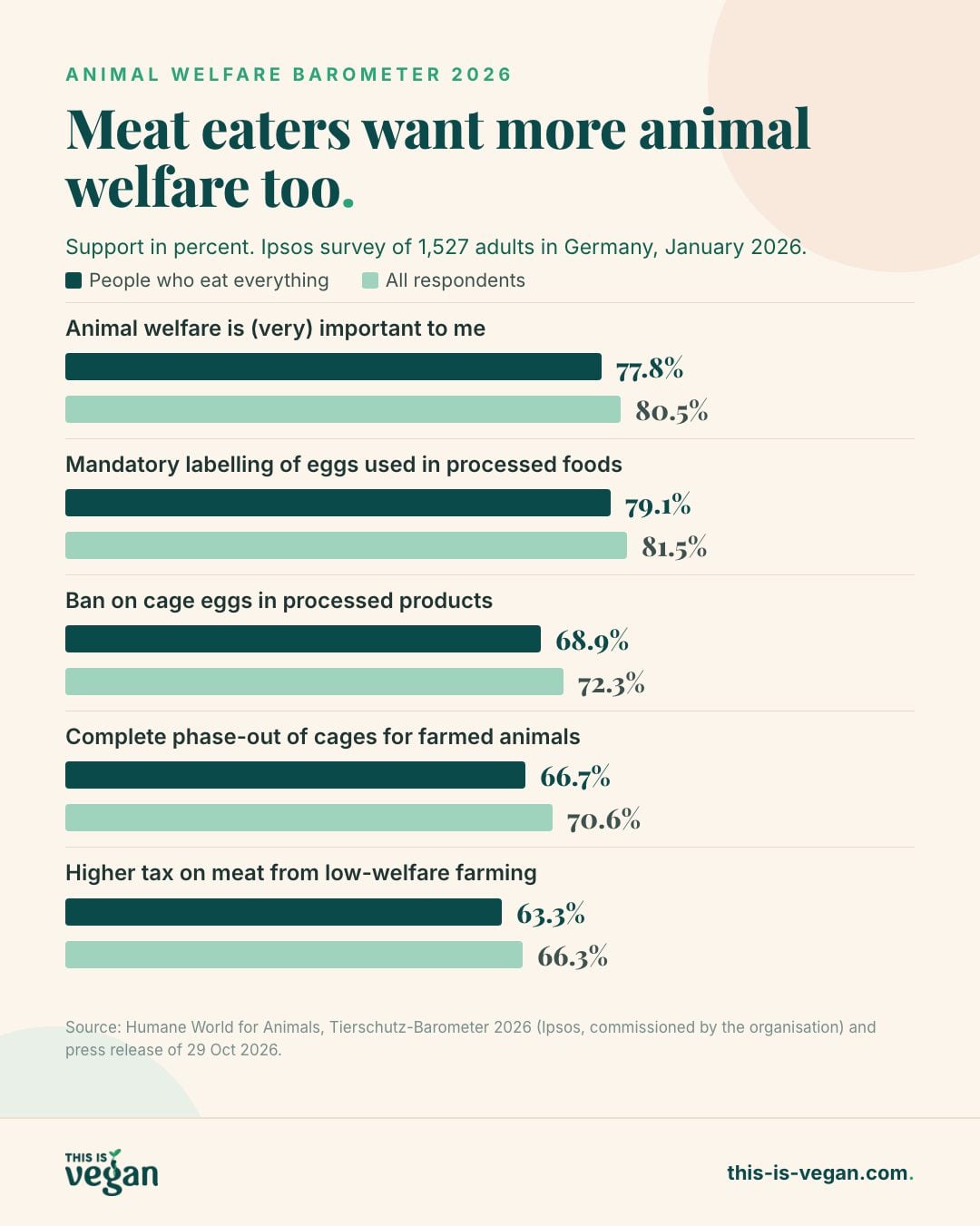
For 77.8% of people who eat everything, animal welfare is important or very important. Across all respondents the figure is 80.5%, among vegetarians 97.6%. The more meat someone eats, the lower the support, but it stays high. People who eat meat less than once a week come in at 86.3%. At two to three times a week it is 79.2%, and even among those who eat meat about once a day it is still 70.4%.
The pattern is similar for specific demands. The chart shows the gap between people who eat everything and the average:
Asked in an open question where the federal government should do more, 33.8% of people who eat everything named factory farming without being prompted. That is practically the same as the average (33.7%), and among vegetarians it was even lower at 28%. Farming conditions worry 63.7% of people who eat everything, and 58% want the government to do more for animal welfare.
Cages, eggs, taxes: the background.
The three demands from the survey land on issues that have been open for years.
- Eggs in processed food: fresh eggs in the EU carry a code showing how the hens were kept. Pasta, biscuits, mayonnaise and baked goods don’t have to say whether the eggs came from caged hens, and cage eggs can still be used in them in Germany. 81.5% of all respondents want this on the label, and 72.3% want cage eggs banned from such products altogether.
- Cages: the European Citizens’ Initiative “End the Cage Age” collected around 1.4 million signatures. The European Commission promised a proposal in 2021 and then missed its own deadline. In its Livestock Strategy of 7 July 2026, it now says it will propose new rules for laying hens and broilers by the end of 2026, focused on phasing out cages. A proposal for pigs, moving from crates to pens, is due by the second quarter of 2027.
- Labelling how animals are kept: Germany’s mandatory husbandry label for fresh pork has been postponed twice. In January 2026 the Bundestag moved the start to 1 January 2027 because the governing coalition wants to overhaul the law.
- A welfare tax: the idea isn’t new. A government advisory body, the Borchert Commission, proposed an animal welfare levy back in 2020, including 40 cents per kilo of meat. It was never introduced, and the commission stopped its work in 2023. Today 66.3% of all respondents and 63.3% of people who eat everything would back a higher tax on meat from low-welfare farming if the money went into better barns.
Humane World for Animals sees a gap between what people want and what the government delivers. According to the barometer, only about one in five is satisfied with the federal government’s work on animal welfare. Denmark shows another approach with its own animal welfare enforcement agency.
How solid the survey is.
Ipsos is an established institute and the method is clearly described in the report. A few things are still worth knowing:
- A client with a goal: Humane World for Animals paid for the survey and wrote the questions. It uses the results to promote its petition “Mandat für Tiere” (A mandate for animals).
- The diet figures can’t be checked yet: the published report and the question document give figures for all respondents. The breakdown by diet so far only comes from the press release.
- Small groups: 2.5% vegan means roughly 40 people in this sample, 8.6% vegetarian roughly 130. The organisation gives no separate figures for vegans, and statements about vegetarians come with wide margins. The same goes for the side note that 10% of conservative CDU/CSU voters are vegetarian, slightly above average. With subgroups this small, that is more likely chance than a trend.
- Saying isn’t buying: people who say animal welfare matters in a survey don’t automatically shop differently. Survey answers tend to be kinder than actual behaviour.
The core message still holds. The differences between people who eat everything and the average are small, and every one of the demands has clear majority support.
The contradiction in the shopping cart.
More than three quarters of people who eat everything say animal welfare matters. Meanwhile, most of the meat sold still comes from the lowest welfare tiers, because it is the cheapest. That is why the survey focuses on laws rather than shopping. If cage eggs are banned, nobody has to choose between their wallet and their conscience at the checkout.
An animal ethics perspective.
An end to cages would make a real difference to millions of hens, pigs and rabbits. More space, straw, the chance to turn around: all of this reduces suffering, and each of these demands deserves to become law.
But the survey also shows a limit. It asked how animals should be kept, not whether. A free-range hen is still slaughtered when she lays fewer eggs, and a pig with outdoor access still ends up at the slaughterhouse. If 77.8% of people who eat everything care about animal welfare, it is fair to ask why the animals’ interest in their own lives barely comes up.
In that sense, Humane World for Animals has a point. Compassion for animals isn’t limited to a vegan minority. It has reached the mainstream. For most people it just stops at the barn door and rarely makes it onto their own plate.
What you can do.
- Read the ingredients. Egg is in a lot of pasta, biscuits, cakes and sauces. If the label says nothing about how the hens were kept, cage eggs may be in there.
- Replace eggs. For baking and cooking, flaxseed, aquafaba or a ready-made vegan egg replacer work well.
- Push for change. If you live in Germany, Humane World for Animals is collecting signatures for stricter animal protection laws with its petition “Mandat für Tiere”. Across the EU, groups like Compassion in World Farming are tracking the cage proposal.
Frequently asked questions.
What is the Animal Welfare Barometer 2026?
A representative online survey of 1,527 adults in Germany, carried out by Ipsos in January 2026 for the animal protection organisation Humane World for Animals. It is the first edition.
How many people in Germany are vegan, according to the survey?
2.5% of respondents said they eat a vegan diet and 8.6% a vegetarian one. 80.7% said they eat everything.
How many meat eaters want an end to cages?
66.7% of people who eat everything support a complete phase-out of cages for farmed animals. Across all respondents it is 70.6%.
Do cage eggs in processed food have to be labelled?
No. In the EU, the farming method only has to be shown on fresh eggs. Processed foods like pasta or biscuits carry no such obligation.
Who paid for the survey?
Humane World for Animals, formerly Humane Society International. The organisation uses the results for its political campaigns, including the petition “Mandat für Tiere”.
Sources ●
Humane World for Animals: Tierschutz-Barometer 2026 and questions and results (both in German), press release of 29 October 2026. European Commission: Revision of EU animal welfare legislation and ECI End the Cage Age. German Bundestag: postponement of the husbandry label, January 2026. Photos: Mark Stebnicki, Will Kirk / Pexels. This article contains affiliate links. If you buy something through them, we earn a small commission at no extra cost to you. As an Amazon Associate, we earn from qualifying purchases.
Want our reporting to show up first in Google's Top Stories? Add This Is Vegan as a preferred source on Google.