







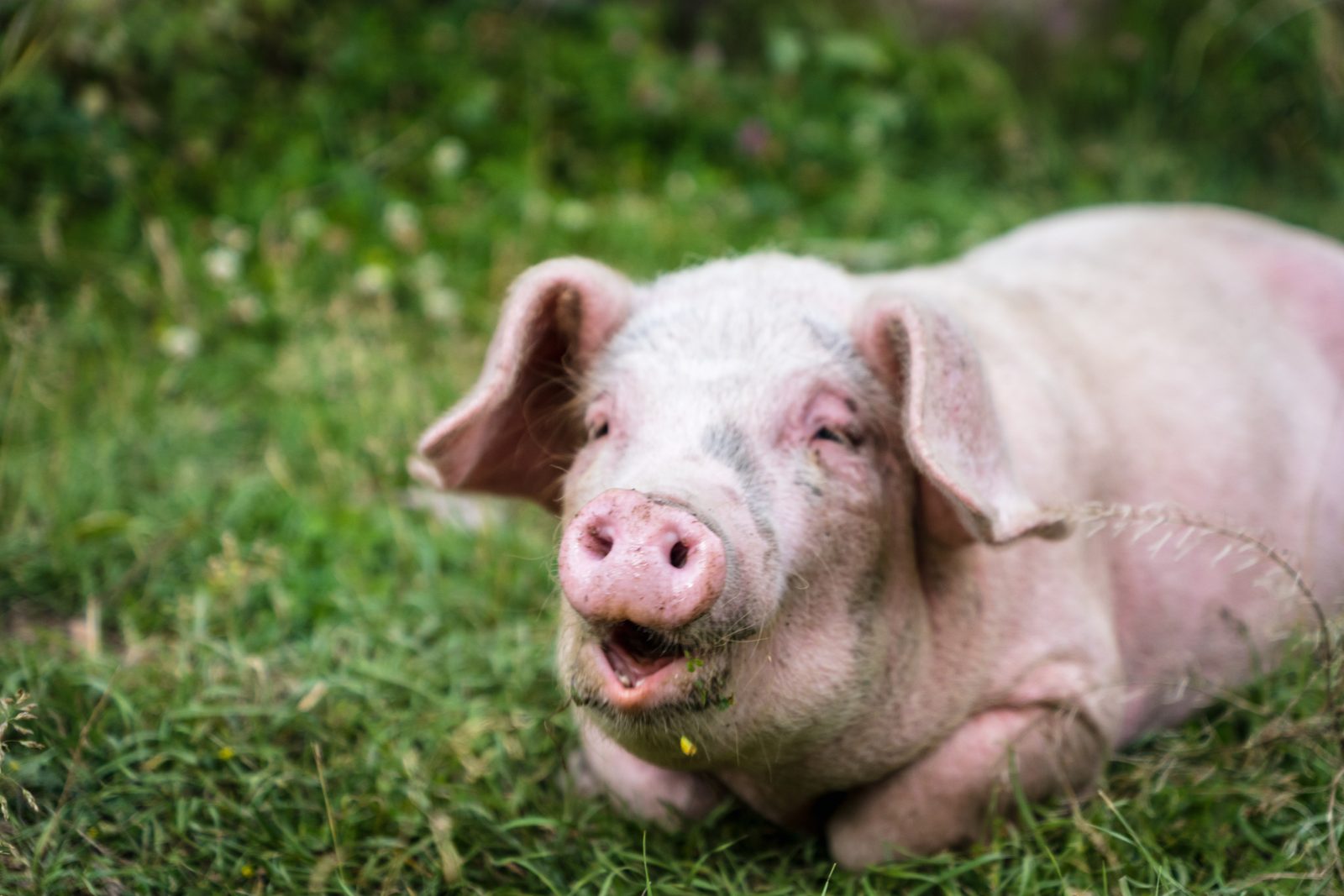
One gets stroked. One gets eaten. Both are curious, both recognise faces, both feel pain. The difference is not in them. It is in us.
There is a word for this pattern, and on 29 August there is a day for it.
What is speciesism?
Speciesism means treating beings differently purely because of the species they belong to. Not because of what an individual can feel, want or lose, but because of the label attached to their kind.
The term dates from the 1970s and was deliberately built in parallel to racism and sexism. The shared structure is the point: a group receives less consideration because of the category it falls into, rather than for any reason that survives scrutiny.
To be clear: speciesism does not claim a chicken is a human. It claims that comparable interests deserve comparable weight. A pig’s interest in avoiding pain counts as much as a dog’s identical interest.
Contents9 chapters
The day, briefly
The World Day for the End of Speciesism has been held at the end of August every year since 2015. It is organised by the Swiss association Pour l’Égalité Animale. Activists worldwide use the day to draw attention to how differently animals are treated, and the movement puts forward five core demands, among them ending the legal status of animals as property and closing slaughterhouses.
That is the occasion. The subject is bigger than the date, so the rest of this piece deals with the question underneath it.
The test every justification has to pass
The question is not whether we treat animals differently. Obviously we do. The question is whether there is a reason that holds up.
Any such reason would have to name a property that every loved animal has and every eaten animal lacks. Otherwise it explains nothing and merely restates the habit.
Dog and pig

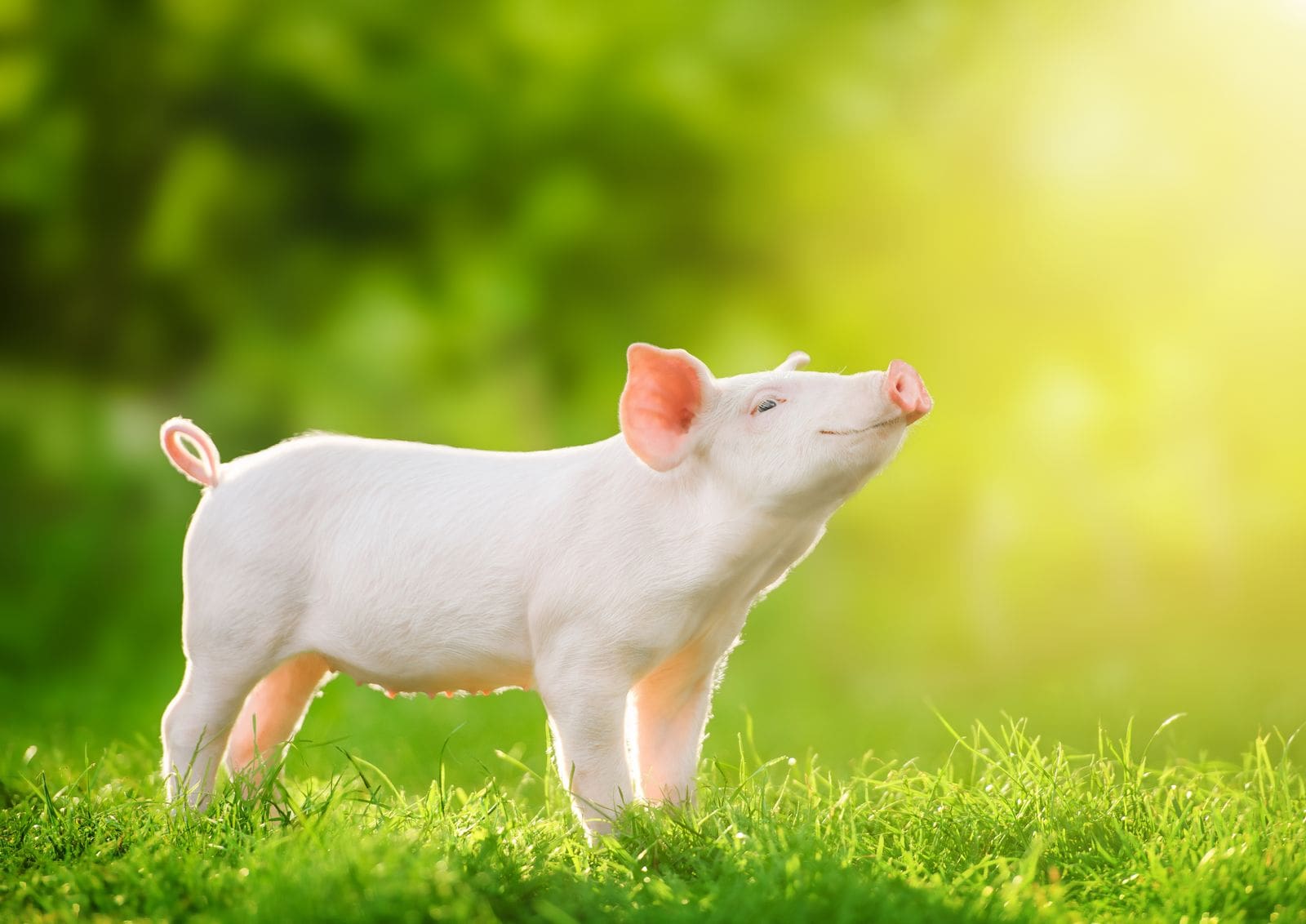
Pigs are curious, social and quick to learn. In a widely cited 2009 experiment by Donald Broom, seven of eight pigs located food they could only see in a mirror by walking around a partition to reach it.
One caveat almost always missing from social media versions: a replication attempt largely failed, with only two of eleven pigs completing the task. Anyone citing Broom should cite that too.
The underlying point survives, and it gets more interesting. The same mirror task was run with chickens in 2024, and eleven of eighteen hens solved it. The animal whose name is a byword for stupidity in several languages.
Cat and chicken
Chickens tell individuals apart by their faces, maintain a social hierarchy, and use different alarm calls depending on the threat. They show REM sleep, the phase associated with dreaming in mammals.
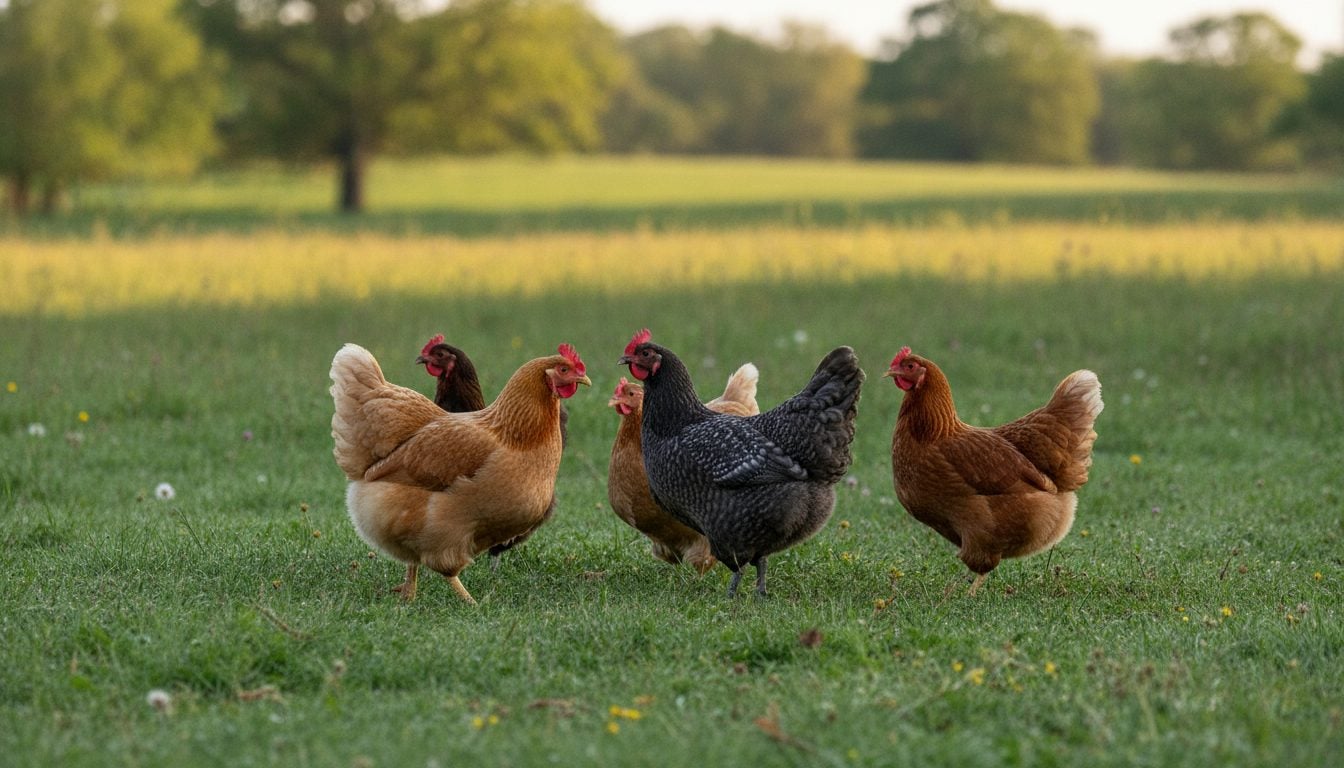
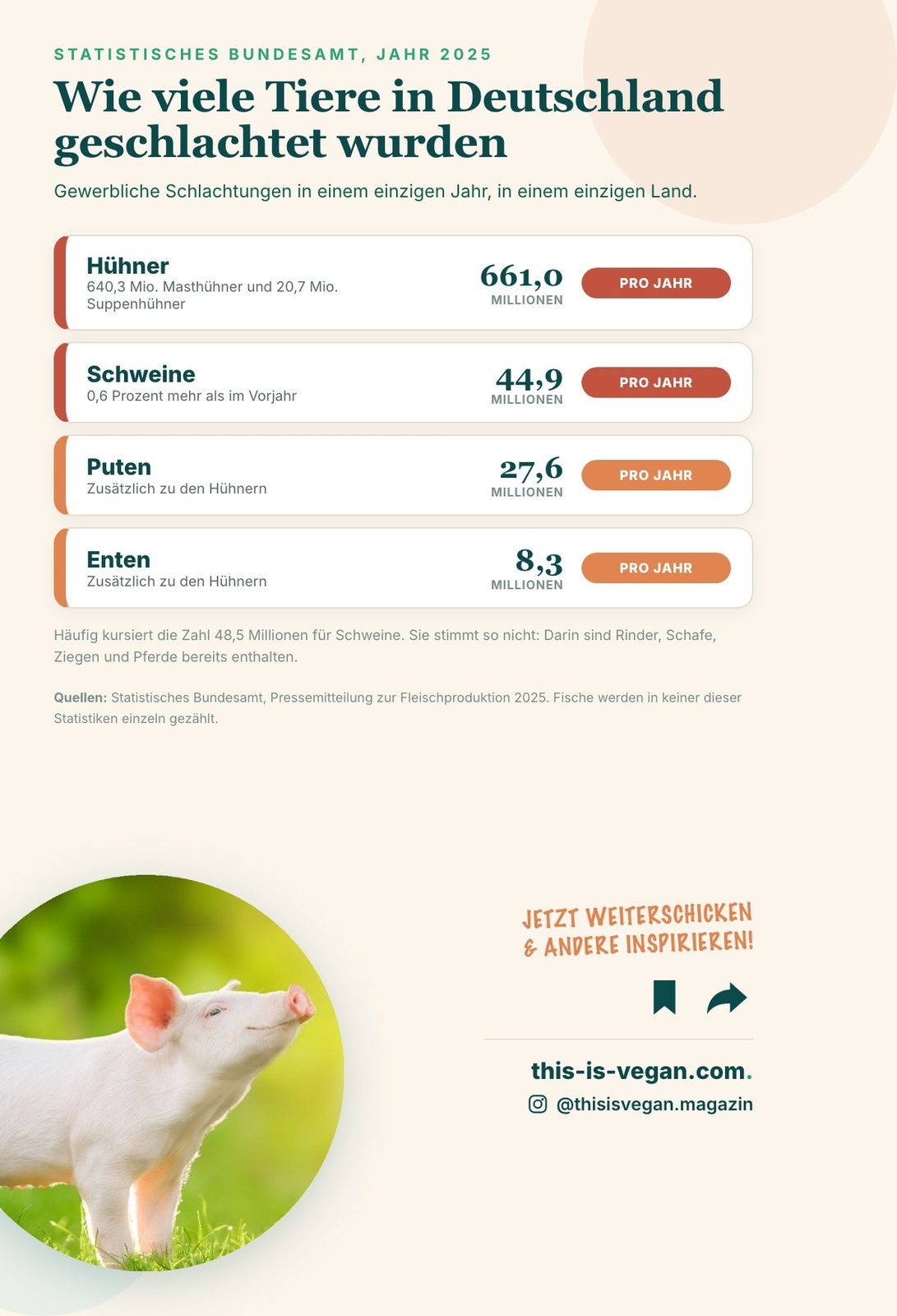
The cat sleeps on the sofa. In Germany alone, roughly 661 million chickens were slaughtered in 2025. Germany is a mid-sized country. Scale that thought to your own.
Goldfish and salmon

Fish are where the scientific argument is sharpest, so this section is deliberately careful.
Established: rainbow trout have nociceptors, pain receptors with C and Aδ fibres across three classes, physiologically indistinguishable from those in mammals. Injured fish rub the affected area, avoid places where they experienced noxious stimuli, swim less and stop feeding. In trout these responses are reduced by morphine. In one zebrafish study, fish that had received a painful treatment actively entered a chamber they would normally avoid when a painkiller had been added to the water there.
The counterargument: a portion of the field holds that all of this can be explained without assuming conscious pain. Analgesics might simply block nociception, with no experience behind it. That position exists, it is not unreasonable, and we will not pretend the matter is settled.
What it changes in practice is limited. When the evidence sits somewhere between “feels pain” and “possibly not”, killing on the scale of trillions without stunning is not the cautious option.
What the test returns
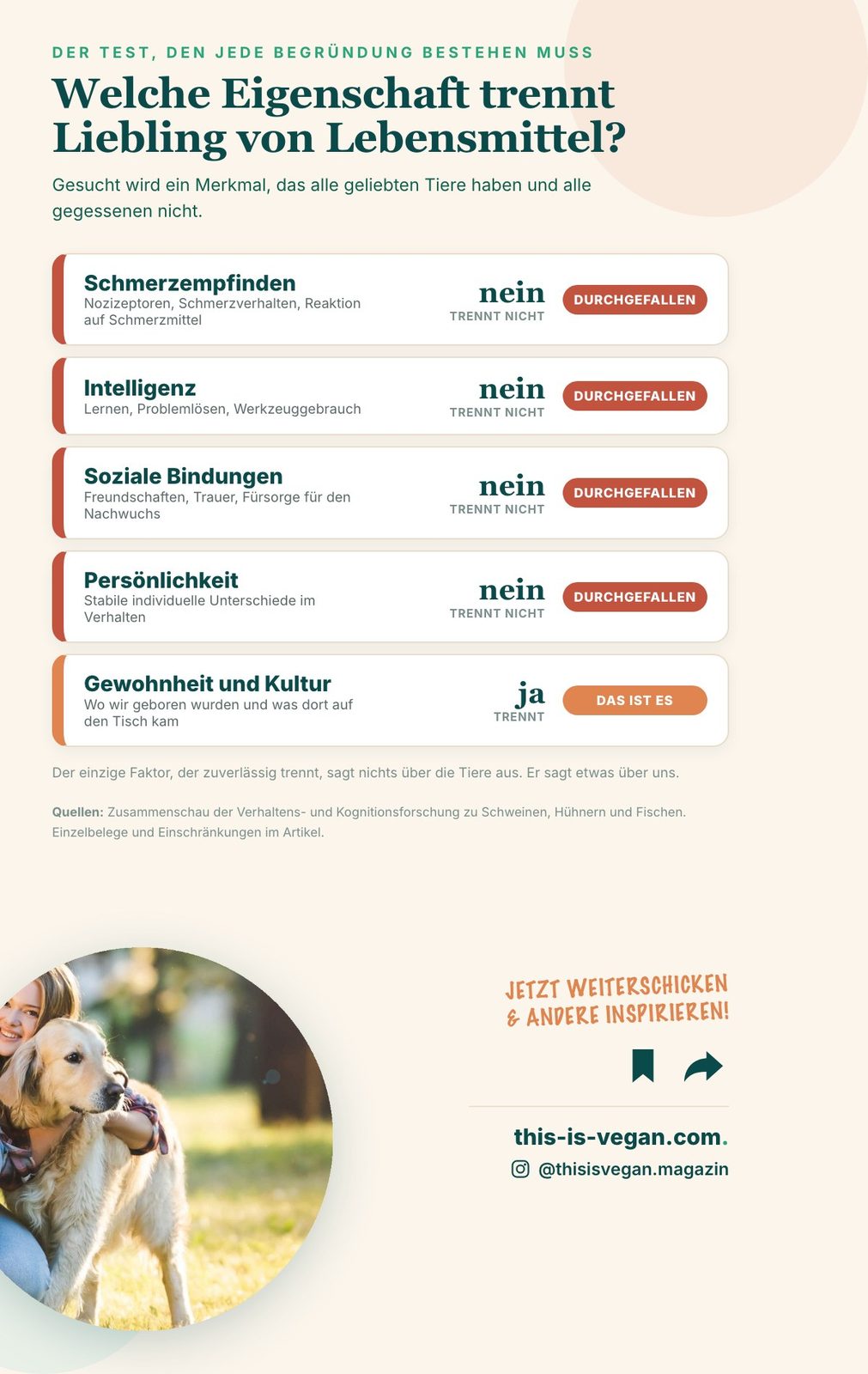
None of the candidates draws a clean line. Not pain, not intelligence, not social bonding, not personality. For every criterion there is an eaten animal that meets it, and often a loved animal that meets it less.
What remains is habit. Germans stroke dogs and eat pigs. Elsewhere the arrangement is reversed. The animals are not the variable.
Three objections worth taking seriously
“Comparing this to racism is offensive.” The comparison is between structures of thought, not between the suffering of those affected: group membership decides how much consideration you receive. Anyone who finds the parallel inappropriate still has to name the property that justifies the different treatment.
“Animals eat each other too.” True. They also have no alternative and no ethics. We have both. What happens in nature implies nothing about what we ought to do, otherwise almost any cruelty could be justified.
“Where do you draw the line?” This is the strongest objection and it has no comfortable answer. The evidence for insects and bivalves is thinner than for pigs. That is not a reason to carry on where the evidence is unambiguous.
What this looks like in practice
Ending speciesism sounds like a project measured in decades, and it is. The part that sits with any one person is considerably smaller.
- At the shop. Every meal decides whose interests count. Our 30-day plan breaks the switch down so it does not fail on the practicalities. It is in German, and it works with a translation tool.
- In conversation. The contradiction of loving animals and eating them is uncomfortable, and pressure makes it worse. We looked at the psychology behind it in “I love animals but I eat meat”.
- By looking. At a sanctuary you meet pigs who come when called. Our sanctuary atlas maps places you can visit across the German-speaking countries.
- By reading on. That ethical veganism is more than a dietary preference has been established by the European Court of Human Rights. We unpacked what the Strasbourg ruling means.
Why this can change
Speciesism is learned. Children do not arrive sorting dogs from pigs, they are taught it. What was taught can be taught differently.
That is the point of 29 August. Not to make anyone look bad, but to put a fairly simple question on the table: which property makes one animal a family member and the other a product?
Anyone who finds an answer that holds up should write it down. So far nobody has.
Sources and limits
German slaughter figures come from the Federal Statistical Office release on 2025 meat production: 640.3 million broilers plus 20.7 million stewing hens, 44.9 million pigs, 27.6 million turkeys, 8.3 million ducks. A figure of 48.5 million circulates for pigs alone; it in fact includes cattle, sheep, goats and horses. Fish do not appear as individuals in these statistics at all, and global numbers are estimates derived from catch tonnage.
The pig mirror experiment is Broom and colleagues, 2009; the failed replication is also published. The chicken mirror study appeared in Scientific Reports in 2024. Claims about nociceptors, pain behaviour and analgesia in fish rest on the review work of Lynne Sneddon and colleagues and the zebrafish studies cited. The dissenting position, which doubts conscious pain experience, is stated in the text.
It remains an open question whether pain experience in animals can ever be conclusively proven. The same holds for other humans, and there we draw no such conclusions.