







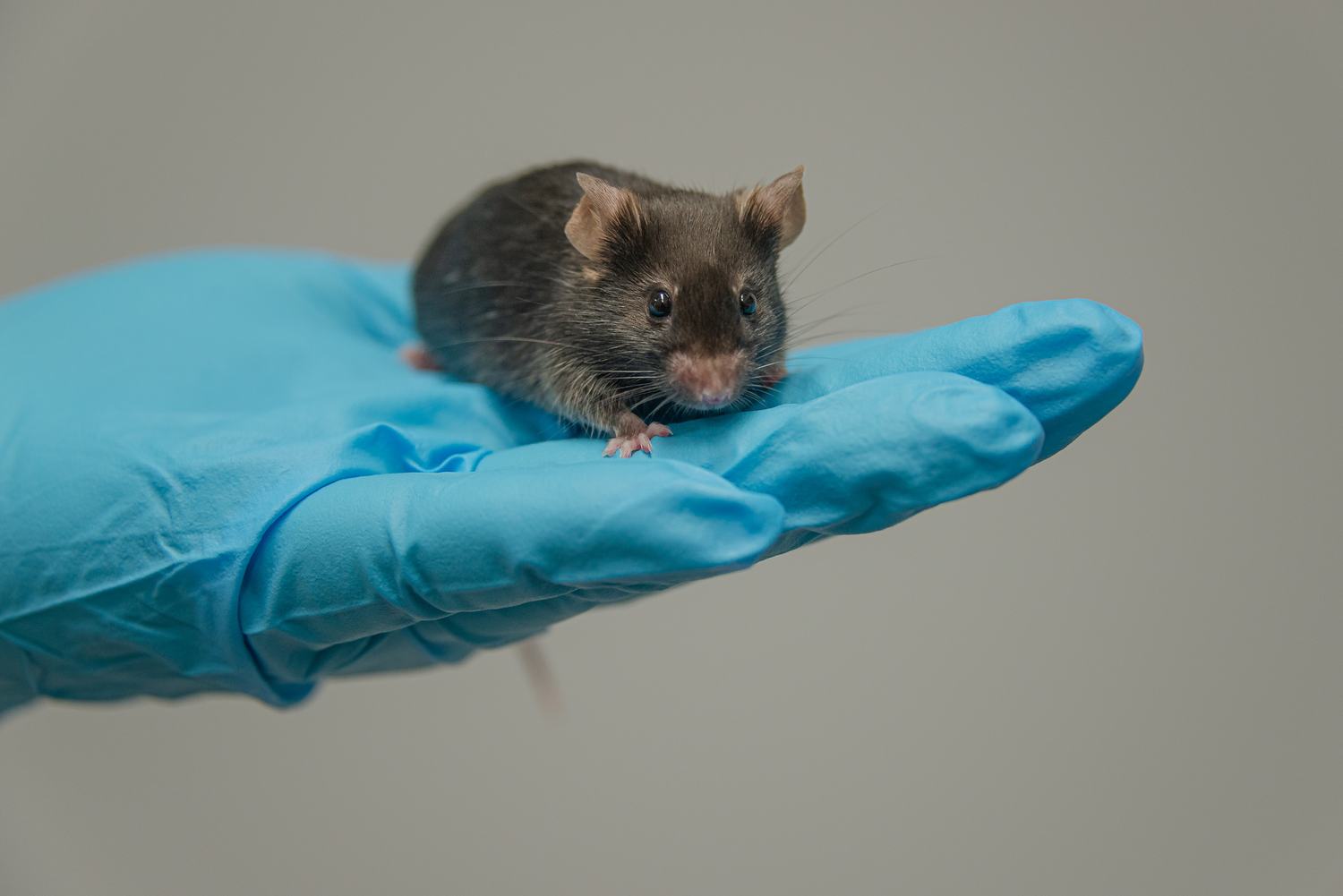
Almost two million animals die in German laboratories every year. The justification has stayed the same for decades: it serves medical progress, and there is no alternative. A major scientific analysis published in 2024 now challenges that reasoning with hard numbers. Of 100 compounds that successfully pass animal testing, only five ever receive regulatory approval.
That figure does not come from an animal rights group. It comes from an analysis in the journal PLOS Biology, authored by researchers at the University of Zurich and the University of Edinburgh.
Contents8 chapters
- 01What the study actually examined
- 02The honest caveat: what the study also found
- 03Nearly two million animals a year, in Germany alone
- 04What is technically possible today
- 05Why so little changes anyway
- 06What scientists on the inside say
- 07The question underneath
- 08Frequently asked questions about animal testing
What the study actually examined
The team led by Benjamin Ineichen did not evaluate a single study. They produced an umbrella review, meaning a review of reviews. They analysed 122 systematic reviews covering 4,443 animal studies and 1,516 clinical studies, spanning 367 therapeutic interventions across 54 different diseases.
To answer the decisive question of how much actually reaches patients, the researchers looked at 281 therapies whose first animal trials lay at least ten years in the past. The results are sobering.
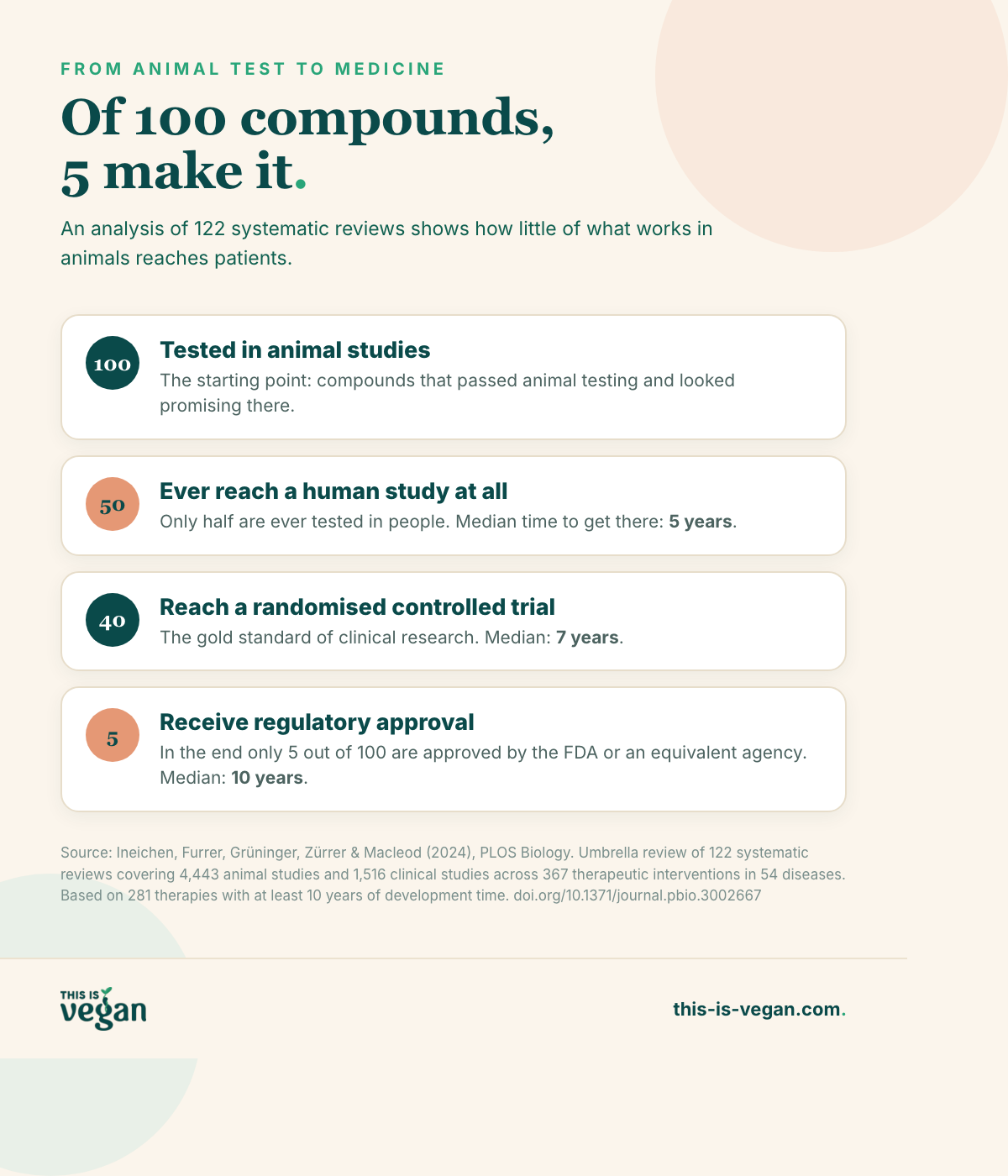
The path from animal study to approved medicine, in numbers. Feel free to save and share this graphic. If you use it elsewhere, please link back to this article.
Only half of the approaches that worked in animals were ever tested in humans at all. Forty percent made it into a randomised controlled trial, the gold standard of clinical research. And a mere five percent ultimately received approval from the FDA or an equivalent agency. Median time to get there: ten years.
The honest caveat: what the study also found
It would be easy at this point to take the headline number and move on. That would be dishonest, because the same study contains a finding that appears to point the other way. Between positive results in animals and positive results in humans, the researchers found 86 percent concordance. Where an animal study showed an effect, that effect frequently appeared in clinical studies too.
So how do these fit together? The authors themselves conclude that the low approval rate says less about overly strict regulators and more about design flaws in both the animal studies and the early clinical trials. Put differently: the system loses an enormous amount along the way, and animals pay for that with their lives regardless of whether a medicine comes out at the end.
There is a methodological point the study raises as well. A large share of the reviews analysed showed considerable quality problems, such as missing blinding or randomisation. Anyone defending the predictive value of animal research has to face that criticism too.
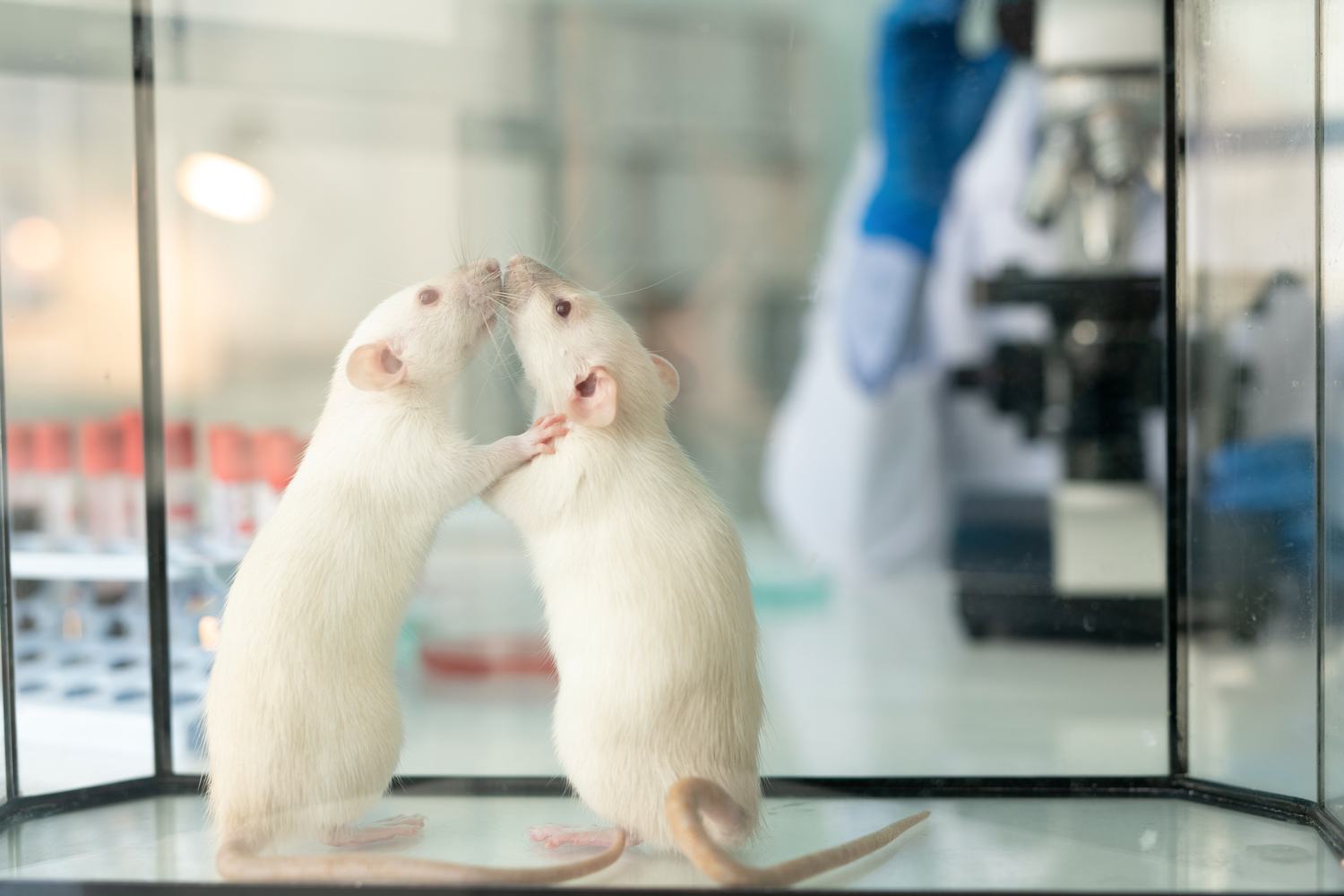
Rats and mice account for the vast majority of all animals used in research.
Nearly two million animals a year, in Germany alone
The scale becomes clear in the official statistics. For 2024, the German Centre for the Protection of Laboratory Animals at the Federal Institute for Risk Assessment reports 1,954,469 animals used for scientific purposes.
That number is only half the picture. Add the animals bred but never used in an experiment and killed afterwards as so-called surplus animals, and the total climbs to 3,063,569. More than a million animals die without ever having been part of an experiment. They simply had the wrong genetics or the wrong sex.
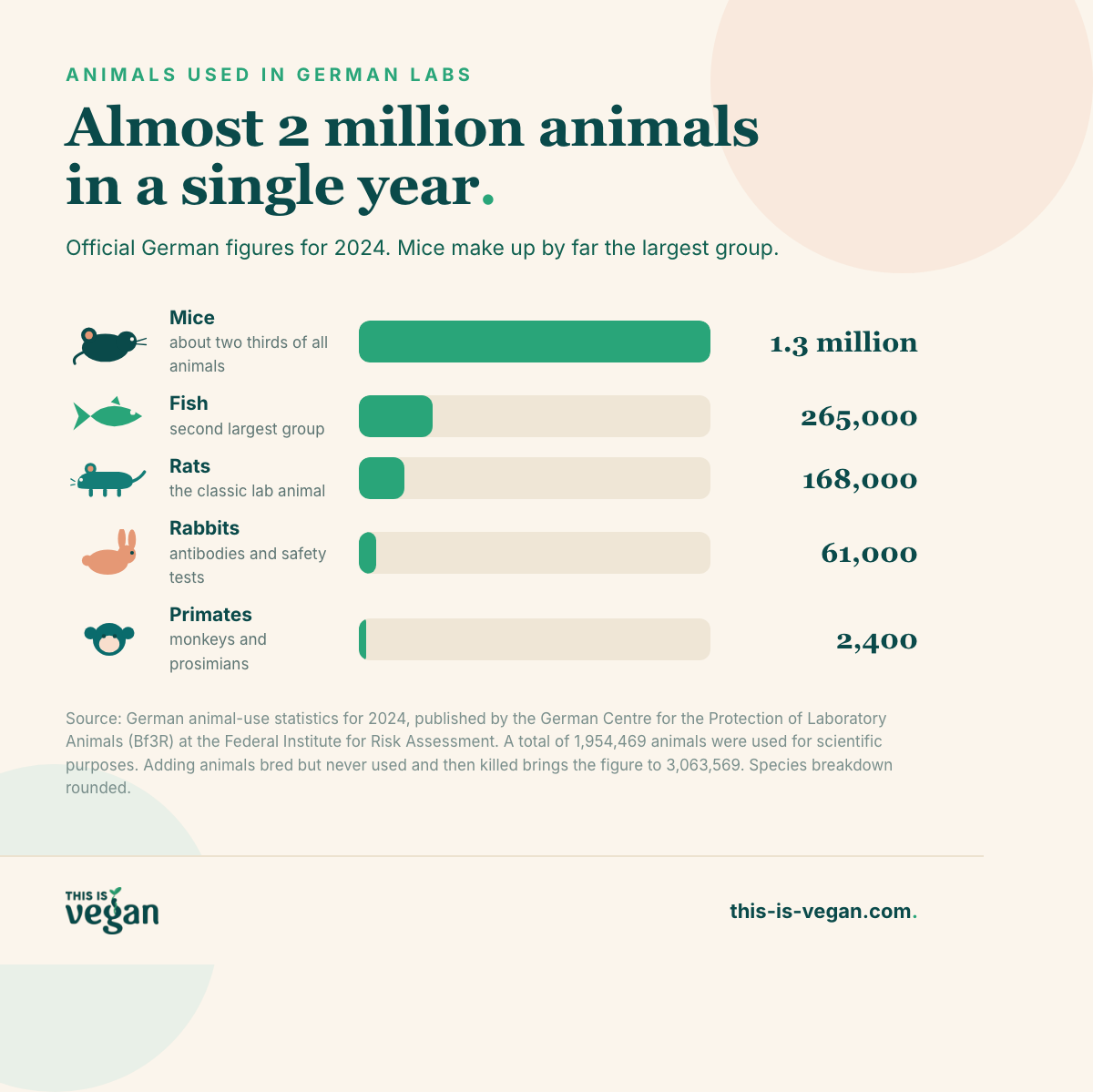
Almost two million animals were used in German laboratories in 2024. Feel free to save and share this graphic. If you use it elsewhere, please link back to this article.
There is some movement in the right direction. The figures have fallen for the fifth consecutive year, down roughly nine percent in 2024 compared with the year before, and for the first time since the turn of the millennium they sit below two million. The trend points the right way, just painfully slowly.
What is technically possible today
The strongest argument against animal testing is no longer purely moral. It has become scientific, because the alternatives have simply got better in many areas:
- Organ-on-a-chip: Human cells grow on microchips and reproduce functions of the liver, lung or kidney. These systems sometimes detect unexpected side effects more reliably than animal models, because they work with human tissue.
- Organoids: Miniature organs grown from stem cells, allowing disease processes to be studied directly in human tissue.
- Computer models and AI: Simulations predict how substances behave before an experiment even begins.
- Multi-organ systems: Several chip organs are linked together so metabolic pathways can be mapped across systems.
The decisive advantage is obvious. These methods work with human material, which sidesteps the very problem animal testing runs into: the species gap.
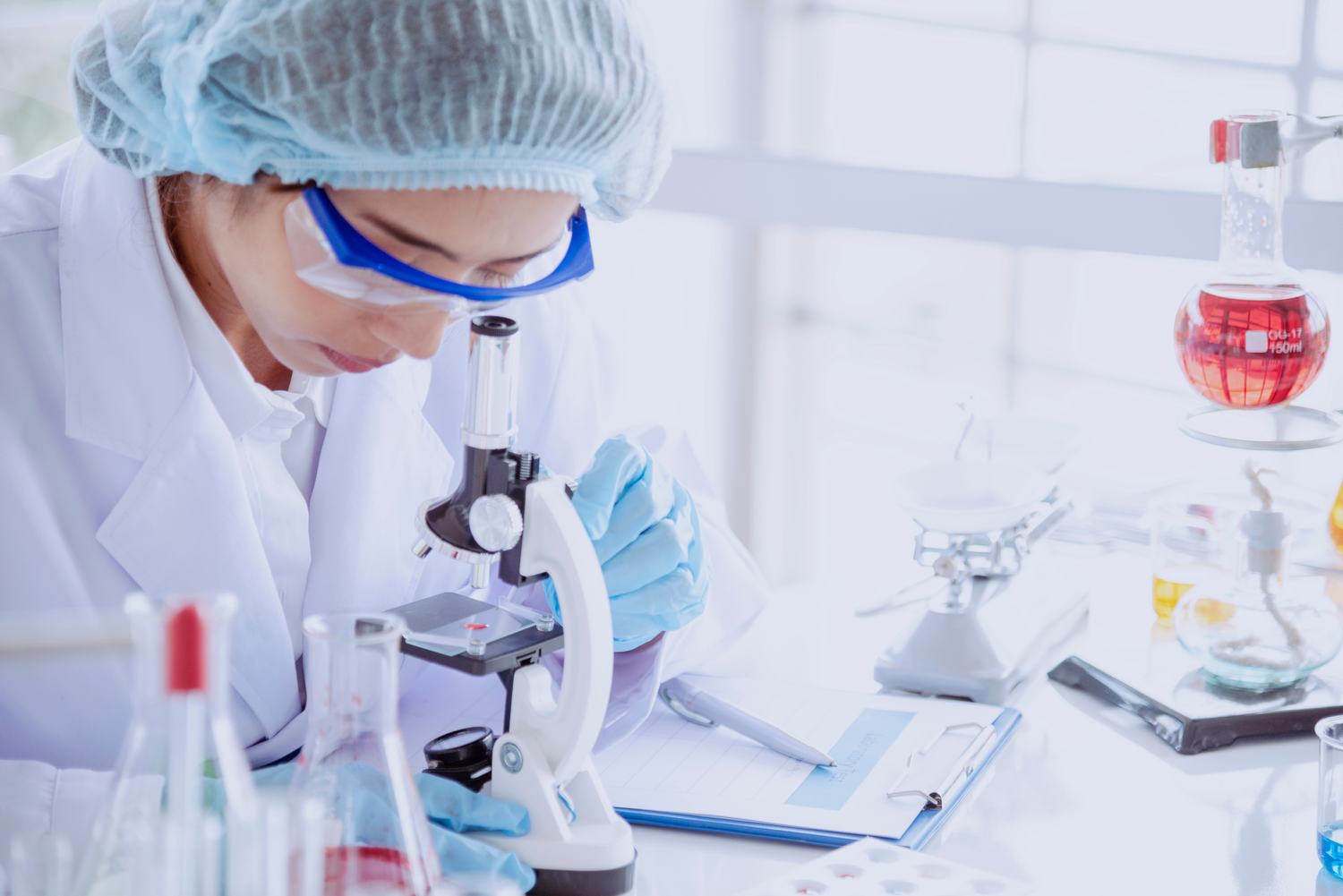
Organoids, organ-on-a-chip systems and computer models increasingly deliver more precise data than animal models.
Concrete examples show that things are shifting. The rabbit test used for decades has now been dropped, and in the United States several states are moving to ban animal testing for cosmetics and cleaning products.
Why so little changes anyway
If the alternatives are that good, why are almost two million animals still sitting in German laboratory cages? The answer has little to do with science and a great deal to do with inertia.
Regulatory frameworks still mandate animal data in many approval procedures, even where better methods exist. Research funding flows into established structures, and entire careers and institutes are built on animal models. A new method must be laboriously validated before it gains recognition, while animal testing as the incumbent standard has never faced the same burden of proof.
What scientists on the inside say
One perspective carries particular weight here. Dr Dilyana Filipova is a molecular biologist and geneticist who earned her doctorate at the University of Cologne and has worked since 2019 as a scientific advisor at the German association Ärzte gegen Tierversuche (Physicians Against Animal Testing). Crucially, she carried out animal experiments herself during her doctoral work and describes how much it affected her, to the point of nightmares before lab days. That insider experience makes her scientific criticism considerably harder to dismiss.
The association also runs the NAT Database for Non-Animal Technologies, connecting researchers worldwide with animal-free methods and studies. Anyone wanting to know what alternatives concretely exist will find the professional starting point there.
The full conversation is also available as a video:
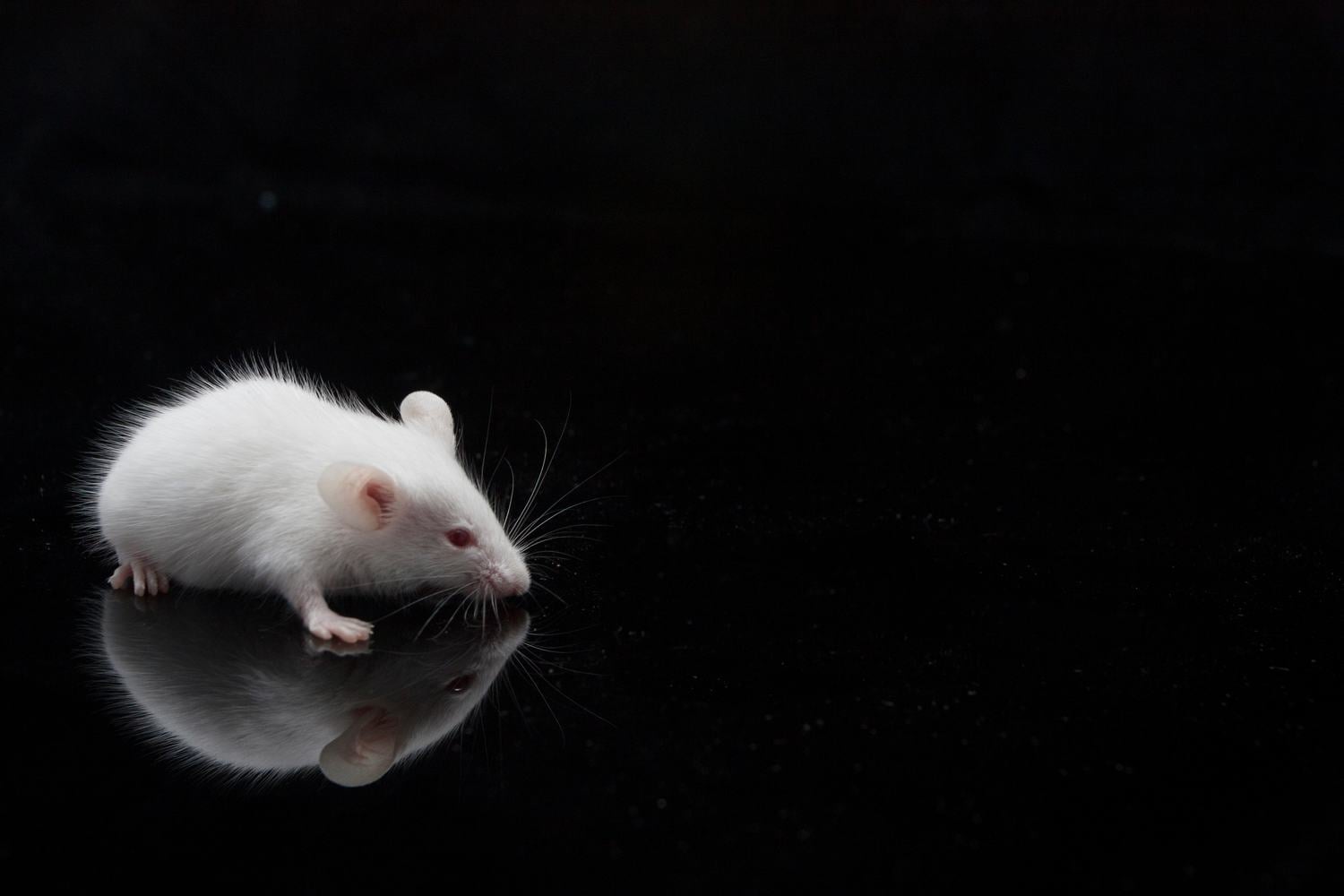
Behind every figure in the statistics stands one individual, sentient animal.
The question underneath
In the end the debate comes down to a point no statistic answers on its own. Even if animal testing worked more reliably than it does, the ethical question would remain: may we weigh the suffering of sentient beings against a possible human benefit?
The numbers from the Zurich analysis only make that question more pressing. They show that the promised benefit fails to materialise in the overwhelming majority of cases. Five out of a hundred. For the other 95, animals died without a medicine ever coming of it.
If you value independent reporting on issues like this, you can support This Is Vegan here.
Frequently asked questions about animal testing
How many animals are used for research in Germany?
In 2024, 1,954,469 animals were used for scientific purposes. Counting animals bred but never used and subsequently killed as surplus brings the total to 3,063,569.
Is animal testing legally required?
In certain approval procedures, particularly for pharmaceuticals, regulations still demand data from animal studies. For cosmetics, by contrast, the EU has banned the sale of animal-tested products since 2013.
Which animals are used most often?
Mice make up by far the largest group at roughly two thirds, followed by fish and rats. Rabbits and primates account for a small share numerically.
Do functioning alternatives really exist?
Yes. Organ-on-a-chip systems, organoids grown from human stem cells and computational models deliver more precise data in many applications, because they work with human tissue rather than animal models.
What can I do myself?
Choose cosmetics and household products carrying recognised cruelty-free certification, support organisations working on animal-free research, and sign relevant petitions.
FAQ - What readers ask
How many animals are used for research in Germany?
Is animal testing legally required?
Which animals are used most often?
Do functioning alternatives really exist?
What can I do myself?
Want our reporting to show up first in Google's Top Stories? Add This Is Vegan as a preferred source on Google.