





Ginger: What It Actually Does and What It Does Not

+22
99 episodes so far with guests like Christopher Hollmann, Dr. Mark Benecke or Maya Leinenbach
Listen to the Podcast →6 min read

Nothing sold out in health food stores at the beginning of the Corona pandemic as quickly as the tuber everyone suddenly wanted ginger. The yellowish-gray tuber had suddenly become one of the most sought-after objects, bought in the hope that it would ward off infections. But does the root live up to its promise and what is the effect of ginger all about?
Wow, that’s hot. Meant perhaps the pumpkin soup, which got the certain kick with grated ginger. Or the hot tea in which thin slices of ginger float and give off the fiery lemony aroma. In Asia and India, this spiciness has been known and wanted for thousands of years. Even more – there it has long been one of the most valued plants in traditional medicine. Where did you encounter the root or when did the effect of ginger really convince you? Here’s a bit of history and more. Because that’s what this tuber deserves!
The healing properties of ginger played a major role in ancient Chinese and Indian medicine and spread to Europe in late antiquity. Confucius is said to have prescribed ginger for motion sickness. Coming from southern China, the plant passed through Greece to Italy and finally – through the Romans – across the Alps. As a spice, it is still indispensable in Indian and Chinese cuisine.
Also in monastic medicine ginger was one of the most frequently mentioned plants. It was given there for digestion, for coughs and other complaints of the airways, and for liver trouble, eye opacity and a sore throat. That is a record of how people used the root centuries ago, not a list of proven effects. But the effect of ginger has been tested in the lab for antibacterial and antiviral activity, and some of those cell studies look interesting. Whether any of it survives the trip into a human body, and into a cup of tea, is the question the evidence has not answered. What the root reliably does is warm you up.
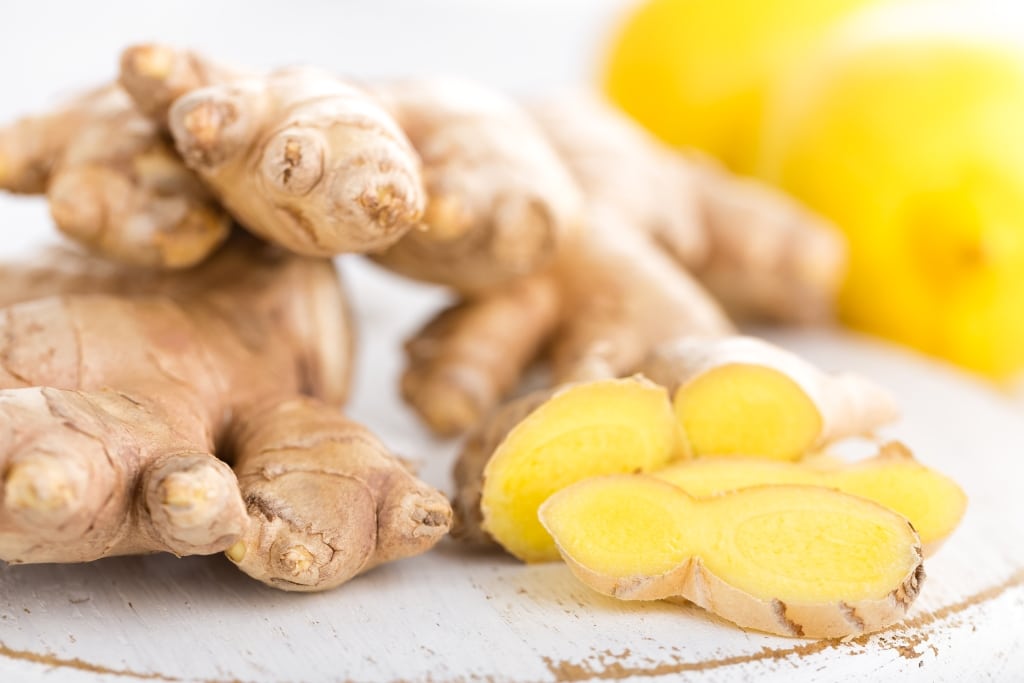
On what this yellow-white tuber contains. These are vitamins such as vitamin C and trace elements such as magnesium, iron, calcium, potassium and phosphorus. In addition, the gingerol, which gives the ginger the pungency.
Yes! Much of the gingerol sits directly under the peel, so it is better to use the ginger root with the peel. To feel safer doing this, you can gently brush ginger with a vegetable brush and rinse with clean water.
You have a cold, you are cold and even have chills? Then you may trust the warming effect of Gingerol and Shoagol, which are found in the ginger root. Crush the ginger root, thinly slice or coarsely grate and add about a teaspoon to a large cup or small teapot. Then pour boiling water over it. To increase the effect you can steep the ginger in boiling water for a few minutes. Feel free to add some honey to sweeten it up. The hot ginger drink will quickly warm you from the inside. In addition, the effect of ginger is expectorant and improves circulation.
In case of nausea, it is recommended to take one gram of freshly cleaned ginger with some liquid. However, the daily dose should not exceed four grams of ginger. For travel, it is recommended to take ginger as a tincture. Dissolve 20 drops of ginger tincture in a glass of lukewarm water and drink 30 minutes before meals or before traveling.
Ginger is a very stimulating spice. If you are prone to heartburn, ginger can exacerbate this. Pregnant women and children are not recommended to use the tuber, and in case of fever over 38 degrees, it can, since it stimulates the circulation, additionally burden it It is recommended not to take more than 40 grams of ginger a day. Especially people who take medication for blood thinning should note that ginger enhances this effect.
We can be happy that nature has so many healthy things in store for us. Ginger plays a very special role here and belongs to many people not only to the “natural medicine cabinet”, but to the daily healthy enrichment. That again and again new ideas appear, which of an optimal effect of ginger with small in addition, large health problems, one may regard calmly somewhat with skepticism and inform oneself simply well.
Especially in summer, the tuber can also have a cooling effect, which you can combine with pleasure.
Simply boil your favorite tea , let cool, dress with ginger and fruit, refrigerate and enjoy as a refreshing summer cocktail. Also particularly tasty: Infused Water – simply take water with a ginger tuber and lemon slices to work, sports or hiking. Our tip for the cold season on top: Organic oregano oil
Sources: www.gesund.at, “Handbuch der Klosterheilkunde”, Zabert Sandmann Verlag
In cooperation with www.naturundich.bio
On our pages you will find so-called affiliate links. If you buy your favorite products through them, we will receive a commission.
By buying sustainable reusable cups from us, you support, for example, the Papillon mercy farm.
Alternatively, you can follow us here on Instagram here directly support:
Danke. 💚
Input your search keywords and press Enter.
The top 5 of the past four weeks.
Once a week: the best recipes, events and exclusive deals, straight to your inbox.
Sign up freeIndependent and free to read. Every donation makes us a little less dependent on ads.
Donate nowIndependent magazine for vegan living, animal protection and sustainability.
Reach people who decide what goes into their cart by values.
A word from us
TIV is independent, light on ads and firmly on the animals' side. If this article was worth something to you, help carry the movement a little further.
Donate now →🔒 Secure via credit card, Apple Pay, SEPA & PayPal · any amount works
Then follow us instead, it costs nothing and keeps us going. A follow, a comment or a share already helps a lot:
And on Spotify, a positive rating for the Plantbased Podcast makes our day. It takes 10 seconds and gives us a mighty push.
Newsletter · free
New tests, recipes and real research, plus the discount codes from our partners. No spam, one click to unsubscribe.