







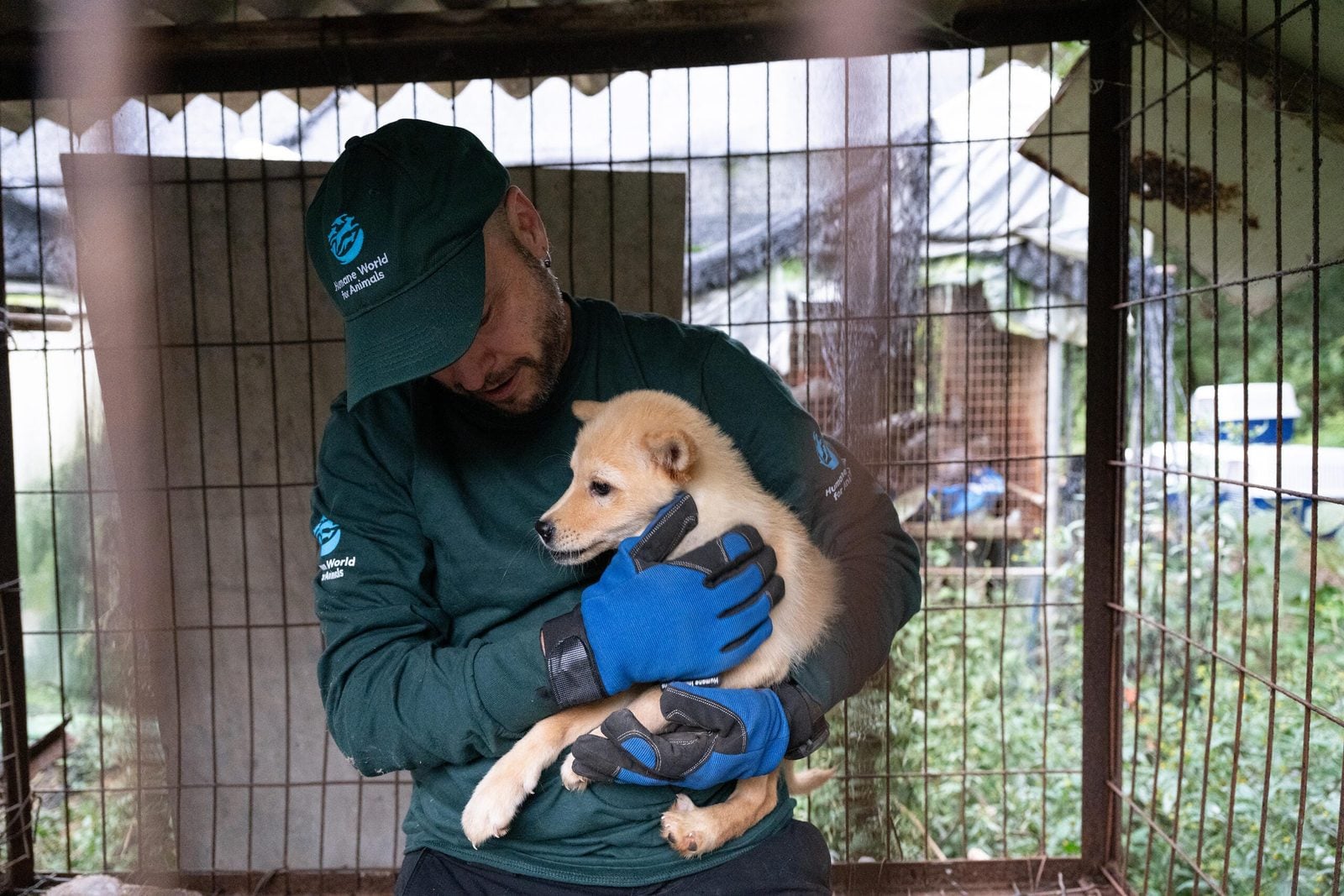
Just months before South Korea’s ban on the dog meat industry takes full effect, Humane World for Animals has rescued more than 70 dogs from a farm in Gangjin. It is the organization’s last large-scale rescue in the country and the end of a mission that began in 2015. The good news comes with a grim footnote: of the dogs on farms that have already closed, only a tiny fraction made it out alive.
Key facts
- The rescue: More than 70 dogs from a farm in Gangjin, including Jindos, a German Shepherd, a Corgi mix and a Husky mix. They will be adopted in the US and Canada.
- The ban: From 7 February 2027, breeding, slaughtering or selling dogs for human consumption is illegal in South Korea, punishable by up to two years in prison.
- The toll: 82 percent of registered dog meat farms have already closed. But of about 394,000 dogs on those farms, only around 0.3 percent got out alive.
Contents5 chapters
The last large-scale rescue.
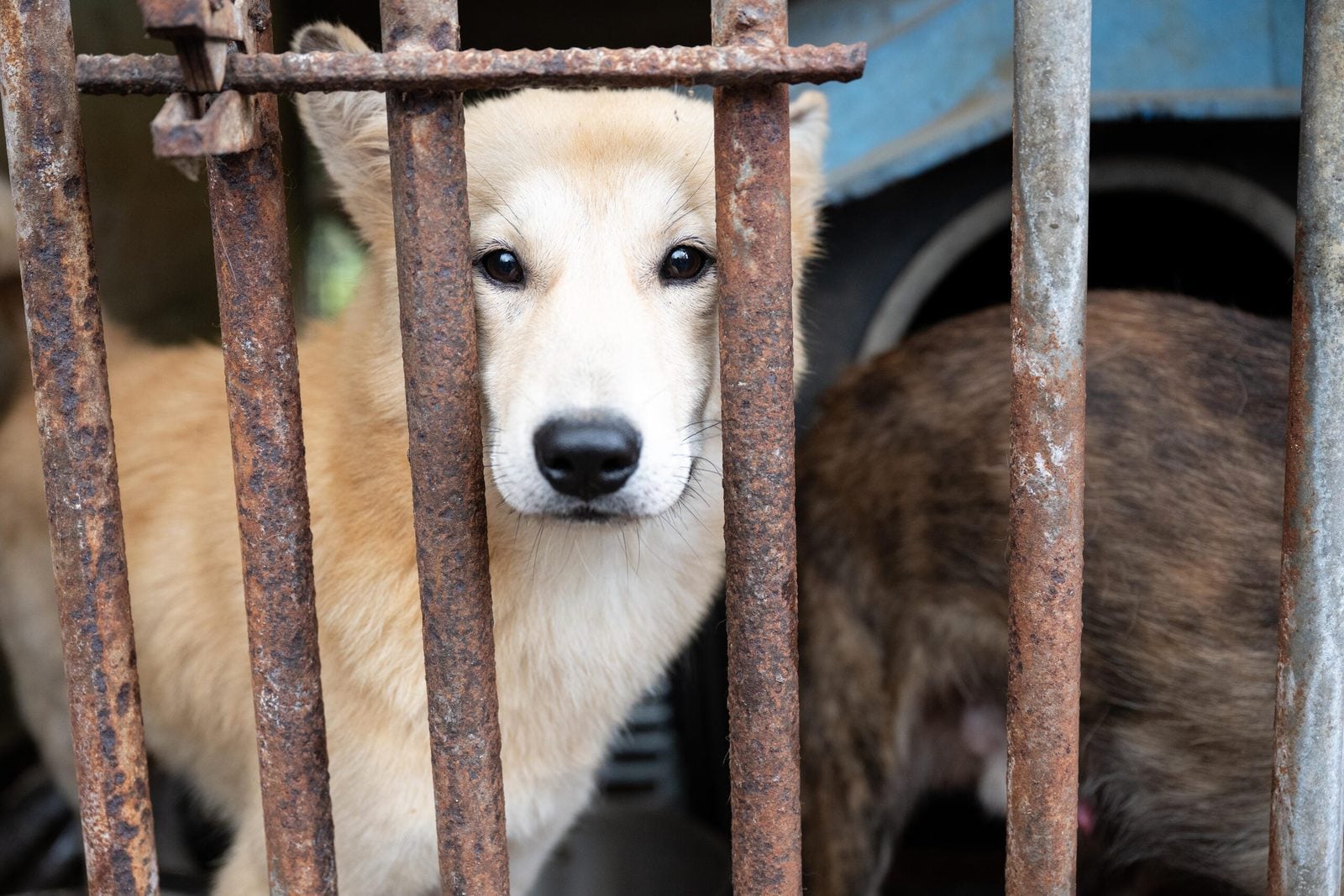
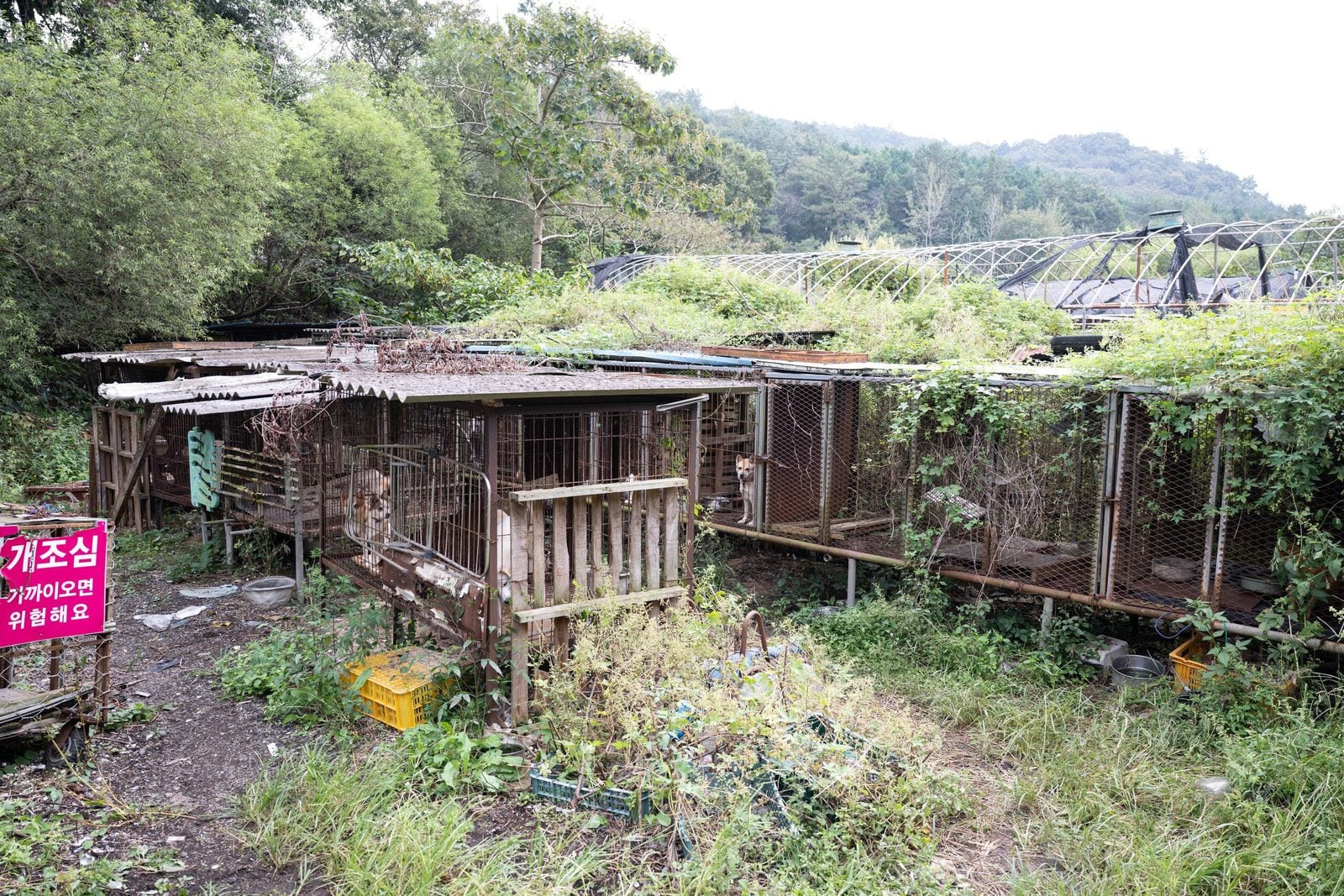
According to Humane World for Animals, the farm in Gangjin in the south of the country once bred and slaughtered up to 1,000 dogs a year. When the rescue team arrived, they found rows of rusting cages, most of them empty, with old collars and the jawbones of long-dead dogs scattered on the ground. The organization learned about the farm earlier this year after a member of the public contacted a local animal group. Together they alerted the authorities, who took action against the farmer for violating the Animal Protection Act.
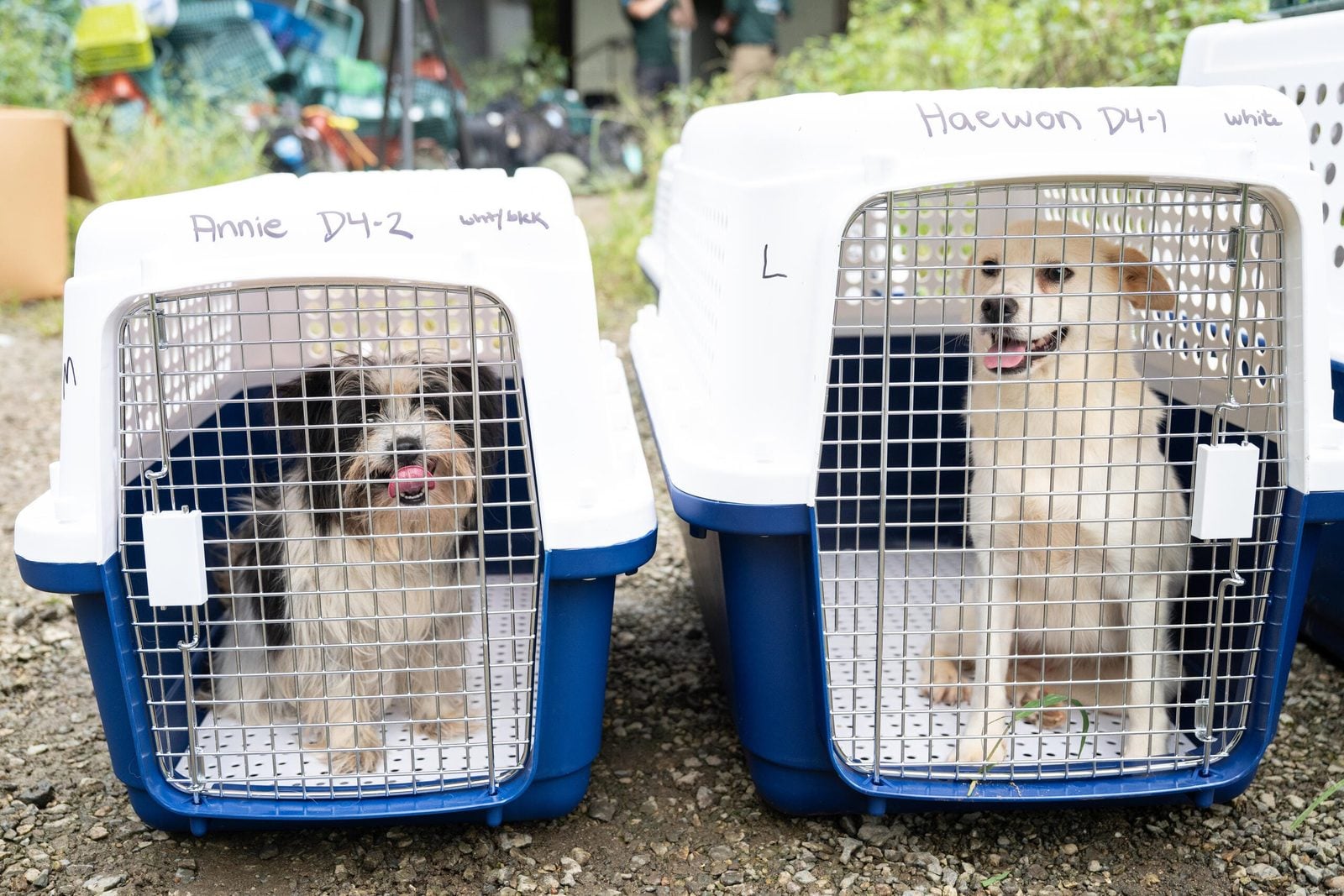
The 80-year-old farmer agreed to hand over the remaining dogs and signed a pledge to leave the dog meat trade for good. Before their flight, all dogs were examined by vets and vaccinated against rabies, distemper, parvovirus and other diseases.
“These 70 dogs are among the very last to suffer in this dying industry,” says Sangkyung Lee, campaign manager at Humane World for Animals Korea. Since 2015, the organization has taken almost 3,000 dogs off South Korean dog meat farms. With Gangjin, that work comes to an end. From now on, the focus is on monitoring whether the ban is enforced.
What the ban covers.
South Korea’s National Assembly passed the special act ending the dog meat industry unanimously in January 2024. It came into force in August 2024 with a three-year transition period. From 7 February 2027, it will be illegal to breed, kill, slaughter or sell dogs or dog meat for human consumption. Offenders face up to two years in prison or a fine of up to 30 million won, which Humane World for Animals puts at around 20,600 US dollars.
When the law passed, the Ministry of Agriculture counted 5,898 businesses in the trade: 1,537 farms, 221 slaughterhouses, 1,788 traders and 2,352 restaurants. In May 2026, the ministry reported that 1,265 farms, or 82 percent, had closed, with 272 still operating. In the same month, it announced measures to speed up the closure of the remaining farms, including on-site inspections over the summer.
Public opinion has shifted too. According to a Nielsen poll commissioned by the organization, 86 percent of people in South Korea have no interest in eating dog meat.
The bitter number: 0.3 percent.
As important as the ban is, for most dogs on the farms it came too late. According to ministry figures reported by the Korea JoongAng Daily, 393,857 dogs lived on the farms that have already closed. About 381,000 of them, roughly 97 percent, were slaughtered or passed on to other farms, including 9,358 moved to other farms. Only 623 were adopted and 498 handed over to public shelters. That is 1,121 dogs in total, or about 0.3 percent.
Overall, the ministry says the number of dogs on farms dropped from around 466,000 in May 2024 to between 20,000 and 30,000 by summer 2026. The end of an industry does not automatically mean rescue for the animals trapped in it. And even with more will, the country’s shelters could hardly have taken in hundreds of thousands of large dogs that had spent their lives in cages.
Why dogs, and not pigs?.
Pictures of dogs in cages rightly shock many people in Europe and North America. According to the organization, the dogs on these farms lived in small, barren wire cages without enough food, water, shelter or veterinary care, and were killed by electrocution. Yet much of this is everyday reality for animals closer to home. Millions of pigs are kept in cramped pens and, in Germany, most are stunned with CO₂ at slaughter, a method that causes panic and breathlessness. Our article on the German slaughterhouse trial Moby supports shows what that means for the animals.
A pig can suffer just as much as a dog. Petting one animal and eating another is a cultural habit, not a biological fact. South Korea shows that such habits can change within a few years.
What happens next.
The dogs from Gangjin will first go to a rehabilitation center in the US and then to adoptive families in the US and Canada. In South Korea, Humane World for Animals will monitor how the ban is enforced. Elsewhere in Asia, the organization says it continues to work against the dog and cat meat trade in Vietnam, Indonesia and India, and in China through a partnership with a Chinese animal protection group. More information is available on the Humane World for Animals website.
Sources ●
Press release by Humane World for Animals, 30 September 2026. Farm and closure figures: South Korean Ministry of Agriculture, 14 May 2026. Figures on what happened to the dogs: Korea JoongAng Daily, based on ministry data. The 86 percent figure comes from a Nielsen poll commissioned by the organization. Photos: Humane World for Animals. This article is not sponsored.
Want our reporting to show up first in Google's Top Stories? Add This Is Vegan as a preferred source on Google.