







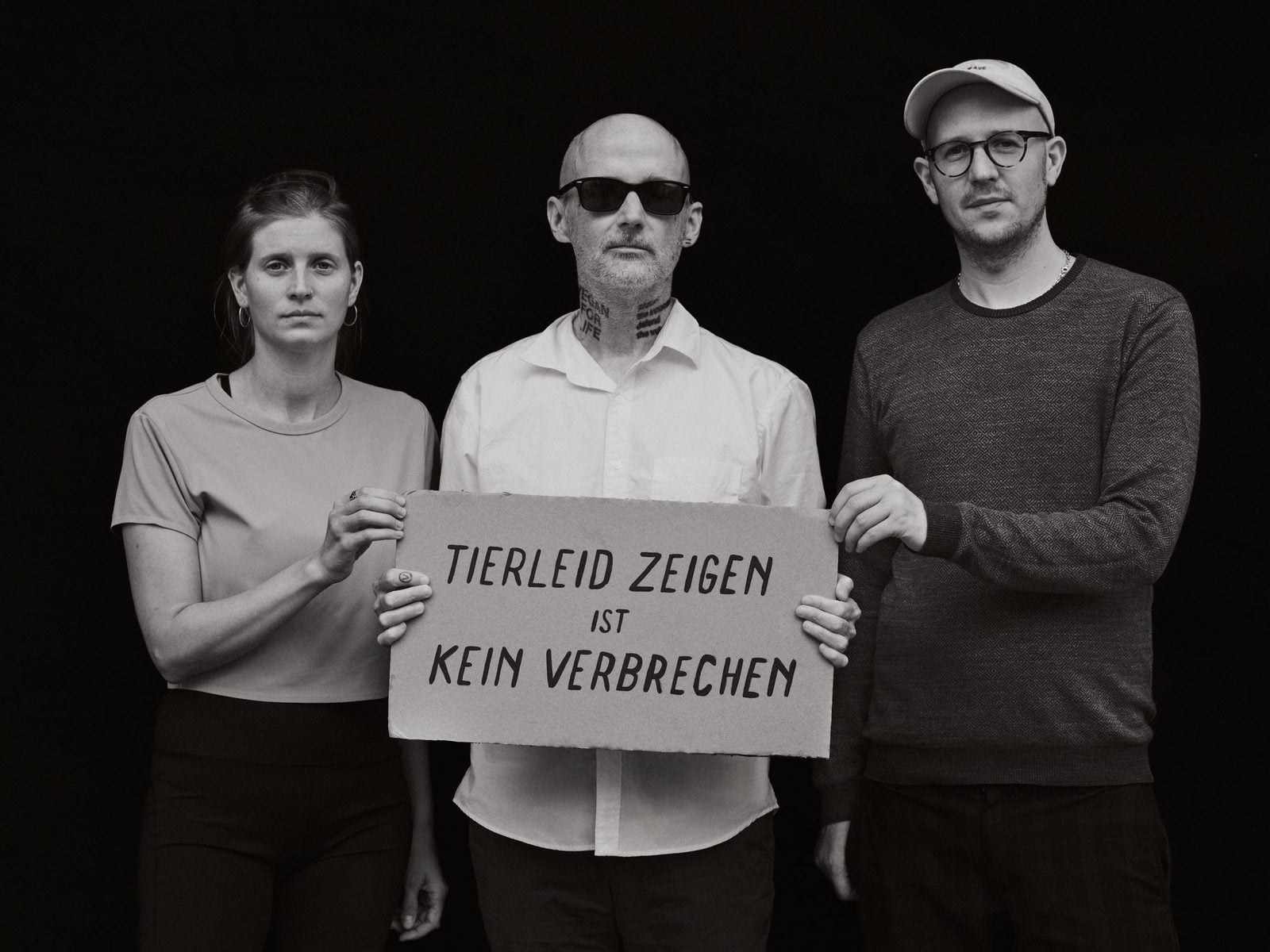
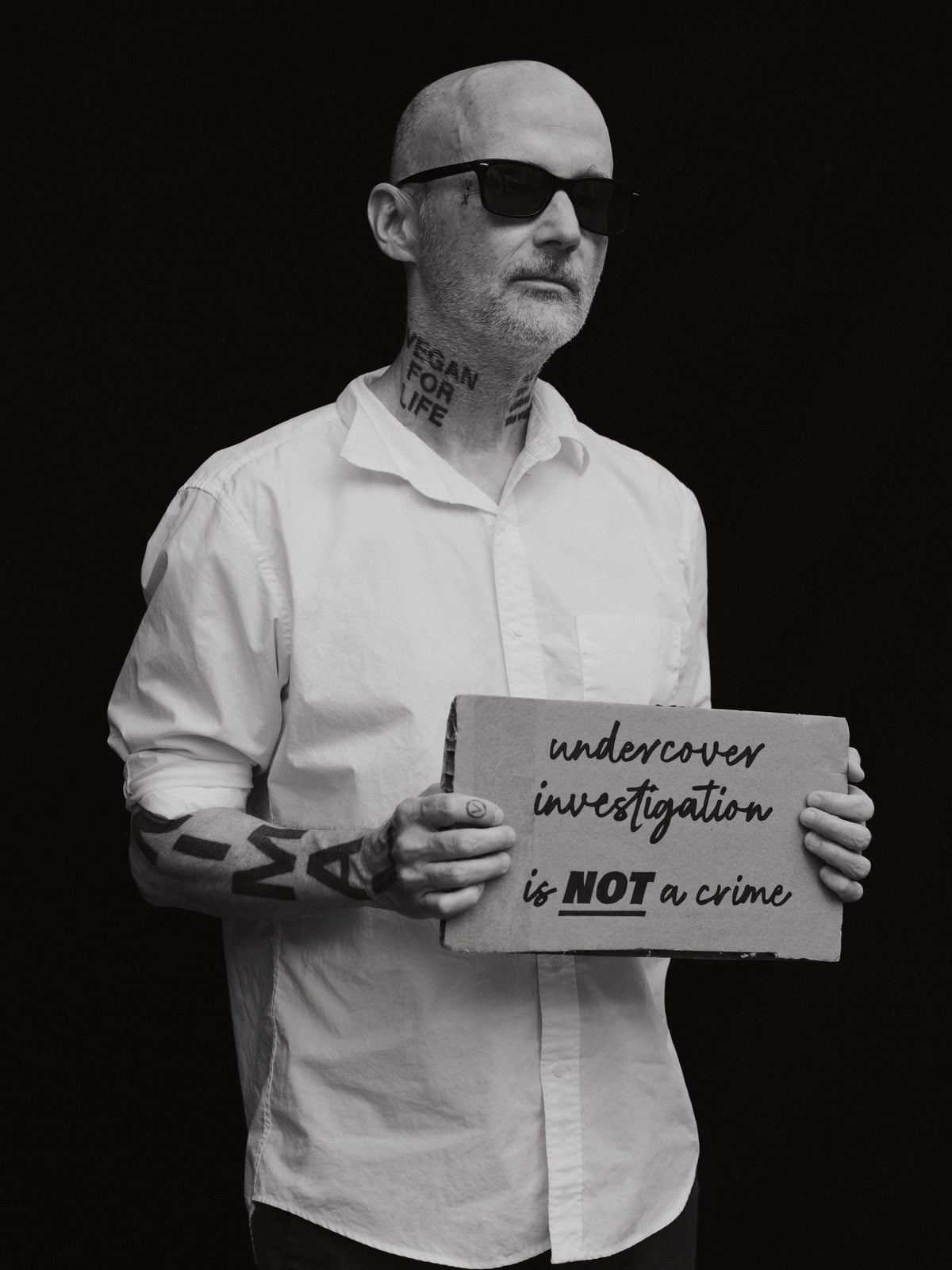
Moby is backing Anna Schubert and Hendrik Haßel, two German animal rights activists who secretly filmed pigs being stunned with CO₂ in a slaughterhouse in Lower Saxony and were sued by the company for it. On 24 September 2026, the campaign account @schlachthofprozess (“slaughterhouse trial”) published photos of the musician with both of them, holding a cardboard sign: “Undercover investigation is not a crime”. The photos were taken by Aglaja Brix.
In short: what is this about?
In 2024, Anna Schubert and Hendrik Haßel used hidden cameras to document how pigs are stunned with CO₂ at a slaughterhouse in Lohne, Germany. In June 2026, the Higher Regional Court of Oldenburg ruled that they are liable in principle for the company’s damages. The amount has not been set yet. Moby supports them publicly.
Contents6 chapters
What Moby is standing up for.
The campaign’s bilingual post, geotagged in Berlin, says Anna and Hendrik documented how pigs suffocate during CO₂ stunning, a method used on countless pigs worldwide. They were sued, are supposed to pay damages and may no longer show their own footage. “@moby stands with Anna and Hendrik,” the post reads. It calls for people who go behind closed doors to make animal suffering visible, and says that instead of silencing those who expose it, the suffering itself has to end.
Undercover investigation is not a crime
The post by @schlachthofprozess featuring Moby, on Instagram.
The slaughterhouse trial at a glance.
In spring 2024, Anna Schubert and others installed hidden cameras at night in the Brand Qualitätsfleisch slaughterhouse in Lohne, Lower Saxony. The footage shows groups of pigs being lowered into a pit of highly concentrated carbon dioxide. The organisation Animal Rights Watch published it, and German public broadcaster ARD picked it up. The company responded with a criminal complaint and a civil lawsuit.
The Regional Court of Oldenburg ruled on 11 June 2025. On appeal, the Higher Regional Court of Oldenburg delivered its judgment on 9 June 2026 (case no. 13 U 45/25):
- Liability in principle: both are liable for the damage caused by the recordings and their distribution. The amount will be decided in separate proceedings.
- Injunction and ban from the premises: Anna Schubert must stop distributing the footage, and neither may enter the site again.
- No blanket ban: the court rejected a broader ban on future publications. Posts by third parties remain lawful.
- No appeal allowed: the two announced they would challenge this at the Federal Court of Justice. We have not found a decision on that so far.
A statement by the Lower Saxony food safety authority LAVES, which fed into the judgment, found that the legal maximum of 20 to 30 seconds between stunning and sticking “appears not to have been met in any case”. It measured at least 45 to 55 seconds, and more than three minutes for individual animals.
We analysed the full 72-page judgment here: Slaughterhouse trial in Germany: what the Oldenburg verdict means.
Moby and animal rights.
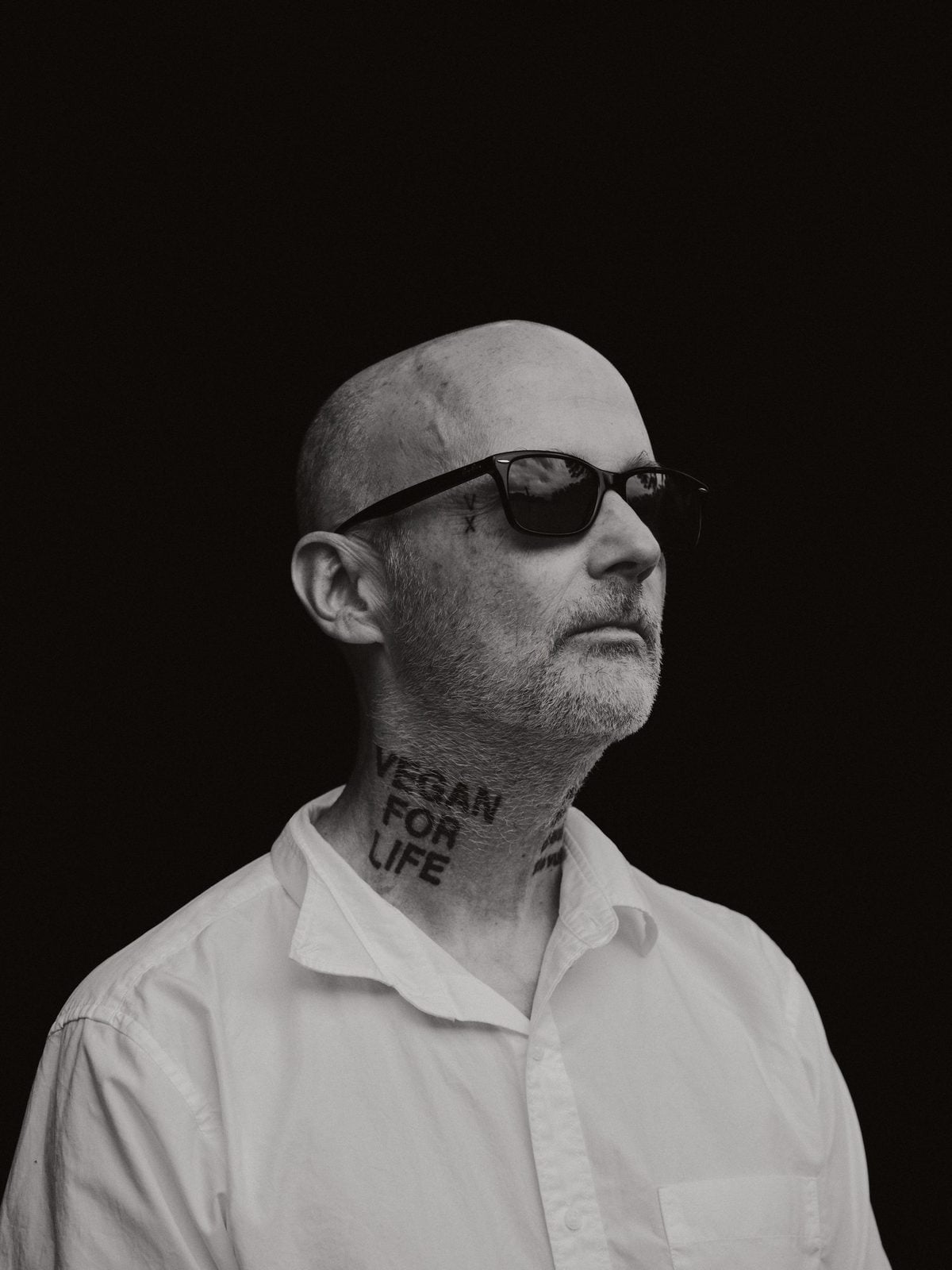
Moby has been vegan since 1987 and has spoken about animal rights for decades. “Vegan for Life” is tattooed on his neck, “Animal Rights” on his forearms. We tell the full story here: Is Moby vegan? With his support, a German court case reaches an audience far beyond Germany.
Behind the camera: Aglaja Brix.
The photos were taken by Aglaja Brix. In Germany, many know her as Vivi from the children’s TV series “Die Pfefferkörner”. Today she works as a photographer and animal rights activist. She was a guest on our Plantbased Podcast (in German):
Why this footage matters.
Around 80 percent of pigs slaughtered in Germany are stunned with CO₂. They are lowered in gondolas into a shaft with a carbon dioxide concentration of around 90 percent. The gas irritates the mucous membranes, and the pigs gasp for air and panic before losing consciousness. The European Food Safety Authority criticised the method as early as 2004 and recommended phasing it out. It is still legal under EU law, mainly because it is fast and stuns many animals at once.
How long the death struggle lasts
How long a pig stays conscious in the gas can be measured with brain recordings (EEG). In a 2016 study by Verhoeven and colleagues, pigs lost consciousness after 33 seconds on average at 95 percent CO₂ and after 47 seconds at 80 percent, counted from the moment the gondola starts descending into the pit. Individual pigs remained conscious for up to 61 seconds. A research team led by Pilar Rodríguez found around 60 seconds at 90 percent CO₂ in 2008. A scientific review puts the range for pigs at 33 to 60 seconds. EFSA usually assumes up to 30 seconds, and its 2020 opinion rates high CO₂ concentrations as “highly aversive”, causing pain, fear and respiratory distress.
What happens during that half minute to a full minute is well documented. The pigs sniff, back away, throw their heads from side to side, jump and gasp for air, all before they lose consciousness. In the Rodríguez study, gasping began after about 23 seconds and the animals started to vocalise after about 26 seconds. A pig that collapses is not necessarily unconscious: in the 2016 study, the animals lost their posture about ten seconds before they lost consciousness. EFSA lists high-pitched vocalisations, escape attempts, hyperventilation and head shaking as signs of pain, fear and respiratory distress during CO₂ stunning.
Official accounts sound far more harmless. Answering a parliamentary question from the Greens in 2006, Germany’s agriculture ministry said the pigs were exposed to stress for about 10 to 20 seconds (Bundestag document 16/2396, in German). The later measurements show that the animals stay conscious in the gas for up to three times as long. In a position paper of 25 March 2026, the German meat industry association VDF calls the method particularly safe and stresses that the pigs move calmly as a group on their way in. The phase in which the animals fight for air is not mentioned at all.
The 45 to 55 seconds that the Lower Saxony food safety authority LAVES measured on the footage from Lohne describe a second interval: the time between stunning and sticking. The legal limit of 20 to 30 seconds is meant to ensure the animals stay stunned until they die. Back in 2012, the German government admitted that certain stunning systems, known as backloaders, cannot meet this limit by design (Bundestag document 17/10021, in German). In our view, talking about a few seconds plays all of this down. Half a minute to a full minute in the gas, gasping for air and trying to back away, is an agonising death struggle. In Germany, it happens millions of times a year.
The public almost never sees what happens inside slaughterhouses. Violations often only come to light through footage like the recordings from Lohne. Yet even a stunning carried out by the book does not make killing fair to an animal that wants to live.
How you can support Anna and Hendrik.
- Sign the petition: according to schlachthofprozess.org, more than 40,000 people have signed (as of 25 September 2026).
- Donate: the two cover their legal costs themselves. Note that the donation page is not run by a registered charity. The account is held privately by Anna Schubert.
- Share: posts by third parties were explicitly ruled lawful. Follow @schlachthofprozess for updates.
Stay up to date
We follow the case. Get the latest vegan news once a week, free and easy to unsubscribe.
Credits and sources ●
Photos: Aglaja Brix, @studio_aglajabrix and @aglaja_brix, used with permission. Video in the embedded post: Till Feldt, @till1feldt.
Sources: the Instagram post by @schlachthofprozess of 24 September 2026, the press release of the Higher Regional Court of Oldenburg on the judgment of 9 June 2026, the judgment itself (13 U 45/25) and schlachthofprozess.org. Times to loss of consciousness: Verhoeven et al. 2016, Frontiers in Veterinary Science (DOI 10.3389/fvets.2016.00038); Rodríguez et al. 2008, Animal Welfare (DOI 10.1017/S0962728600027834); Steiner et al. 2019, Animals (DOI 10.3390/ani9110911); EFSA, Welfare of pigs at slaughter, 2020 (DOI 10.2903/j.efsa.2020.6148). Government statements: Bundestag documents 16/2396 (15 August 2006) and 17/10021 (15 June 2012). Industry position: VDF, 25 March 2026. As of 26 September 2026.
Want our reporting to show up first in Google's Top Stories? Add This Is Vegan as a preferred source on Google.