







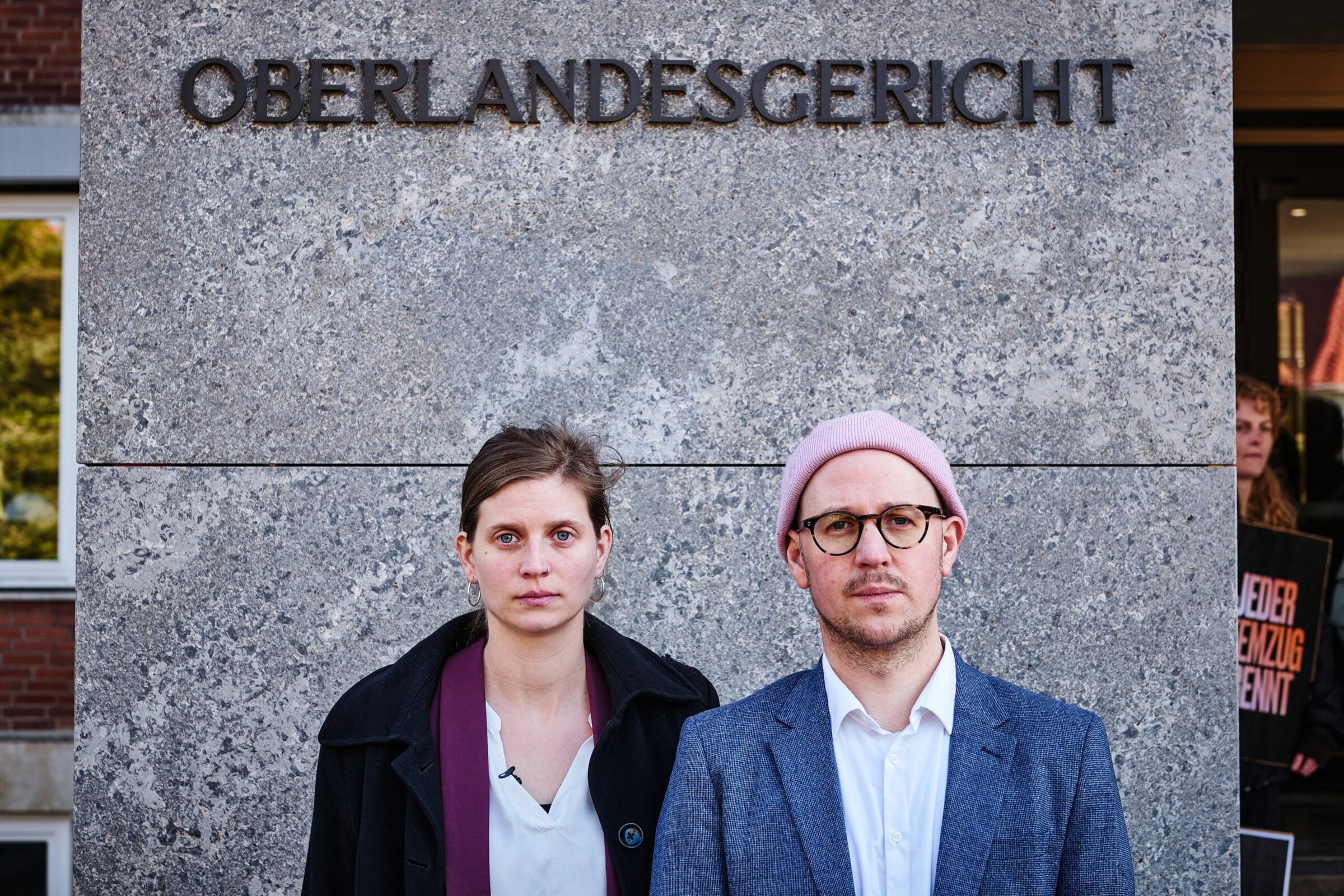
It is one of those moments when animal welfare, law and the public collide head-on. On 9 June 2026, the Higher Regional Court of Oldenburg handed down its verdict in what has become known in Germany as the Schlachthofprozess, the slaughterhouse trial (case 13 U 45/25, in German). The two animal-rights activists Anna Schubert and Hendrik Haßel are liable in principle for the damage caused to slaughterhouse operator Brand Qualitätsfleisch in Lohne by their undercover footage and its distribution. A further appeal to Germany’s Federal Court of Justice was not admitted by the court.
I read the full 72-page ruling. And I would love to write something else, but the story is significantly more layered than the headlines suggest. Because between the lines of this verdict, there are findings that are genuinely important for the animal-rights movement. A regulatory expert opinion that documents animal-welfare violations inside the slaughterhouse. A blanket ban that the court rejected. And the judges’ explicit finding that the footage shows exactly what is everyday reality in German slaughterhouses.
For the complete background and how CO2 stunning of pigs actually works, I have written it up in detail in our research piece on the Oldenburg slaughterhouse case (in German). Here, let’s unpack the recent verdict together. You will find the full ruling linked at the bottom of this article.
Contents8 chapters
- 01What the slaughterhouse trial is about: the backstory in 90 seconds
- 02The verdict at a glance: who is liable for what?
- 03The striking detail: a public authority confirms animal-welfare violations
- 04What the court does concede to the activists
- 05What happens next: three arenas
- 06What you can do
- 07FAQ: the slaughterhouse trial verdict
- 08My take: a tough ruling that still moves something
What the slaughterhouse trial is about: the backstory in 90 seconds
Rewind. In spring 2024, Anna Schubert and others climb several times at night into the Brand Qualitätsfleisch slaughterhouse in Lohne (district of Vechta, Lower Saxony). They install hidden cameras that record the stunning and slaughter process. On the night of 4 to 5 May 2024, Hendrik Haßel is also there to collect the cameras. Police catch both of them on site.
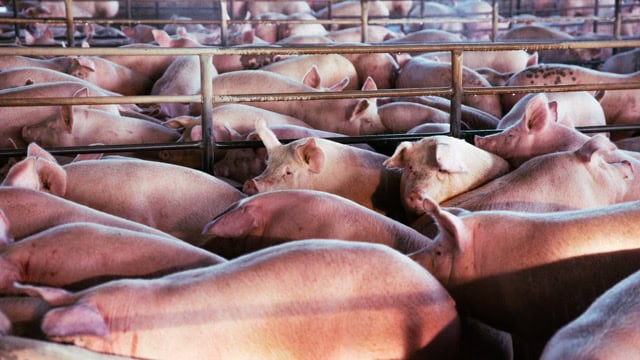
The footage shows what millions of people in Germany eat every day but almost nobody has ever seen: the CO2 stunning of pigs (in German). Animals are driven into gondolas and lowered into a pit filled with highly concentrated carbon dioxide. The gas irritates their mucous membranes, the pigs go into respiratory distress and panic until they lose consciousness. Around 80 percent of all pigs slaughtered in Germany are stunned this way. The procedure is approved under EU Regulation 1099/2009, even though the European Food Safety Authority EFSA recommended phasing it out as early as 2004.
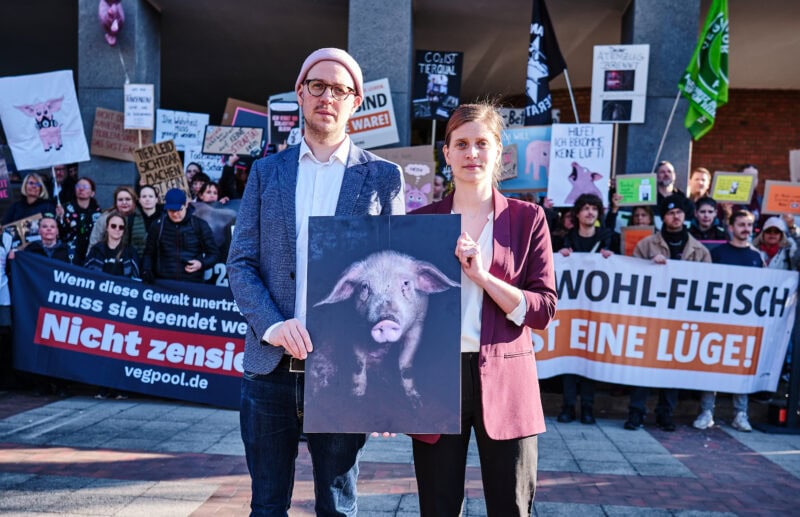
The animal-rights organisation Animal Rights Watch (ARIWA) publishes the material, the public-broadcasting show Plusminus on Germany’s ARD picks it up, and the images travel across the country. The slaughterhouse responds with a criminal complaint and a civil lawsuit. Anna and Hendrik respond with the Instagram channel “Der Schlachthofprozess”, on which they document the proceedings publicly and turn the legal dispute into a movement. In July 2025, the Regional Court of Oldenburg rules primarily against Anna in the first instance. Both sides appeal. Now the appellate court has decided.
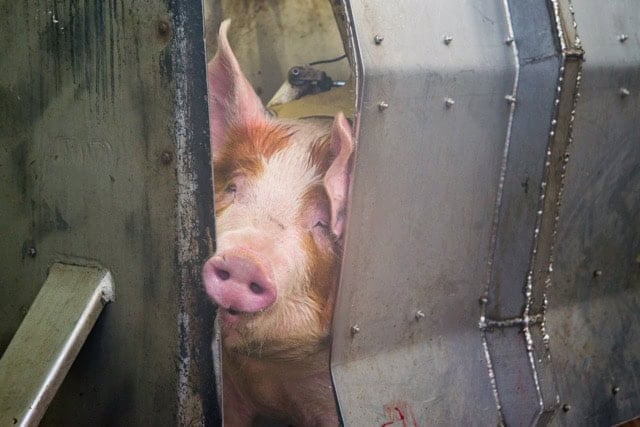
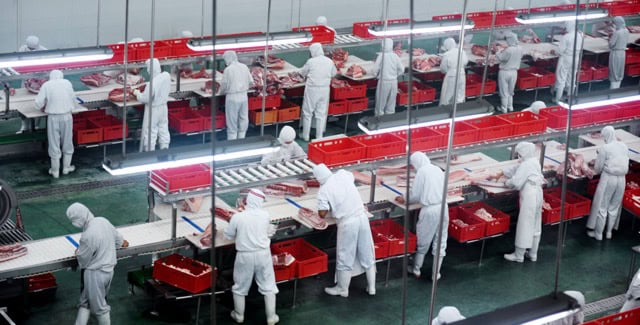
Symbolic image (not from the slaughterhouse this trial is about).
The verdict at a glance: who is liable for what?
The Higher Regional Court has largely upheld the first-instance ruling and tightened it in parts. I have summarised the key points in a table for you:
| Decision | Ruling of the Higher Regional Court of Oldenburg |
|---|---|
| Ban on entering the premises | Neither of them may enter the company premises in the future; violations may be fined up to 250,000 euros |
| Damages, Anna | Liable in principle for trespassing and for the distribution of the ARIWA video |
| Damages, Hendrik | Now also liable for several Instagram posts containing the footage – the key tightening compared to the first instance |
| Blanket ban on future publications | Rejected; the slaughterhouse’s sweeping injunction request failed |
| Third-party posts (e.g. solidarity accounts) | Classified by the court as permissible; third parties’ freedom of expression prevails |
| Further appeal (Revision) | Not admitted |
| Value of dispute | 110,000 euros |
Important context: “In principle” does not yet mean a specific sum of money. The court has merely established that liability for damages exists. Whether the slaughterhouse can actually prove a quantifiable loss, and how high it would be, has to be clarified in separate proceedings. The burden of proof there lies entirely with the slaughterhouse. The court itself writes in the ruling that possible damages “may be minor or hard to establish and prove”.
View this post on Instagram
The striking detail: a public authority confirms animal-welfare violations
And now the part that almost no headline picks up, and that genuinely stunned me when I read the ruling.
The reasoning of the judgment incorporates a technical statement by the Lower Saxony State Office for Consumer Protection and Food Safety (LAVES), prepared for the Oldenburg public prosecutor’s office. This authority, not an animal-rights organisation, comes to remarkable conclusions after evaluating the footage:
- During the driving of the pigs, according to LAVES, “in part a working method is shown that does not meet the requirements of an animal-friendly handling that avoids stress and agitation”.
- The legally mandated maximum interval between stunning and the bleeding cut of 20 to 30 seconds appears “not to have been observed in any case”. Measured intervals were at least 45 to 55 seconds, in individual animals more than 3 minutes.
Read that twice. The footage for whose distribution Anna and Hendrik are now liable documented what a state regulatory authority subsequently classified as breaches of animal-welfare law. In its balancing of interests, the court even expressly credited the post that addressed precisely these violations with the fact that it concerned concrete possible breaches of the Animal Welfare Act. The publication was nevertheless found unlawful in the end because it went beyond the pure documentation of these breaches.
This is, for me, the central tension of the whole proceeding. Without the break-in, this footage would not exist. Without the footage, no one would know about the documented processes. The legal order protects both at the same time: the slaughterhouse’s property and the public’s interest in information. In its weighing of interests, the court came down predominantly on the side of property.
What the court does concede to the activists
For all the harshness of the outcome, the ruling contains passages that are valuable for the movement. I have pulled out the most important ones for you.
The footage shows reality
The court finds that the footage shows the everyday workflow inside the slaughterhouse and the operational reality there. It bases its assessment on the premise that nothing visible or audible on the videos depicts anything that did not actually happen. The slaughterhouse’s claim that the audio track had been manipulated did not play a decisive role in the decision. Anna Schubert’s sentence after the verdict was announced sums it up: “The images are real!”
Criticism of CO2 stunning is and remains legitimate
The ruling states verbatim that a public debate about the conditions of industrial animal processing is “not only legitimate”, but meets “broad public interest”. The activists may continue to express criticism of the slaughterhouse and its practices, clearly and openly. Just not while using the unlawfully obtained footage.
The blanket ban is off the table
The slaughterhouse wanted to obtain a sweeping ruling that practically any future distribution of the footage would be prohibited. It failed with that. The court made clear that there can be constellations in which a publication would be permissible, and that this can only be assessed case by case. Several solidarity posts by third-party accounts were classified by the Higher Regional Court as covered by freedom of expression. The movement may continue to report, contextualise and mobilise.
What happens next: three arenas
With this ruling, the slaughterhouse trial is not over, it is shifting. Three developments are worth keeping on your radar:
1. The proceedings on damages. The slaughterhouse must now demonstrate concretely which damage was caused by which publication. That is legally demanding, because losses in revenue have to be linked causally to individual posts. The final word here is far from spoken.
2. The lawsuit against CO2 stunning itself. Anna and Hendrik together with allies have sued the responsible authority (in German) in order to challenge the approval of CO2 stunning. Their argument: EU regulation requires that animals be spared avoidable pain, stress and suffering, and this method demonstrably fails to deliver on that. The EFSA has been recommending alternative gas mixtures for years.
3. The EU level. The European Commission is working on a revision of the EU animal-welfare slaughter regulation. One of its bases is the EFSA expert opinion from 2020, which confirmed the concerns about CO2. Every public proceeding like this one increases the pressure to finally tackle the issue.
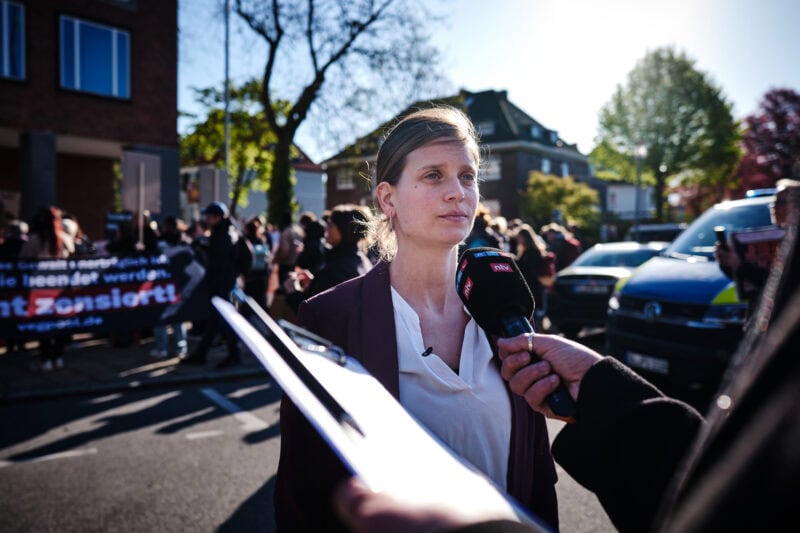
Update 25 September 2026: Moby now publicly backs Anna and Hendrik, photographed by Aglaja Brix. Read more: Moby backs Germany’s slaughterhouse trial.
What you can do
You may be wondering what this verdict has to do with your everyday life. A lot, I think. Because the most effective answer to a system that prefers to keep its workflows behind factory gates we all give three times a day.
- Support Anna and Hendrik directly with a donation
- Stay informed and share. The movement’s reach exists thanks to people like you. The court expressly confirmed that reporting and solidarity are permissible.
- Bring plant-based alternatives into your everyday life. The market in 2026 is as good as never before, from taste and texture to price. Every meal is a decision.
- Get politically active. The activists’ petition against CO2 stunning is running, the EU revision of the slaughter regulation is on the agenda. Letters to elected representatives matter more than people think.
- Support organisations. Investigations like this cost money, nerves and, as we now know, potentially damages.
- Sign the petition – more than 30,000 people have already joined.
FAQ: the slaughterhouse trial verdict
Do Anna and Hendrik now have to pay damages?
Not yet. The Higher Regional Court only established liability in principle. Whether anything has to be paid and how much will be decided in separate proceedings, in which the slaughterhouse must prove each individual loss concretely.
Is the ruling final?
The Higher Regional Court did not admit a further appeal (Revision). The defendants still have the option of filing a complaint against the non-admission of further appeal with Germany’s Federal Court of Justice (BGH). At the time of writing, they have not yet conclusively stated whether they will pursue this route.
Can the slaughterhouse videos now no longer be shown anywhere?
The activists themselves may no longer distribute the specific footage. Independent press reporting is expressly not covered by the injunction, and posts by third parties were also partly classified as permissible. There is no blanket total ban.
Is the CO2 stunning of pigs legal?
Yes, it is authorised under EU Regulation 1099/2009 and affects around 80 percent of all pigs slaughtered in Germany. The EFSA has been criticising the method since 2004 (in German) and recommends alternatives. A revision of the EU rules is in progress, and in parallel a lawsuit is challenging the regulatory approval.
Did the court find animal-welfare violations inside the slaughterhouse?
The civil court itself did not decide on this. What did feed into the ruling, however, was a statement by the state office LAVES, which documented partly non-animal-friendly handling during the driving of the pigs and significantly exceeded bleeding-out intervals.
What does this verdict mean for future undercover investigations?
It makes them riskier, especially financially. Anyone who publishes unlawfully obtained footage themselves will be more easily liable for damages in the future. At the same time, the court confirmed that the topic is of high public interest and that criticism remains legitimate. Investigations will continue, presumably with adjusted publication paths via the press and organisations.
My take: a tough ruling that still moves something
Let me be honest: my first impulse after the verdict was frustration. Two people make visible what a public authority later classifies as problematic under animal-welfare law, and in the end they are the ones liable for the company’s reputational damage. That feels backwards, and I understand everyone who uses the term SLAPP, a “Strategic Lawsuit Against Public Participation”. And on top of that comes a post from the CEO of “Brand Qualitätsfleisch” on LinkedIn in which he speaks of a “won lawsuit” and smiles while posing in front of dead pigs.
At the same time, reading the 72 pages, I gained respect for the senate’s level of nuance. The court visibly does not make it easy for itself. It confirms the authenticity of the operational reality on the images, it defends the freedom of expression of third parties, it strikes down the slaughterhouse’s blanket ban request, and it names the documented violations explicitly. The message between the lines: the rule of law also protects slaughterhouses, but it equally protects the debate about them.
Even so, this is not good news for the movement, for journalism and for transparency. Many animal-welfare organisations are now afraid of further lawsuits.
What is also absurd, as Vegpool reports, is that 125,000 euros of taxpayer money have gone to this very slaughterhouse in recent years under a German-Dutch funding programme called Interreg. For a digitalisation project in pig farming.
What is positive is this: the debate has been fuelled by this trial like almost nothing before. Hundreds of people in front of the court, nationwide press coverage, an ongoing lawsuit against CO2 stunning itself, movement at EU level. Anna and Hendrik have legally “lost” for now and gained an enormous amount in terms of public conversation. The decisive question is now asked by every single one of us when we go shopping: do I want to be part of a system whose everyday operations have to be defended in court so that no one sees them? You know my answer. And maybe this verdict is, for one or the other person, exactly the nudge needed to find their own.
I have enormous respect for the work and the courage of Anna and Hendrik and wish them only the best. Support them where you can. Through donations or by sharing this article.
If you want to read the verdict yourself, here is the full text (in German).
One important note: I am not a lawyer. I researched and analysed this to the best of my judgement. If you spot anything that needs correcting, please drop me a line by email and I will update where needed.
Stay critical, stay kind, stay plant-based.
Want our reporting to show up first in Google's Top Stories? Add This Is Vegan as a preferred source on Google.