







Beans have an image problem. Boring, beige, the thing at the back of the pantry. And yet a new US survey suggests people are far more open to them than the endless culture war over the burger would have you believe.
The animal-protection group Humane World for Animals (formerly the Humane Society of the United States) commissioned The Harris Poll to find out. One month after launching its “Beansday” campaign, it asked a simple question: would meat-eaters actually be willing to swap meat for beans now and then? The answer is more encouraging than you might expect.
This is not just a curiosity from across the pond. Behind the survey sits one very low-effort lever that works on any plate: once a week, reach for the bean instead of the beef. No manifesto, no label, no all-or-nothing pledge. Just a swap most people already have half stocked in the cupboard.
Contents6 chapters
The short answer
A Harris Poll survey for Humane World for Animals (June 2026, 2,003 US adults) found that 57 percent of meat-eaters would replace meat with beans at least once a week. 95 percent of Americans already eat beans. The main drivers are grocery bills, personal health and animal welfare, not ideology.
What the survey actually says
The headline number: nearly three in five meat-eaters, 57 percent, are willing to replace meat with beans at least once a week. 62 percent of everyone surveyed want to eat less meat overall. And beans are hardly unfamiliar territory: 95 percent of Americans already eat them.
The why is the interesting part. It is not the classic activist talking points topping the list, it is everyday life. Roughly two-thirds of the meat-eaters surveyed said they were concerned about the hit to household finances and grocery costs (67 percent), their own health (64 percent) and animal welfare (64 percent). 58 percent pointed to the environmental and climate impact of eating meat. Health, money, animals, planet, the motives converge.
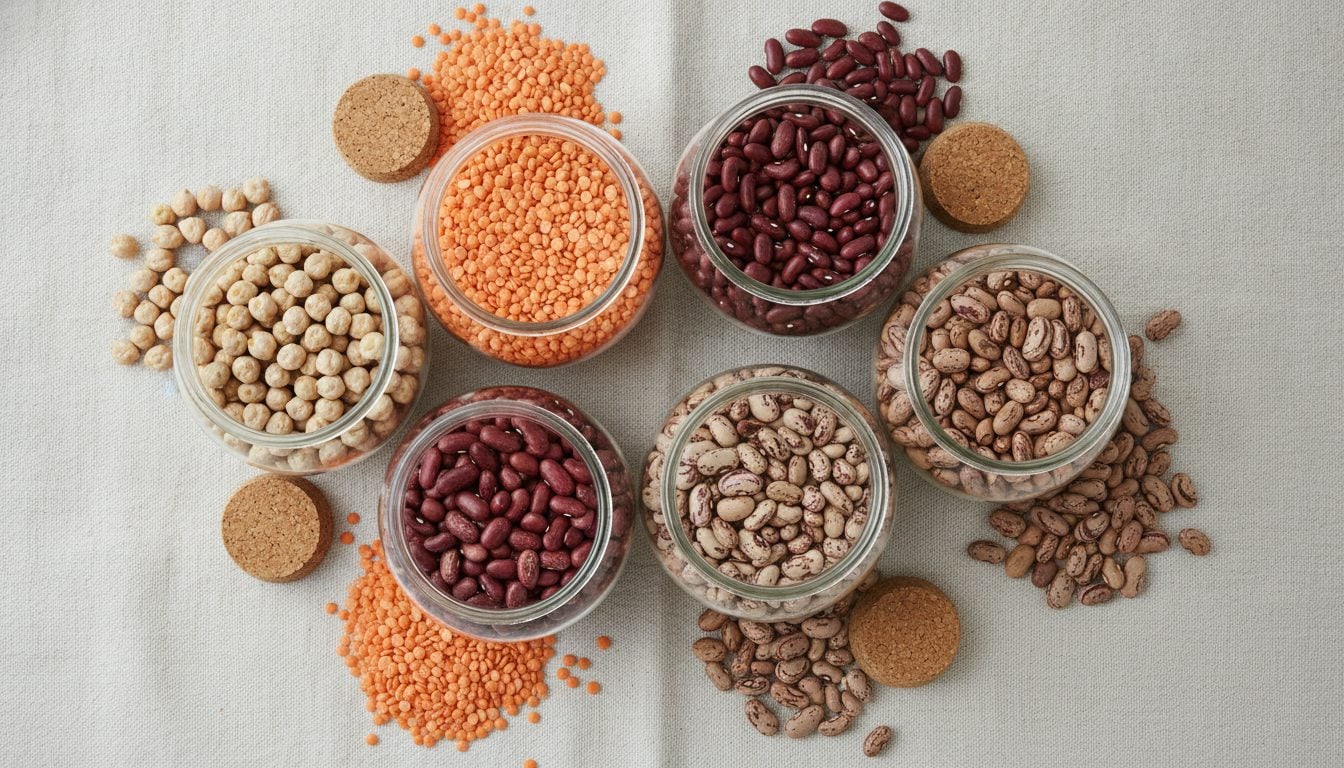
Among the beans themselves, America has a clear favorite. The black bean leads at 46 percent, with the pinto bean close behind at 41 percent. There is a nutritional case for the dark varieties in particular, and black beans bring plenty of antioxidants to the table.
One telling detail: younger adults aged 18 to 34 were noticeably more likely to name animal welfare as a reason to switch (27 percent) than people aged 55 and over (19 percent). The next generation is thinking about the animals at the checkout more often.
Why beans are the underrated protein hero
Start with protein, because that is the first question anyone asks about a meat swap. Cooked beans deliver roughly 7 to 9 grams of protein per 100 grams, depending on the variety. On top of that you get a load of fiber, complex carbohydrates, iron, folate and almost no saturated fat. Pair beans with a grain such as rice or bread and the amino acids complement each other into a high-quality protein profile. Rice and beans is not an accident, it is good nutrition.
Then there is price. Legumes are among the cheapest sources of protein anywhere. A can of kidney beans or a bag of dried lentils costs a fraction of what the same amount of protein from meat would set you back. That is exactly why the household budget was the strongest motive in the survey.
And climate. Here the gap is not small, it is enormous. According to the landmark life-cycle study by Poore and Nemecek (Science, 2018), beef generates around 60 kilograms of CO2 equivalent per kilogram, while lentils come in at under one kilogram. Measured per 100 grams of protein, legumes sit many times below beef. Peas, for example, carry a climate footprint more than 60 times lower than beef. A single weekly swap adds up noticeably over a year.
How to swap meat for legumes once a week
The trick is not to overhaul your whole diet but to pick dishes where the swap barely registers. A few everyday ideas that work straight away:
- Chili sin carne: use kidney and black beans instead of ground meat. With cumin, paprika and a square of dark chocolate, hardly anyone tastes the difference.
- Lentil bolognese: red or brown lentils simmer down in the tomato sauce and give the same hearty texture as mince.
- Bean burger patty: shaped by hand, it holds together surprisingly well and grills like the real thing.
- Chickpeas as the all-rounder: in a curry, blitzed into hummus, or roasted in the oven as a crunchy snack. If you like the idea of a bean-based dip, our guide on whether hummus contains dairy is a good starting point.
- Bowls and salads: one can of rinsed beans turns a tired lunch salad into a filling meal.
A small kitchen tip for the bloating that puts a lot of people off eating beans more often: soak dried beans well, throw out the soaking water, cook them fresh, and add a strip of kombu seaweed or some cumin. Your gut also adapts to more fiber if you ramp up the amount slowly rather than going from zero to a can a day.
How solid is the study
Now the part a lot of news outlets skip. This is a commissioned survey. It was ordered by an animal-protection group with a stated interest in seeing less meat eaten. That does not make the numbers wrong, but you should keep it in mind when you read them.
On the method: The Harris Poll ran the survey online in the United States from June 23 to 25, 2026, among 2,003 adults aged 18 and over, of whom 1,919 eat meat. The pollster puts the margin of error at plus/minus 2.7 percentage points at a 95 percent confidence level. That is a solid sample size for a representative snapshot.
Two caveats remain. First, the survey measures intentions, not actions. “I would be willing” and “I do it” are different things, and social science knows this gap well. Second, online panels are not perfectly representative, and an NGO’s framing can nudge answers in one direction. As a read on the public mood, the survey holds up. As proof that millions are about to reach for beans, it does not. The nutritional, financial and climate advantages of legumes, by contrast, rest on independent scientific data and hold regardless of any campaign.
Frequently asked questions
Can beans fully replace meat for protein?
Nutritionally, legumes get you a long way. Cooked beans provide roughly 7 to 9 grams of protein per 100 grams, and combined with a grain they form a complete amino acid profile. Anyone eating a varied plant-based diet meets their protein needs without trouble.
Which bean is the healthiest?
There is no single “best” bean, the variety is the point. Black beans bring antioxidants, lentils bring iron and cook fast, chickpeas bring versatility. You get the most out of them by rotating between types.
Why do beans give me gas?
Certain complex sugars that your gut has to break down are the culprit. Soaking, changing the water and increasing the amount slowly all help a lot. After a few weeks your digestion adjusts to the extra fiber.
What is the “Beansday” campaign?
Humane World for Animals launched Beansday in June 2026 with actor Kevin Bacon, who jokingly goes by “Kevin Bean” for the occasion. The idea: swap meat for beans every Wednesday. A low-stakes entry point rather than a full dietary overhaul.