






Up to 4.5 million fewer disease cases over 30 years if the UK eats half as much red and processed meat. That figure is doing the rounds this week. It comes from a modelling study in the European Journal of Nutrition, and the paper contains a finding most headlines skip: around three quarters of the effect comes from the extra vegetables and legumes. The meat that disappears accounts for the smaller share.
Diesen Artikel auf Deutsch lesen.
In short
Researchers in Stockholm, London and Oxford calculated what the UK Climate Change Committee’s meat targets would mean for public health. With 50% less red and processed meat, the model arrives at 4.5 million averted cases of cardiovascular disease, type 2 diabetes and colorectal cancer. The range runs from 0.6 to 8.1 million.
This is a simulation. Nobody was examined. Meat alternatives, poultry and dairy play no part in the health calculation.
Contents6 chapters
What the researchers modelled.
The UK Climate Change Committee recommends cutting meat consumption by 35% by 2030 and by 50% by 2050. A team led by Patricia Eustachio Colombo of Karolinska Institutet and the London School of Hygiene & Tropical Medicine asked what that would do to disease rates and life expectancy. The paper was published on 17 September 2026 and is open access.
The calculation has two stages. First, a computer model simulates how the diets of UK adults shift when the government runs information campaigns, taxes meat and subsidises vegetables, legumes and meat alternatives. The starting point is intake data from the 2019 National Diet and Nutrition Survey. In the simulation, the 35% target is reached after roughly five years and the 50% target after roughly eight.
A second model then translates the new diets into disease cases. It uses risk estimates from the Global Burden of Disease study, which are associations drawn from large observational studies: this many more grams of legumes per day, this many fewer heart attacks. The time horizon is 30 years, with the full effect assumed to arrive after ten.
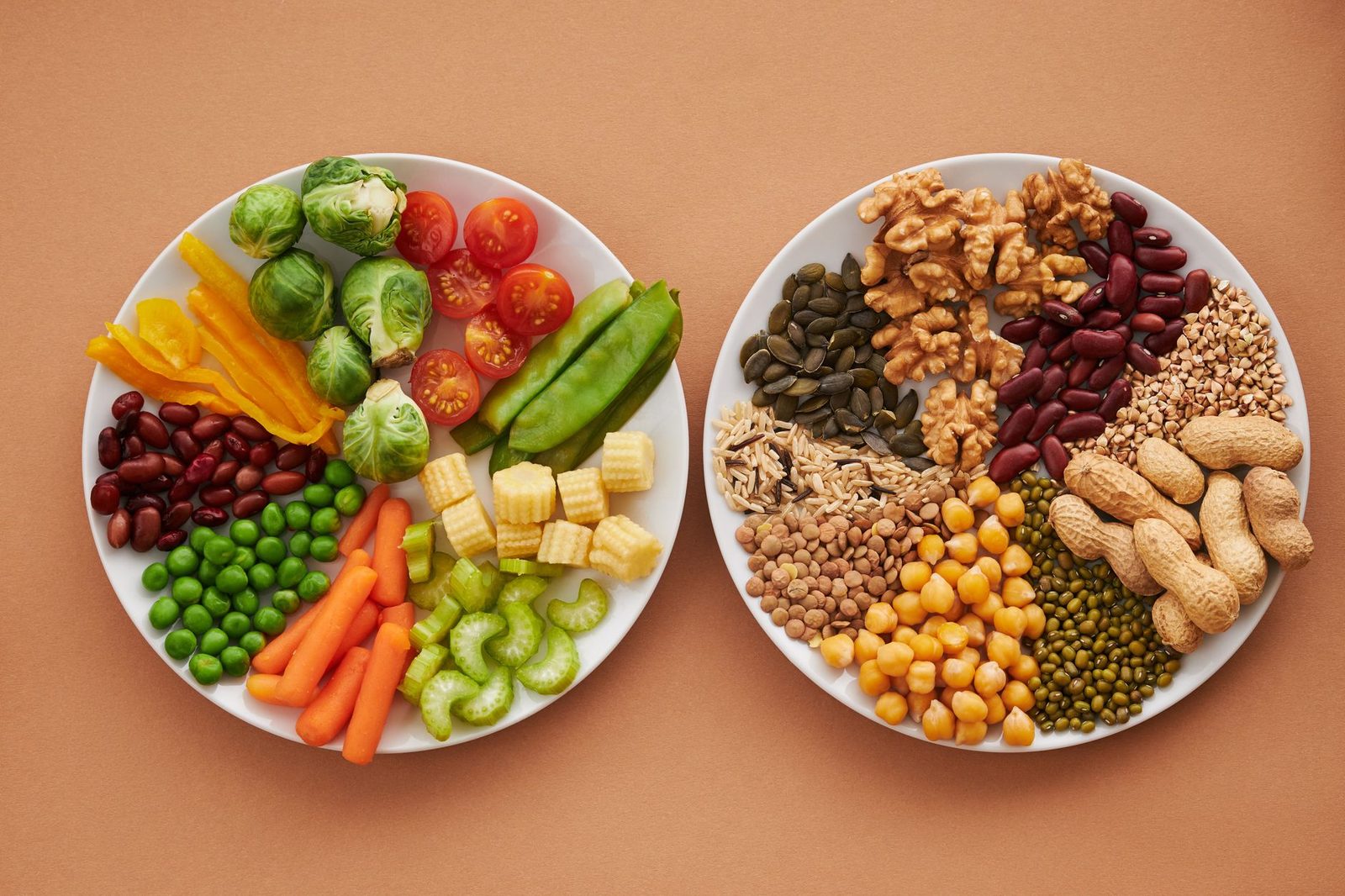
On the plate, the change is less dramatic than “50%” sounds. In the central scenario, men eat about 23 grams less red meat and 21 grams less processed meat per day. In return they add 83 grams of legumes and 243 grams of vegetables. For women it is 16 and 12 grams less meat, 50 grams more legumes and 172 grams more vegetables.
The results in detail.
For the 50% scenario, over 30 years, the paper reports:
- about 3.3 million fewer cardiovascular cases (range 0.4 to 5.4 million)
- about 1.1 million fewer cases of type 2 diabetes (0.1 to 2.5 million)
- about 72,000 fewer colorectal cancer cases (7,800 to 225,000)
- life expectancy up by 9.4 months (1.3 to 15.4 months)
In the 35% scenario the totals are 3.4 million cases (0.5 to 6.6 million) and 7.2 months.
Roughly three quarters of all averted cases are cardiovascular. That follows from how the model is built: vegetables and legumes act only through cardiovascular disease, and their quantities change far more than the meat does. Diabetes and colorectal cancer are tied to red and processed meat alone.
Why the replacement matters
This is the part that touches everyday eating. According to the authors, about three quarters of the health gains trace back to higher vegetable and legume intake. They write themselves that the benefit of eating less meat also depends on what people choose instead.
Drop the steak and fill the gap with white bread, and you are not in this calculation. The model knows one swap only: meat out, vegetables and legumes in, at equal calories.
And meat alternatives? Plant-based burgers and sausages do rise in the diet simulation, but they enter the health calculation at zero. The researchers’ reasoning: so far there are only a handful of short trials on blood markers and no robust data on heart attacks, diabetes or cancer. So this study has nothing to say about the veggie burger, good or bad.
If you want a practical takeaway: lentils, beans and chickpeas are the part of the plate doing the work in this model.
What the study does not show.
The list is long, and the authors supply most of it themselves.
It is a model. Nobody changed their diet for this study and nobody was followed up. The researchers call their numbers exploratory and write that the results are “indicative of potential, rather than guaranteed, population-level effects”.
The ranges are huge. Between 0.6 and 8.1 million cases lies a factor of more than 13. The 4.5 million is the central estimate of the more ambitious scenario.
The risk estimates come from observational studies. Those show associations. Whether legumes cause the difference, or whether people who eat a lot of them also live differently in other ways, can never be fully separated.
The behaviour is assumed. That taxes, subsidies and campaigns would move Britain to this diet within five to eight years is the output of a simulation with simplified social networks. The authors themselves call it an open question whether people would raise their vegetable intake on that scale.
Nutrients were not checked. Whether iron or vitamin B12 intake holds up in these scenarios was not modelled, and the team calls this a black box.
Poultry and dairy are missing. White meat is assigned no health effect because the evidence is inconclusive. Dairy stays unchanged, although the Climate Change Committee recommends cutting it too.
Everyone is treated alike. The model works with average people and constant disease rates over 30 years. It does not capture the gap between rich and poor, or new drugs such as GLP-1 weight-loss injections.
Assume the full effect takes 30 years to arrive rather than ten, and the gains shrink by 28 to 35%.
On funding: the lead author was supported by the Swedish Research Council, which according to the paper had no role in design or analysis. The authors declare no conflicts of interest.
The animals are not in the model.
The study asks about heart attacks and months of human life. It does not ask what halving consumption would mean for cattle, pigs and sheep. For a public health paper that is fair enough, but it should be said.
One point deserves attention. Because white meat is neutral in the health model, the paper is easy to read as advice to switch from beef to chicken. For animals that would be bad news: a chicken yields a fraction of the meat a cow does, so far more individuals die for the same amount. The underlying simulation does not foresee that swap. Poultry consumption falls there as well, and the replacement is plants.
We are vegan because animals are not commodities, and that holds whatever a risk table says. If a model also suggests that a plate of beans could benefit the health of many people, that is one more argument. The reason stays a different one.
Frequently asked questions.
Does the study prove that eating less meat makes you healthier?
No. It projects what could happen if known statistical associations from observational studies hold for a changed UK diet. Nothing was measured.
Is the study about a vegan diet?
No. It examines halving red and processed meat. Dairy and eggs stay unchanged, and poultry is assigned no health effect.
Does the study say meat alternatives are unhealthy?
It makes no statement on that. The researchers left plant-based meat alternatives out of the health calculation because long-term data on disease outcomes are lacking.
How we researched this
All figures come from the original paper: Eustachio Colombo P. et al., “Health co-benefits of sustainable dietary transitions to reduced red and processed meat intake in the United Kingdom: a modelling study”, European Journal of Nutrition, volume 65, article 254, published 17 September 2026, DOI 10.1007/s00394-026-04093-6. We checked the abstract, the methods, tables 1 and 3, the discussion and the funding and conflict of interest statements.
We did not read the supplementary material or the upstream simulation study (Fontan et al. 2025) on which the diet scenarios are based. This article is not medical advice. If you want to change your diet because of a health condition, talk to your doctor.
FAQ - What readers ask
Does the study prove that eating less meat makes you healthier?
Is the study about a vegan diet?
Does the study say meat alternatives are unhealthy?
Want our reporting to show up first in Google's Top Stories? Add This Is Vegan as a preferred source on Google.