






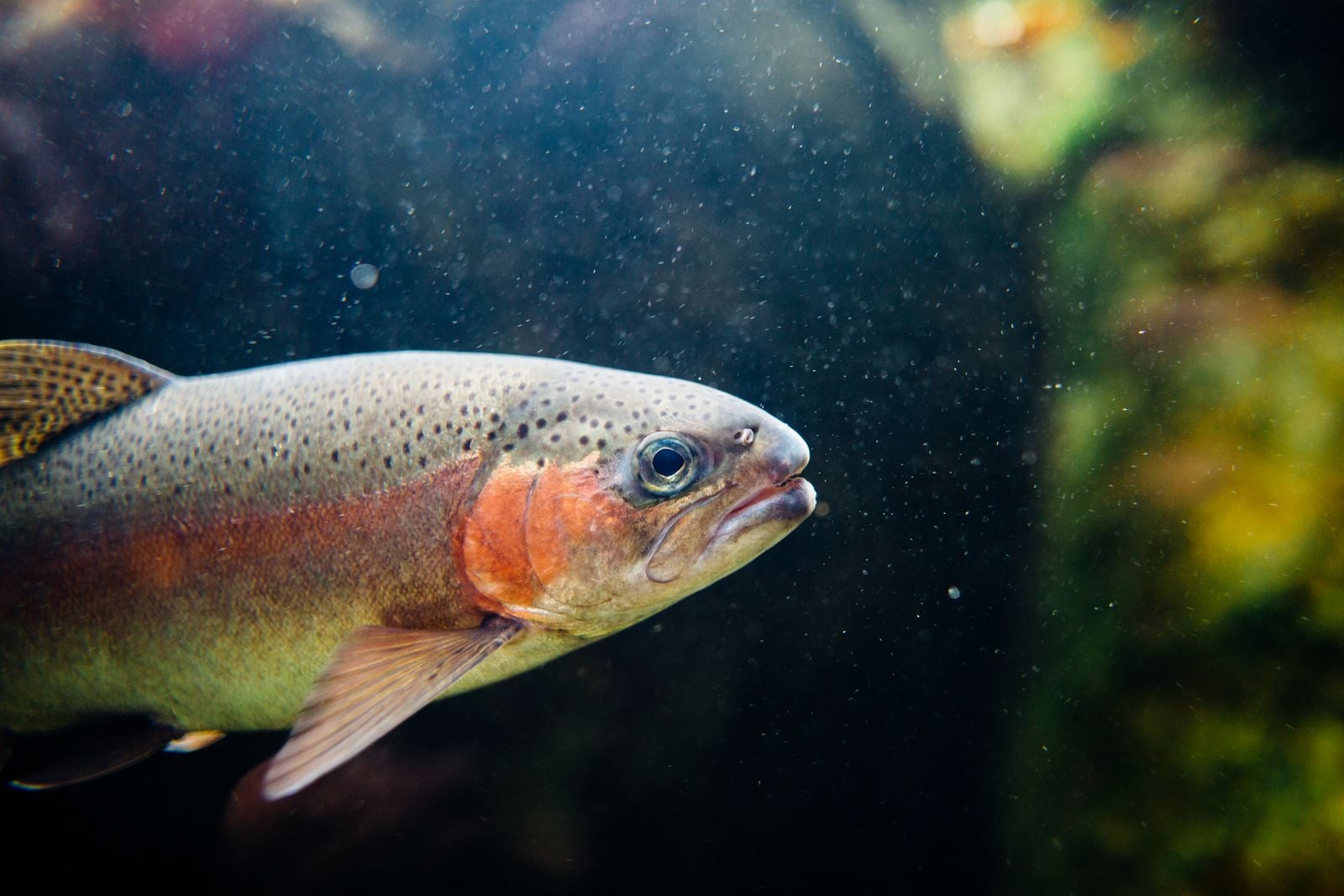
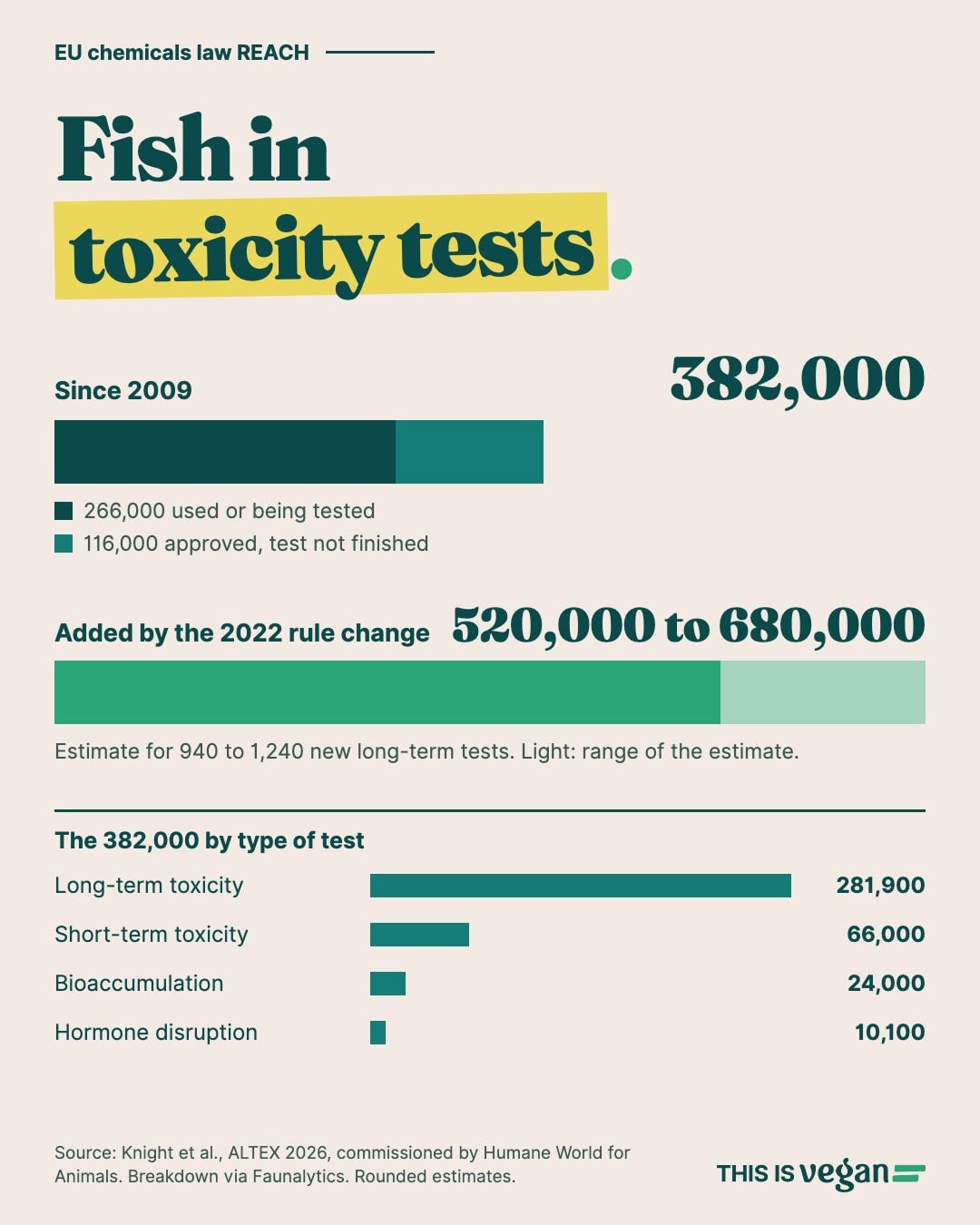
Around 382,000 fish have been used or earmarked for chemical tests under EU law since 2009. That is the estimate of an analysis in the journal ALTEX commissioned by Humane World for Animals. It went online in October 2025 and is circulating again after research organization Faunalytics summarized it in September 2026. A rule in force since 2022 could more than double the number.
In short
- About 266,000 fish have been used or are being tested. Another 116,000 are approved for tests that are not finished.
- Almost three quarters fall under long-term tests, which start with fertilized eggs.
- The 2022 change to REACH could add an estimated 520,000 to 680,000 fish.
- According to the study, long-term tests have no animal-free replacement yet.
Contents6 chapters
What is behind the 382,000 fish.
REACH is the EU’s chemicals regulation. It requires companies to show how their substances affect health and the environment. The researchers searched two databases of the European Chemicals Agency (ECHA) for fish tests, removed likely duplicates and took animal numbers from the test reports. They found 2,220 tests.
The breakdown published by Faunalytics matters here: almost one in three of the fish counted belongs to an approved test that is not finished. Humane World’s 2025 press release said nearly 400,000 had been used, which goes further than that breakdown. The group’s latest German Instagram post is more precise and names both categories.
Share this graphic:WhatsAppTelegramFacebookX
What the fish go through.
A short-term test finds the concentration that kills half the fish within 96 hours. It mostly uses zebrafish, rainbow trout and common carp.
A long-term test starts with fertilized eggs, usually from zebrafish or fathead minnows. The young fish grow up in contaminated water while labs record how many hatch, how many survive and how big they get. Other tests measure whether a substance builds up in the body or interferes with hormones.
The study only counts larvae once they feed independently, about five days after fertilization in these two species. That is when the EU directive on animal experiments generally starts to apply, with earlier stages covered only under certain conditions. Roughly 24,000 fish who hatched and died before that point are therefore missing from the 382,000.
Why the number could grow so much.
Companies used to be able to skip the long-term test in many cases if their risk assessment raised no concern on paper. A 2020 ruling struck down that argument, and a REACH amendment that has applied since October 2022 made this permanent. The test is now a standard requirement for substances of 100 tonnes or more a year, whatever that assessment says. For some poorly water-soluble substances it can be required at lower volumes.
The authors expect 940 to 1,240 additional long-term tests using 520,000 to 680,000 fish. That is a projection, but the rule itself is already law. Humane World’s press release gives a different range of 530,000 to 690,000. We use the figures from the study’s abstract.
What could replace the tests.
In 2021, the OECD adopted a test guideline for a method using rainbow trout gill cells as an option for short-term testing. Combined with computer models it needs no live fish, but Faunalytics says REACH guidance neither requires nor encourages it so far.
For bioaccumulation, there is a test using small crustaceans. It spares fish and uses other animals in their place. The long-term test, which accounts for most of the fish, has no validated replacement. Humane World is calling for more funding for non-animal methods and wants existing ones written into REACH.
The law already allows tests on vertebrates only as a last resort. “Modernising REACH is not about lowering standards,” says Jay Ingram of Humane World, the organization that also co-authored the study.
What the EU is planning.
On June 1, 2026, the European Commission adopted a roadmap to phase out animal testing in chemical safety assessments. It is not legally binding and sets no end date. The Commission intends to take legislative steps on short-term actions by the end of 2029. Applications to join its expert group close on December 21.
The full REACH reform, meanwhile, was shelved in April 2026, although the Commission can still change the annexes that set testing requirements. Industry association Cefic welcomes the roadmap but points to the limits of animal-free methods and says protection of people and the environment must stay high. How well animal experiments predict results is covered in our overview of the evidence on animal testing.
Germany shows how common fish are in labs: 176,778 fish were used in experiments there in 2024, nine percent more than the year before. That figure covers all research purposes and cannot be compared directly with the REACH count.
An animal ethics perspective.
A fish cannot scream, and his face tells us little. That makes it easy to treat him as a data point. A review by biologist Lynne Sneddon concludes that fish very likely feel pain. How consciously they experience it is debated among scientists, and that doubt should count in the animals’ favor.
We want to know whether a chemical poisons rivers and seas, so we poison fish on purpose. That this contradiction rarely registers has a lot to do with speciesism. As long as the biggest test has no replacement, developing one should come first when research money is handed out.
In everyday life, you can spare fish directly with vegan fish alternatives and, if you take omega-3, with algae oil from German brand Nutri+* instead of fish oil.
How we researched this
This article was prompted by an Instagram post from Humane World for Animals Germany. We only had access to the study’s abstract, as the full text is paywalled. The breakdown and methods come from the Faunalytics summary, which Faunalytics says was drafted with a language model and reviewed by a human.
Humane World commissioned the study, and two of its four authors work there. The figures are estimates: short-term tests are hard to attribute to REACH, and animal numbers in long-term tests were partly calculated. The authors believe the total is more likely too low. We read the REACH annexes in an unofficial consolidated version.
* Affiliate link: if you buy through this link, we earn a small commission. The price stays the same for you.
Want our reporting to show up first in Google's Top Stories? Add This Is Vegan as a preferred source on Google.