







An oat drink without a single gram of added sugar could soon be taxed in Germany. Cow’s milk, with its natural milk sugar, would stay tax-free. That is what the German Finance Ministry’s outline paper for a planned sugar tax proposes, and it is exactly where the plan is now catching political headwind.
Diesen Artikel gibt es auch auf Deutsch.
Are plant drinks about to get more expensive?
Not yet. The Finance Ministry’s outline paper is not a draft law, and the proposal is contested even within the federal government. Under the current outline, however, oat, almond, soy and rice drinks without added sugar would become taxable, while cow’s milk with its natural lactose content is set to stay exempt. Update, 27 August: Finance Minister Klingbeil has clarified that sugar-free drinks are not meant to be affected, calling the oat milk passages a technical working draft. Nothing is decided yet; details below.
Dr. Zoe Mayer, nutrition policy spokesperson of the Green Party’s parliamentary group, is demanding that the tax target added sugar instead of product categories.
Contents7 chapters
The sore spot: same sugar, unequal tax
 Alpro to Oatly and vly” width=”2400″ height=”1597″ class=”wp-image-37690″ loading=”lazy” decoding=”async” />
The sugar in an unsweetened oat drink is not added; it forms during processing when the oat’s starch is broken down. The sugar in cow’s milk is not added either; lactose is naturally present. Two drinks, comparable sugar contents, neither with added sugar, but only one of them would be taxed under the outline. That imbalance is exactly what Zoe Mayer criticises:
“The culture war over plant-based alternatives appears to be continuing with the sugar tax.”
Dr. Zoe Mayer, nutrition policy spokesperson, Green parliamentary group (translated)
An unsweetened oat drink with the same natural sugar content as milk would become taxable under the outline, the MP notes, even though its sugar is process-related rather than added.
A pattern repeating itself
The unequal treatment is not new. Cow’s milk enjoys Germany’s reduced VAT rate of 7 percent, plant drinks pay the full 19 percent. REWE, vly, Berief and Oatly, among others, backed a petition to lower it; little has happened so far. In Mayer’s view, the sugar tax continues the same pattern: products with comparable nutritional profiles are treated differently depending on whether they are animal or plant based.
“This continues the structural discrimination against plant-based alternatives that we already see with VAT.”
Dr. Zoe Mayer (translated)
Her demand to the Finance Ministry: target the tax specifically at added sugar rather than product categories. That would serve the health policy goal without making exactly those products more expensive that many people choose for climate or animal welfare reasons.
How binding is any of this?

Important context: the outline paper is based on recommendations of the government’s finance and health commission and is still in the political process. There is no draft law yet, and the proposal is disputed within the federal government itself. Whether, when and in what form the tax arrives is open. Nothing changes at the checkout for now.
Update: Klingbeil backpedals on oat milk
After the more far-reaching plans became public, Finance Minister Lars Klingbeil clarified, according to tagesschau: drinks without sugar are not meant to be taxed, including sweetener-based sodas like Cola Zero. The documents under which oat and almond drinks, juices from concentrate and alcohol-free beer and wine would also be taxed, he called a technical working draft, neither politically agreed nor decided by the coalition.
There is also an arithmetic point tagesschau highlights: unsweetened oat drinks usually contain less than 4.5 grams of sugar per 100 grams, putting them below the lowest tier of the discussed model. Even an expanded sugar tax would therefore be unlikely to make your oat milk coffee much more expensive. Whether juices from concentrate, mixed milk drinks or plant-based alternatives end up included, however, remains open, and that openness is exactly what Mayer’s criticism targets.
What the tax would cost
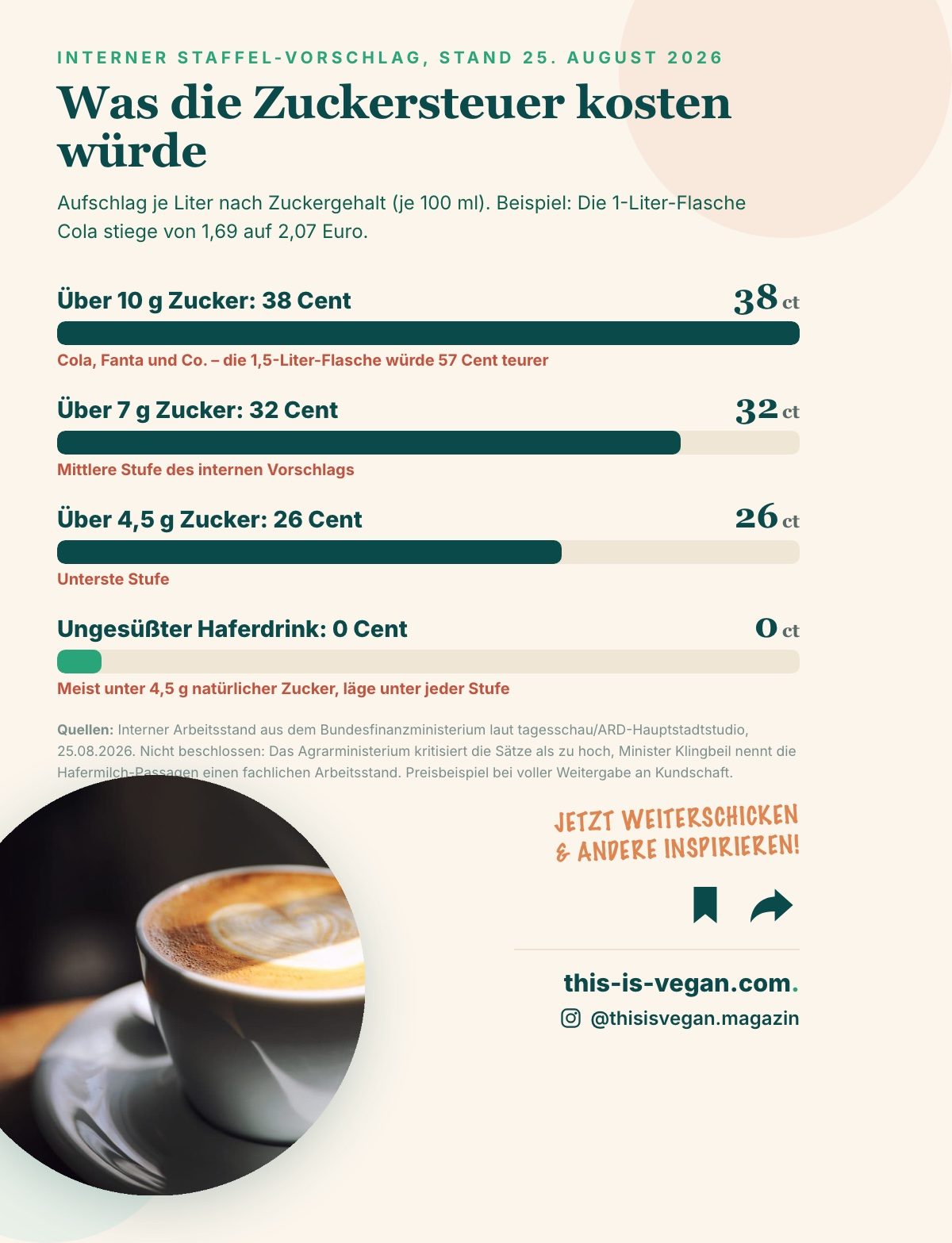
The internal proposal foresees tiered rates per litre: 26 cents above 4.5 grams of sugar per 100 millilitres, 32 cents above 7 grams, 38 cents above 10 grams. For a one-litre bottle of cola or Fanta that would mean going from 1.69 to 2.07 euros. A 1.5-litre bottle of a particularly sugary drink would get 57 cents more expensive, provided producers pass the levy on in full. The Agriculture Ministry criticises the rates as higher than the expert commission proposed.
The tax is planned from 2027 as part of a savings package for statutory health insurance. How much it raises depends on its scope: the coalition agreement mentions around 650 million euros per year, the Agriculture Ministry calculated roughly two billion for the far-reaching version, industry associations expected almost four. Critics therefore worry the levy would mainly serve the budget rather than health policy.
The debate joins a series of tax and labelling disputes around plant-based products, from the freshly reignited EU debate about banning the names veggie burger and sausage to the call for a reduced VAT rate on plant drinks.
The context: plant drinks are everyday products

What is being decided here is no niche: plant drinks generated 632 million euros in German retail in 2025, almost one litre in eleven of milk sold is now plant-based, and 78 percent of milk buyers purchase both. The full numbers and sources are in our World Plant Milk Day article, and our plant milk guide (in German) covers which drink works for what.
We will keep following the legislative process and report as soon as the outline becomes a bill.
Zoe Mayer on the TIV podcast
We spoke with Zoe Mayer at length about animal protection, veganism and her everyday life in the Bundestag in a full podcast episode (in German). Clicking the preview image starts the player; nothing loads from YouTube before that. Her written interview is also available in German.
Transparency and sources
This article is based on the German Finance Ministry’s outline paper for the planned sugar tax, which builds on recommendations of the government’s finance and health commission, and on the statement by Dr. Zoe Mayer (Greens), as of 27 August 2026. Quotes come from that statement and were translated by us. No draft law exists yet; details may change during the process. The tax tiers, price examples, Minister Klingbeil’s clarification and the assessment of oat drink sugar content come from reporting by tagesschau/WDR and the ARD capital bureau, 25 August 2026 (update added 27 August 2026). Market figures (632 million euros, 9.2 percent volume share, 78 percent dual buyers) come from GFI Europe and YouGov and are sourced in the linked article.
The images in this article are stock images from our media library.
Want our reporting to show up first in Google's Top Stories? Add This Is Vegan as a preferred source on Google.