







Last updated: 17 September 2026. This is an ongoing criminal investigation. A search is not a charge and not a conviction, the operator is presumed innocent. We will update this article when prosecutors, police or the park comment.
German police searched a wildlife park with a birds of prey centre in Rhineland-Palatinate on Wednesday, 16 September 2026. The search was authorised by the local court in Kaiserslautern. Investigators suspect the operator of breaking Germany’s Animal Welfare Act. According to police, the facility in the district of Kusel, in the hills of the northern Palatinate, keeps around 800 animals from roughly 140 species.
Detectives from Kaiserslautern were supported by specialists from the district veterinary office and by officers from the state police logistics unit. The public prosecutor’s office in Kaiserslautern and the West Palatinate police announced the operation in a joint statement.
The authorities did not name the facility. Two regional outlets, Pfalz-Express and lokalo.de, identify it as the Wildpark und Greifvogelzoo Potzberg near Föckelberg. We do not name the operator.
Contents5 chapters
What investigators allege.
The wording of the police statement closely follows Section 17 of the German Animal Welfare Act (Tierschutzgesetz). The operator is suspected of having killed vertebrate animals without reasonable cause, or of having caused them considerable pain or suffering out of cruelty. The authorities also cite prolonged or repeated considerable pain or suffering.
Those are the three offences German animal welfare criminal law knows. The maximum penalty is three years in prison or a fine. Police have not said which incidents, which animals or which time period the case is about.
In Germany, a judge signs off on a search warrant when there is an initial suspicion and evidence is likely to be found on site. It says nothing about whether the suspicion will hold. Police and prosecutors say they will report results once the evidence has been reviewed.
What we don’t know yet.
Quite a lot. It is unclear whether any animals were seized or moved, whether the park will stay open, whether the veterinary office has issued orders, and how the suspicion arose. On the morning of 17 September, the park’s own website said nothing about the operation and still advertised daily opening hours and its flight show. No public statement from the operator was available when this article was published.
Some background: the park sits on top of the Potzberg, a 562 metre hill about 20 kilometres northwest of Kaiserslautern. It opened in 1984 and has been privately run since 1998. Besides hoofed animals such as European bison, moose and reindeer, its birds of prey have been the main attraction for decades, with flight demonstrations from late March to late October.
Why convictions are rare.
Section 17 requires intent. Negligently causing an animal to suffer is not a crime in Germany. “Out of cruelty” is read by German courts as acting from an unfeeling attitude that disregards the suffering of others, which is hard to prove in court.
The animals’ situation can change long before any verdict, though. Under a separate administrative provision, Section 16a, veterinary authorities can remove animals, place them elsewhere and ban a person from keeping animals if animals are seriously neglected or rules have been broken repeatedly or grossly. No criminal conviction is needed for that. Whether the authorities in Kusel have used it is not known.
The rules for wildlife parks in Germany.
German wildlife parks need two permits. The Federal Nature Conservation Act, implementing the EU Zoos Directive, defines a zoo as any permanent facility that displays wild animals for at least seven days a year, with an exemption only for very small enclosures. Zoos need a licence, which can be revoked, up to closure. On top of that comes an animal welfare permit, supervised by the local veterinary office.
For birds of prey and owls there is also a federal expert report setting out minimum standards. It was revised in December 2024 for the first time since 1995. It is not a law, but authorities and courts use it as a benchmark. According to the German Animal Welfare Federation (Deutscher Tierschutzbund), it now bans displaying these birds at constantly changing locations, flight shows included. The federation still called it “progress with flaws”: tethering remains legal, and minimum aviary sizes were not raised, in some cases lowered. The German Legal Society for Animal Welfare Law, which sat on the expert committee, argues that imprinting, food reduction and tethering are incompatible with the Animal Welfare Act. The animal protection groups had their dissent recorded in the report itself.
What a flight show asks of a bird.
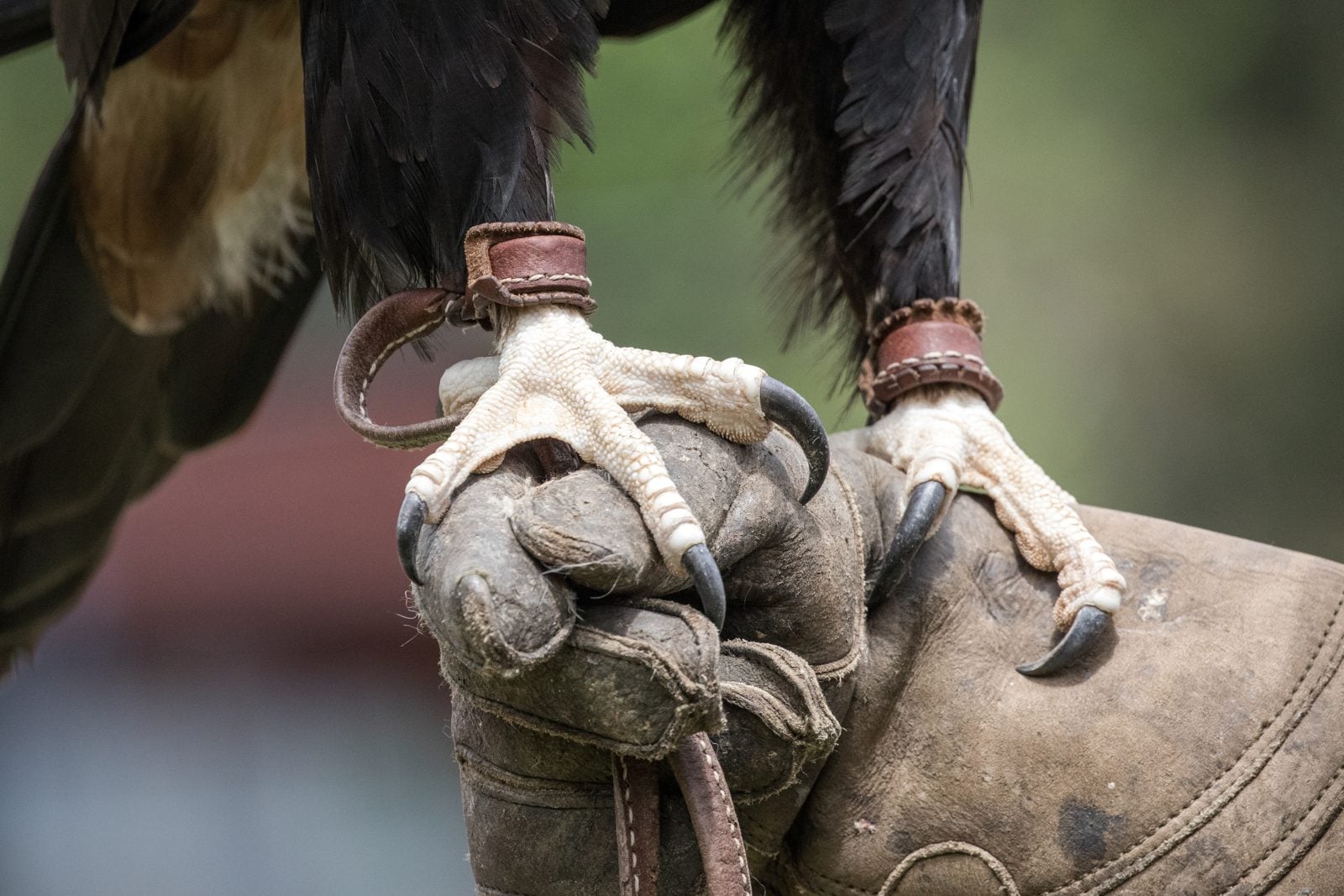
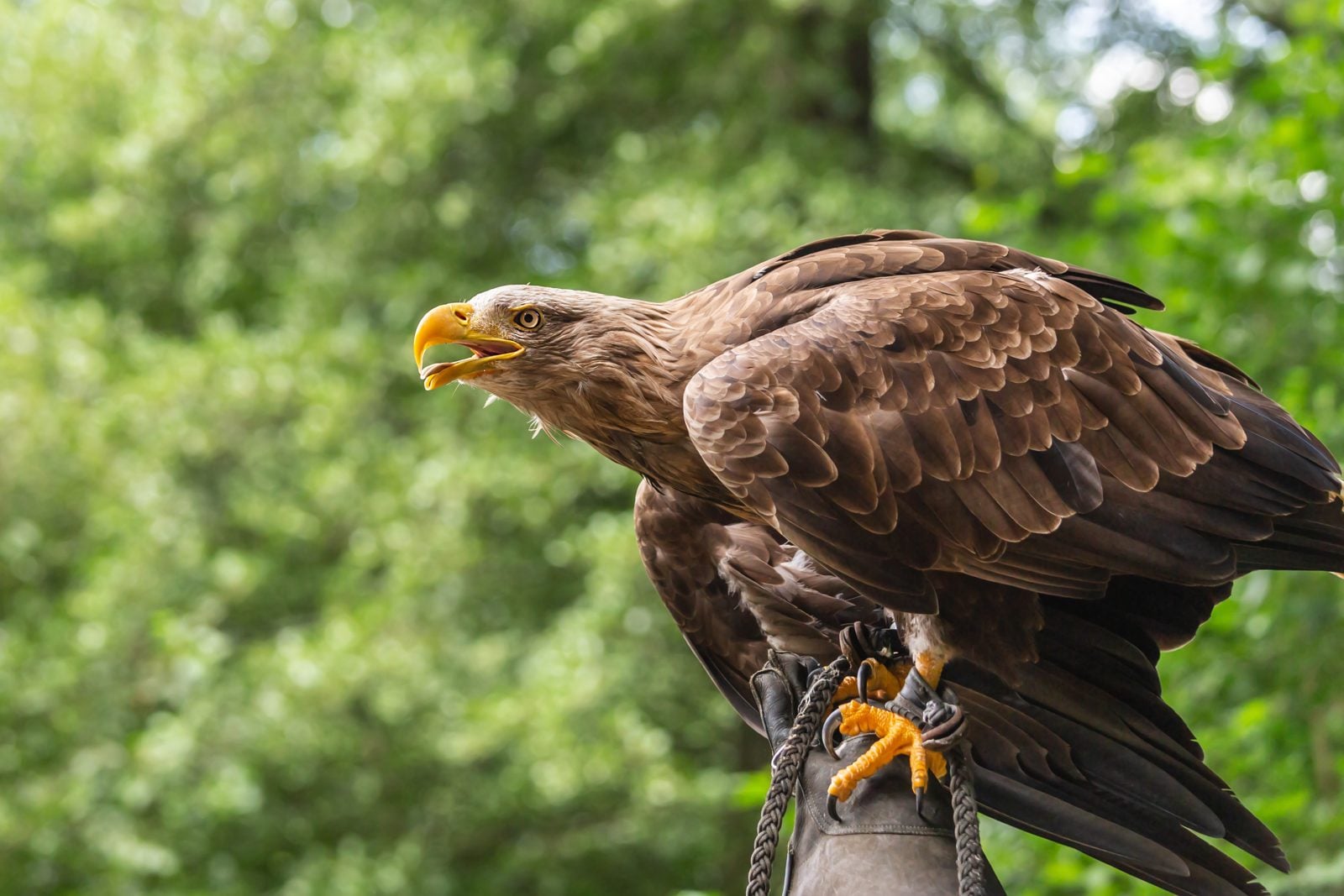
Whatever comes of this investigation, it points at a kind of animal keeping that in Germany counts as a family day out. An eagle gliding over the audience and landing on a glove looks like freedom. It is training. To make it come back, the bird is usually hand-reared, imprinted on humans and controlled through its food. Between shows it often sits tethered to a block or in an aviary a fraction of the size of the territory it would cover in the wild.
The law allows all of that. Section 1 of the Animal Welfare Act forbids causing an animal pain, suffering or harm without reasonable cause, and Article 13 of the EU Treaty recognises animals as sentient beings. The 2024 New York Declaration on Animal Consciousness sums up the science: there is strong support for conscious experience in birds and mammals. Whether entertainment and a few facts shouted across a flying field are a reasonable cause for keeping animals on straps for life is a question the law leaves open. Our answer is no.
That holds regardless of whether anything criminal happened in this park. Most of what animals in zoos, wildlife parks and falconry centres go through is perfectly legal. The same logic runs through dolphin shows and animal actors, as we wrote when Universal Orlando ended its animal show. The idea underneath is explained in our piece on speciesism. For a look at how differently European countries punish animal cruelty, see our report on Croatia’s proposed sentences.
Our reporting on cases like this one is funded by readers. If you want to support it, you can do that here.
Sources and what we checked
Primary source: the statement by West Palatinate police of 16 September 2026 (German), read in full. It names neither the facility nor any person. The name of the park comes from Pfalz-Express and lokalo.de, cross-checked with Die Rheinpfalz. Background on the park is taken from its website and Wikipedia. We were not on site and have not seen any case files.
Legal texts: Section 17 TierSchG, Section 11 TierSchG and Section 42 BNatSchG, checked at gesetze-im-internet.de. On the birds of prey report: Deutscher Tierschutzbund and DJGT, both 18 December 2024 and both advocates in this debate. All photos are stock images unrelated to the park. This article is reporting, not legal advice.
Want our reporting to show up first in Google's Top Stories? Add This Is Vegan as a preferred source on Google.